Toy Story 5 (PG)
27/07/26 22:39 Filed in: 2026
Starring: Tom Hanks
June 2026
Warning! This is NOT a movie review. This is a critique of the film. Intended to initiate a dialogue, the following analysis explores various aspects of the film and may contain spoilers. For concerns over objectionable content, please first refer to one of the many parental movie guide websites. Ratings are based on a four star system. Happy reading!
As with several prior Toy Story movies, Toy Story 5 opens with a prologue focusing on Buzz Lightyear (voiced by Tim Allen). This time, the teaser involves an army of Space Rangers in search of Star Command. The story occasionally cuts back to the brigade of Buzz’…they finally reach their objective during a pivotal scene near the end of the movie.
When the main story begins, the movie’s theme—the effects of devices on kids—is hammered home when young Bonnie (Scarlett Spears) is given a device to help her connect with other kids online. It’s a desperate decision made by loving parents who mistakenly think the device will help their lonely daughter find some new friends. Right out of the gate, the movie subtly indicts parents for allowing their kids to become addicted to screens.
The film unabashedly addresses a topic that, by now, is a universal issue, especially with kids—although many parents are addicted to video games and social media too. Some may see the movie’s message as timely, but the sad reality is kids and screens have been a problematic combination for decades (starting with Atari?).
In several scenes, adults are shown working on their computers in the same room where their kids are playing on their devices. This is another sly shot at certain parents—the “do as I say, not as I do” set. Granted, exceptions should be made for necessary internet usage, but at the end of the day, are parents any better than their kids at responsibly using personal electronic devices? Are they actually worse?
Am I being too harsh in my criticism of hypocritical (when it comes to devices) parents? Perhaps. Claiming the moral high ground on this issue is a cinch when you don’t have kids. Such status allows one to plainly see how permissive some parents are in allowing their kids to have cellphones…younger and younger all the time, it seems.
As an “outsider,” it’s easy to judge parents who allow their kids to scroll on their phone or play video games (cellphone or console) for hours on end, effectively abdicating their role as parents to devices/tech. The inconvenient truth is, for the survival of our society (yes, that sounds hyperbolic, but look at the research and trends), parents must do better where their kids and devices are concerned. Fortunately, the movie doesn’t castigate bad parents for their lax attitudes toward their children’s consumption of tech. Instead, it ends on a happy note, however disingenuous (more on this later) that conclusion is to the story.
By now, the Toy Story formula is well established—one or more characters is separated from the group and the rest of the toys must work together to rescue their lost friend. This often requires an extraordinary, coordinated effort that frequently involves a rip-roaring action sequence laced with humorous one-liners.
These movies also feature deeply-affecting moments, often dealing with the past. Tapping into emotionally-charged memories, like the tear-jerker montage when Jessie (Joan Cusack) is loved by Emily in Toy Story 2, is also a staple of these films.
But other emotions are also at play here. Jessie was left in a donation box when Emily’s family moved away. Since then, she’s dealt with abandonment issues (yes, we’re talking about toys here). Jessie has grown weary of always losing kids as they age out of playing with toys. Anger gradually turns to acceptance, which leads to the mature insight that it’s essential to enjoy every moment you have with the ones you love—a powerful message for toys and humans.
Since Jessie is sheriff now—Woody (Tom Hanks) left with Bo Peep (Annie Potts) in the previous film—and ostensibly the main character, writer/director Andrew Stanton wisely brings Jessie back to her roots…Emily’s house. The distinctive hillside with large tree and tire swing from Toy Story 2 will be a trip down memory lane for kids who grew up watching the Toy Story movies and are now adults; many of whom will have kids of their own by now. In yet another clever story element Stanton baked into the plot, this location serves as an emotional focal point for both Jessie and those who’ve seen Toy Story 2. In my master’s thesis, I dubbed this phenomenon Locus Nostalgia, which is defined as “sentimental memories for a particular place which is associated with some past event or simply an overall mood of the physical location.”
There are plenty of nuggets that can be unearthed from this “Toys v Tech” tale. First, there’s an important distinction made between playing games and playing with toys. Playing games, especially video games, engages spatial awareness, strategy and hand-eye coordination. Playing with toys promotes behavioral, social and inter-personal skills, oxytocin release from physical touch, and, crucially, learning how to use the imagination (video games blunt this ability). While there are benefits to both activities, society has skewed heavily toward playing with games, especially since the COVID lockdown period. The movie is a gentle nudge that playing with toys is an enjoyable, time-honored way for kids to have fun.
This lays the groundwork for another of the movie’s messages—tech is making kids grow up too fast. One of Bonnie’s new friends says, in a supercilious tone, she no longer plays with toys—as if doing so makes one a simpering child. Giving into peer pressure, Bonnie turns her back on Jessie and Bull’s-eye, which devastates the newly-minted sheriff and her noble steed.
Instead of playing with toys, hanging out with friends and having fun, it’s all about being part of the “in crowd” now—and the social pecking order is starting younger than ever thanks to tech. Call it Group Think 101. These days, it’s possible to be cancelled even before you graduate from elementary school. What a sad, tragic world.
The movie also touches on the issue of cyber-bullying when one of the mean girls sends a crybaby meme to represent Bonnie’s affinity for toys. Disappointingly, Bonnie’s mother just shrugs off the post as if to say, Just ignore them. Again passive/permissive parents are ruining our country by raising weak, needy, emotionally imbalanced kids, and by failing to fight for their kids in instances like this one, where clearly the bullying girl’s parents need to be confronted with what their daughter posted online. Failing to do so only reinforces bad behavior. To paraphrase the popular aphorism, evil flourishes when good people sit around and do nothing.
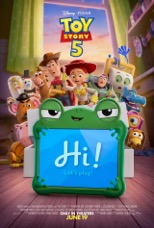
Having sufficiently bashed bad parents, let’s focus on the film’s true villain, the frog-themed computer tablet for kids called Lilypad (Greta Lee). Bonnie’s parents cave and buy her the popular device since all her friends have one. Bonnie becomes instantly addicted to Lily, spending hours a day playing games and conversing with her friends—selected by Lily, of course. Bonnie’s behavior and engagement with her family also radically changes…for the worse. She gets cranky when she has to wait for Lily to recharge and plays on Lily all the way up to bedtime. Bonnie becomes far more sedentary when she plays with Lily. Even worse, her vibrant personality is subdued to the point where she’s practically a zombie.
From these scenes, it’s easy to see how constant exposure to tech can negatively affect social skills and the ability to read social cues, while also numbing the pleasure centers in the brain. Many mental health issues in young people are either made by, or made worse by, the excessive use of tech. And the trend line continues to climb.
So, what makes Lily so malicious? The device chooses the wrong friends for Bonnie (something Lily admits to doing), but says it will do better in the future. Okay. So that makes up for the bullying and ostracism, right? Also, Lily thwarts Woody’s efforts to locate Jessie (the reason Lily can’t refuse Buzz’ commands is never explained—one of the movie’s only plot contrivances).
Lily’s most egregious action is hacking into Bonnie’s account and texting her father to pack up all the toys and put them in the garage. Yes, Lily helps the toys find Jessie and helps Bonnie become friends with Blaze (Mykal-Michelle Harris), but do these positive actions make up for its harmful ones? Lily never apologizes for posing as Bonnie, and manipulating Bonnie’s father, in its plot against the toys. Lily’s apparent transformation is unconvincing because we’ve seen its capacity to do evil, without hesitation or compunction, and know it’s more than capable of turning on its users in an instant. Message: beware the mercurial morality of the machine.
After an awkward introduction, Bonnie and Blaze become instant friends. That’s great for these two girls. But what about the scores of isolated kids out there? Is the happy ending, where tech decides to play nice with toys/kids/parents, disingenuous in light of the countless kids in the throes of digital obsession? Is the “tossing back one starfish at a time” approach enough to positively impact our society, or does wholesale change need to occur?
Unfortunately, the film takes the easy way out and doesn’t properly resolve its central question: What can parents do to help their kids put down their devices, go outside and make some friends? Toy Story 5 highlights a success story, but ultimately fails to deliver a plan for how parents can help their kids balance tech and real life.
Devices taking over our society—depicted in one scene as faces all around the neighborhood lit up by the green glow of electronic screens—is reminiscent of the subtle takeover of our planet by pod plants in Invasion of the Body Snatchers (1956). But is there a greater threat than tech looming on the horizon—AI? Will AI always have our best interests at heart? Doubtful. Skynet (The Terminator) could be right around the corner.
Thankfully, not all tech is portrayed as diabolical in the movie. There’s a charming subplot where older tech—devices that serve one specific function, like a pre-GPS roadmap device, or a handheld potty-training assistant for kids (which spews non-stop toilet humor)—comes to Jessie’s aid. Just as Jessie has been abandoned by Bonnie, the old devices have been relegated to junk drawers by their owners. In a twist of poetic justice, Jessie and the outmoded devices, team up to find Bonnie.
I anticipated a digital v analog showdown like the one in the reboot of Battlestar Galactica (2004), but, sadly, no such conflict occurred. It would’ve been amazing to see the older tech working together to outsmart the “smart” devices. Oh well, fodder for Toy Story 6.
Though radically different in theme and tone, this film is a kind of mirror image of Stanton’s WALL-E (2008). While the robot movie is a cautionary tale of a stark future we must work diligently to avoid, Toy Story 5 is a reprimand for the harmful societal influences that have been allowed to plague our young people. WALL-E is a deterrent; Toy Story 5 is a corrective.
Aside from its adult messages, there’s plenty to enjoy in this kids’ movie. Though merely there to service the story, the “big moment” for the Buzz army is pretty spectacular. There are some meaningful moments too—I got choked up a few times (it’s been known to happen to grown men while watching a Pixar movie), especially during the wedding scene.
So, will there be a Toy Story 6? If so, I hope it focuses more on the ancillary toys, who are largely superfluous here.
In the end, Toy Story 5 isn’t a great film, but it contains the most important message of any animated movie ever made.
Rating: 3 out of 4