Young Washington (PG-13)
24/08/26 20:31 Filed in: 2026

Starring: William Franklyn-Miller
July 2026
Warning! This is NOT a movie review. This is a critique of the film. Intended to initiate a dialogue, the following analysis explores various aspects of the film and may contain spoilers. For concerns over objectionable content, please first refer to one of the many parental movie guide websites. Ratings are based on a four star system. Happy reading!
The latest in a string of historical movies released for America’s 250th anniversary, Young Washington is exactly what you’d expect, and yet still manages to offer more.
The movie opens with the titular hero rousing from an illness as his camp is ambushed. He stumbles into the fray, yelling orders and killing enemy combatants with the requisite skill of an action hero. All of this is to be expected. But what about his coat? Red? What?
Is this an alternate history of George Washington? Nope. This is the real history we’ve forgotten or were never taught in school.
If you’re like me, and only know bits and pieces of George Washington’s (William Franklyn-Miller) Revolutionary War exploits and presidency, this new film from Angel Studios is a timely retrospective of the first U.S. president’s early years. It’s also a salient history lesson, reminding us of how dangerously close we came to never having a free country.
Young Washington is the story of an ambitious young man who wants to serve a cause bigger than himself, and to fight against tyranny. It’s also the story of an idealistic young man who, at one point, discovers he’s fighting for the wrong side. What happens then? I don’t know…we’ll have to wait for the sequel.
The movie is filled with historical dates, names and places. Even after walking out of the theater, I still wouldn’t pass a quiz on the events depicted in the movie. All I know is there were many vying armies intent on making the New World their own: the British and the French, for starters. Then there were the indigenous tribes who fought the French, fought with the French and fought each other. Then there were colonists who resisted the British invaders, and those who sympathized with them. Lots to keep track of.
The performances help ground the story’s involving historical events. For a fairly low budget, independently-produced film, Angel Studios has assembled an impressive cast of veteran actors here. Mary-Louise Parker (Weeds) plays George’s mother, Mary Washington. Kelsey Grammer (The Jesus Revolution) plays Lord Fairfax, a wealthy nobleman who takes a shine to young Washinton. Ben Kingsley (Schindler’s List) is absolutely superb as British colonial administrator, Robert Dinwiddie, Washington’s commanding officer. Rounding out the movie’s notable actors is Andy Serkis (The Lord of the Rings trilogy) who plays swaggering, pig-headed General Braddock.
Though all these actors offer solid support, it’s Franklyn-Miller who makes the movie work. He perfectly portrays Washington’s youthful exuberance, zealous idealism and strong moral convictions. Having done mostly TV work in the past, this is Franklyn-Miller’s first major role. The trajectory of his career will certainly bear close inspection.
Director Jon Erwin (I Can Only Imagine) proves himself equally adept at filming character moments and action sequences. The latter are brought to life with intricate choreography, kinetic cutting and numerous POV shots of Washington charging into battle. Though undeniably violent, the action scenes aren’t overly graphic or bloody. However, atypical for the uber-conservative features released by Angel Studios in the past, there are a handful of swear words in the film, so viewer beware.
Young Washington certainly isn’t the best historical movie ever made, but it provides a lens into the early years of our nation’s first president and the Pre-Revolutionary War period.
Will there be a sequel to this film? Perhaps entitled General Washington? To be followed by President Washington? There’s plenty of material to make several sequels to this film…that’s how extraordinary our first president was.
For what it’s worth, there’s my analysis of the movie (history teachers everywhere are shaking their heads in dismay).
So, is this film worth watching? Absolutely!
I cannot tell a lie.
Rating: 2½ out of 4
Spider-Man: Brand New Day (PG-13)
10/08/26 21:01 Filed in: 2026

Starring: Tom Holland
July 2026
Warning! This is NOT a movie review. This is a critique of the film. Intended to initiate a dialogue, the following analysis explores various aspects of the film and may contain spoilers. For concerns over objectionable content, please first refer to one of the many parental movie guide websites. Ratings are based on a four star system. Happy reading!
When last we saw Peter Parker/Spider-Man (Tom Holland), he was ordering coffee in a NYC café from his girlfriend, MJ (Zendaya)—who has no idea who Peter is. To protect the ones he loves, Peter reset the universe in the previous film, Spider-Man: No Way Home (2021). Now, Peter must learn how to live without the ones he cares about most—his guardian, Aunt May (Marisa Tomei); his best friend, Ned Leeds (Jacob Batalon); and MJ.
So how does Peter respond to such a catastrophic personal loss? By throwing himself into his work. The Friendly, Neighborhood Spider-Man is back with a vengeance, ensnaring countless criminals in webs and handing vanquished villains over to the police. Well, maybe remove “Friendly” from his moniker. This new version of Spidey is far more aggressive and reckless; when he goes on a rampage, there’s collateral damage, namely destruction of property and an injured cop.
With most of Spider-Man’s rogue’s gallery behind bars, a new threat emerges and begins terrorizing the city. First, a mysterious force orchestrates an elaborate jailbreak, then an attempt is made to infiltrate a corporate building that houses a secret vault. This unseen assailant can enter a person’s thoughts and manipulate them in any way desired. As Spidey searches for a way to regulate his heightened arachnid senses, he also must track down the invisible enemy and prevent them from harming MJ, Ned and the entire city.
Spider-Man: Brand New Day is the fourth Spider-Man movie starring Tom Holland, who now becomes the most tenured actor to suit up in red spandex. Directed by Destin Daniel Cretton (Shang-Chi and the Legend of the Ten Rings), Brand New Day is a significant departure from the earlier Holland trilogy; the Harry Potter-esque easy camaraderie and teen angst that existed among the central triad is replaced with an adult story and a darker tone as Spidey goes it alone…a new day indeed.
Cretton creates a moody atmosphere with a series of superb establishing shots of NYC, often under an overcast sky. The director also takes us into gritty corners of the city previously unexplored in the earlier Holland Spider-Man movies. These are excellent creative choices as they perfectly match the somber mood and tortured psyche of the titular hero.
Though the POV shots of Spidey swinging from building to building are thrilling and immersive, the CGI isn’t much better than what you’d see in the newer Spider-Man video games. The scenes where Spider-Man holds MJ while soaring through the air are also exhilarating and recall the Superman and Lois Lane flying sequence from Superman (1978).
Brand New Day boasts a bevy of side characters, both heroes and villains (and some heroes that act like villains). Though most only have bit parts, several familiar Spider-Man villains appear in the movie, including: Ramrod (Billy Clements), Scorpion (Michael Mando) and Tombstone (Marvin Jones III). On the good side are Frank Castle/Punisher (Jon Bernthal), Dr. Bruce Banner/Hulk (Mark Ruffalo) and Yelena Belova/Black Widow (Florence Pugh).
Potty-mouthed Punisher feels out of place alongside the wholesome wallcrawler; his appearance here feels shoehorned (to raise awareness of the TV show on Disney+?). Dr. Banner and his alter ego have significant screen time, but ultimately, The Hulk is just a blunt object wielded by both the villain and the writers in the climactic action sequence. Though Black Widow provides Spidey with valuable information, her superfluous scenes (all shot in one room) could’ve been cut with little consequence.
Another new character for the good guys is NYPD Detective Jean DeWolff (Liza Colón-Zayas). Though she doesn’t know Spider-Man’s true identity, she has him on speed dial and they often consult on cases…her kids are big fans. Detective DeWolff is to Spider-Man what Commissioner Gordon is to Batman; but she doesn’t need a Bat-Signal to summon her superhero, just a cell signal.
For those who haven’t been following the news about Brand New Day, wild speculation has swirled around Sadie Sink’s unnamed role in the movie. Don’t worry, for those who haven’t already guessed, I won’t reveal the identity of the mystery character. I will say that a word linked with Sink’s character, “V-Max,” is a clever inside gag since her character’s name in Stranger Things is Max. Cutting deeper, “V-Max” is similar to “V’Ger” in Star Trek: The Motion Picture (1979) since both words contain missing letters that reveal important aspects of the plot during climactic moments of their respective movies.
When Peter begins to experience physical changes, presumably due to added stress, he desperately searches for a way to keep his arachnid DNA from triggering aggressive behaviors during heightened situations. Peter wants to rein in the negative aspects of his mutant abilities, which are causing him to commit harmful actions. He doesn’t want to do what’s wrong, but he can’t stop himself.
Peter creates several versions of an inhibitor chip to better balance his human and spider selves, and to sublimate unwanted behaviors. After much trial and error, Peter discovers the correct frequencies and creates a tiny device that he places on the back of his neck. He then wonders if it’s possible to create a universal inhibitor that can control everyone. Unfortunately, he’s late to the party on that idea, since the Mad Hatter from the Batman mythos has already mastered mind-controlling technology.
Like the Mad Hatter, this movie’s villain is all about controlling other people. The shadow character’s ability to enter a person’s mind, and then leapfrog from one person to another, is referred to as “possession,” though the powers on display are more like mental projection or telepathy. The villain can, in essence, hypnotize an individual and make that person do whatever they want; when the person snaps out of the spell, they don’t remember anything. An ethical question arises—is a person responsible for what they’ve done while under the mental control of an evil mastermind?
In one scene, the villain overrides the awareness of a random man on the street and makes him step into oncoming traffic. The mysterious antagonist kills the man, seemingly without compunction or remorse. People are just pawns to this evil mastermind. Finally, a realistic malefactor, unlike the cartoony miscreants listed above.
Though the villain instigates some of the conflicts in the movie, Spider-Man finds enough trouble on his own. Spider-Man fights a few security guards who carry machine guns and some type of electrical wand, which is similar to those brandished by General Grievous’ lackeys in Star Wars: Episode III – Revenge of the Sith (2005).
Spider-Man goes berserk in one action beat; he smashes cars (including a cop car) and pounds the daylights out of Scorpion. His aggressive behavior is similar to that of another Avenger—the Hulk. Though only in a few scenes, the not-so-jolly green giant cracks some skulls and does major damage to a building…nothing new here.
The melee where ninja-like warriors, called The Hand, attack Spidey, is the most elegantly storyboarded action sequence in the movie; it uses a variety of filming techniques including a Matrix-style slo-mo shot as Spidey bends away from throwing stars and another slo-mo shot where the warriors build a human pyramid to launch their leader at the webslinger—absolutely gorgeous cinematography. Though unquestionably violent, most of these sequences aren’t overly bloody or graphic.
While action scenes are clearly the movie’s strong suit, the plot often flounders. Largely missing from the story, written by Chris McKenna and Erik Sommers, is any hint of lightness or levity; the movie only contains a few of Spidey’s signature quips. The one major exception is the uproariously funny “stretching scene”—worth the price of admission.
Brand New Day is a jumbled web of narrative elements that the writers mistakenly think is a complete, and satisfying, Spidey tale. The story is frustratingly uneven; it’s a tug-of-war between the hero and villain, where neither comes out ahead. The movie’s Achilles’ heel is that its focus is fractured: Peter’s emotional trauma, Peter’s physical changes, Peter’s attempts at reestablishing relationships with his former friends, Punisher, Banner, Scorpion, DeWolff, the new villain, corporate corruption, other story elements, ad nauseam. What’s the movie’s overall theme? More importantly, what’s the main takeaway?
Though effective at filling in the backstory and highlighting the emotional connections between the main characters, the movie has far too many flashbacks. First, we’re in Peter’s thoughts for a montage flashback sequence. Then we’re inside the villain’s flashback. Later, the villain is inside Peter’s flashback with Peter watching from the sideline. Which character should we focus on? Whose movie is it anyway?
Despite its plot deficiencies and overblown action sequences, Brand New Day has a handful of meaningful character moments. Though far too predictable, the scenes where Peter tries to reconnect with Ned and MJ are well acted and well executed. At the end of the film, the status of Peter and MJ’s relationship is…complicated. The final scene reveals Peter’s tacit concession that befriending Ned is a far easier prospect than wooing MJ. Peter’s attempts at getting back together with MJ will surely be a major story element in the inevitable sequel.
Brand New Day certainly lives up to its name since it’s a significant departure from the earlier movies in the Holland era. It’s a tale of unrequited love, anger, revenge, and the desire to control the negative aspects of our lives. It’s also a classic example of the hero’s dichotomy: to accomplish his goal, Spider-Man must face the enemy without as well as the enemy within.
Though Brand New Day effectively moves the series forward, it’s actually more of an origin story for the villain than a towering triumph for the hero, which is disappointing. Plus, the movie is unnecessarily serious (Joker agrees).
Sad to say, but compared to many other superhero movies, Brand New Day is small potatoes.
Rating: 2½ out of 4
P.S. For those who routinely sit through the entire movie to catch an additional clip, be advised that Brand New Day contains the lamest post-credits bonus scene ever. Oh, and James Bond called and wants his sign-off back.
Pressure (PG-13)
29/07/26 21:59 Filed in: 2026
Starring: Andrew Scott
May 2026
Warning! This is NOT a movie review. This is a critique of the film. Intended to initiate a dialogue, the following analysis explores various aspects of the film and may contain spoilers. For concerns over objectionable content, please first refer to one of the many parental movie guide websites. Ratings are based on a four star system. Happy reading!
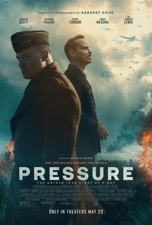
Perfectly timed to hit theaters right before the 250th Anniversary of America on July 4th, Pressure tells the story of D-Day from a unique angle most people probably haven’t considered. The movie title is a double entendre since it refers to the immense stress the leaders of the combined Allied forces were under prior to the attack, as well as the intense weather systems that created massive storms that pounded Normandy, France on the proposed date for the historic military operation. The entire thrust of the movie isn’t about what you’d expect, the preparation for the invasion or the horrific battle itself (that’s been done plenty of times before in movies). Rather, the movie is focused on the weather.
General Dwight “Ike” Eisenhower (Brendan Fraser) of the U.S. and General Bernard “Monty” Montgomery (Damian Lewis) of the U.K. are gung-ho to move forward with the unparalleled strike. But a disagreement between American meteorologist Irving Krick (Chris Messina) and British meteorologist James Stagg (Andrew Scott) throws a monkey wrench into the “go/no go” decision. Krick, who has a perfect record predicting weather for Hollywood directors and the U.S. military, calls for clear skies and sunshine. Stagg’s forecast is much gloomier: wind, rain and 8-10-foot waves. It would be impossible to conduct a full-scale naval operation in such inclement conditions.
Eisenhower and Montgomery find themselves caught between drastically divergent outlooks. As military men, their natural inclination is to attack. But, as the old chestnut cautions, discretion is the better part of valor. The arguments that ensued between these four men, and the ultimate decision they arrived at, changed the course of history.
On the face of it, an entire movie focused on the weather patterns leading up to one of our nation’s most pivotal battles doesn’t sound very exciting, but the performances help sell the story. While it’s a stretch to say Fraser looks, acts or talks like Eisenhower, he delivers a solid performance as a man desperate to atone for a recent training exercise turned bloody massacre. Lewis’ thick British accent is convincing, and his bravado and hawkish stare are highly effective in bringing Montgomery to life onscreen. Eisenhower’s assistant, Kay Summersby (Kerry Condon), is the heart and conscience of the film. She serves as a buffer between Eisenhower and Stagg, whose unwavering convictions frustrate and infuriate the action-oriented American general.
But what really makes the film pop is Messina and Scott—their backgrounds playing a cocky twit (Messina in The Newsroom) and an unhinged, evil mastermind (Scott in Sherlock), perfectly qualify them to play rockstar weatherman Krick and cautious, methodical meteorologist Stagg here. The contentious relationship between Krick and Stagg provides palpable tension, snappy dialog, and just enough doubt about who’s right to sustain the drama throughout the picture.
The friction between Krick and Stagg is, at its core, a battle of methodologies. Krick follows the time-honored approach of using weather records from the past to predict the future. Stagg believes weather is unpredictable, and can defy historic models at any moment. Stagg uses a variety of reports—measuring wind, cloud density, high altitude (via weather balloons), etc.,—from weather stations near and far (even thousands of miles away) to help him predict the weather. This weather smackdown could be billed as historical patterns v real-time data. The latter was a paradigm shift in meteorology.
When the D-Day operation is threatened by unprecedented weather (for the month of June), Krick and Stagg bury the hatchet and pool expertise to predict the best time for the Allied troops to attack the French beaches. There are some quick-cut, fairly bloodless war scenes of soldiers exiting transports and charging the beach in stormy weather. These action beats, intercut with scenes back at HQ—where worried generals wait with baited breath for the first reports to come in, are effective in giving a taste of the horrors of the conflict without delivering a blow-by-blow depiction of the battle, which you can certainly see elsewhere, i.e., Saving Private Ryan, Band of Brothers, etc. While other movies focus on the violence of the battle, Pressure focuses on how the weather affected the battle.
In the end, Pressure is a taut WWII movie that recounts the D-Day invasion from a rather solitary perspective. Whether this movie stands the test of time is anyone’s guess. But for those who love history or just want to learn something new about the landmark battle the film foregrounds, Pressure is well worth watching.
Now, if you’ll excuse me, I’m feeling the pressure to wrap this up so you can read it.
Rating: 2½ out of 4
Toy Story 5 (PG)
27/07/26 22:39 Filed in: 2026
Starring: Tom Hanks
June 2026
Warning! This is NOT a movie review. This is a critique of the film. Intended to initiate a dialogue, the following analysis explores various aspects of the film and may contain spoilers. For concerns over objectionable content, please first refer to one of the many parental movie guide websites. Ratings are based on a four star system. Happy reading!
As with several prior Toy Story movies, Toy Story 5 opens with a prologue focusing on Buzz Lightyear (voiced by Tim Allen). This time, the teaser involves an army of Space Rangers in search of Star Command. The story occasionally cuts back to the brigade of Buzz’…they finally reach their objective during a pivotal scene near the end of the movie.
When the main story begins, the movie’s theme—the effects of devices on kids—is hammered home when young Bonnie (Scarlett Spears) is given a device to help her connect with other kids online. It’s a desperate decision made by loving parents who mistakenly think the device will help their lonely daughter find some new friends. Right out of the gate, the movie subtly indicts parents for allowing their kids to become addicted to screens.
The film unabashedly addresses a topic that, by now, is a universal issue, especially with kids—although many parents are addicted to video games and social media too. Some may see the movie’s message as timely, but the sad reality is kids and screens have been a problematic combination for decades (starting with Atari?).
In several scenes, adults are shown working on their computers in the same room where their kids are playing on their devices. This is another sly shot at certain parents—the “do as I say, not as I do” set. Granted, exceptions should be made for necessary internet usage, but at the end of the day, are parents any better than their kids at responsibly using personal electronic devices? Are they actually worse?
Am I being too harsh in my criticism of hypocritical (when it comes to devices) parents? Perhaps. Claiming the moral high ground on this issue is a cinch when you don’t have kids. Such status allows one to plainly see how permissive some parents are in allowing their kids to have cellphones…younger and younger all the time, it seems.
As an “outsider,” it’s easy to judge parents who allow their kids to scroll on their phone or play video games (cellphone or console) for hours on end, effectively abdicating their role as parents to devices/tech. The inconvenient truth is, for the survival of our society (yes, that sounds hyperbolic, but look at the research and trends), parents must do better where their kids and devices are concerned. Fortunately, the movie doesn’t castigate bad parents for their lax attitudes toward their children’s consumption of tech. Instead, it ends on a happy note, however disingenuous (more on this later) that conclusion is to the story.
By now, the Toy Story formula is well established—one or more characters is separated from the group and the rest of the toys must work together to rescue their lost friend. This often requires an extraordinary, coordinated effort that frequently involves a rip-roaring action sequence laced with humorous one-liners.
These movies also feature deeply-affecting moments, often dealing with the past. Tapping into emotionally-charged memories, like the tear-jerker montage when Jessie (Joan Cusack) is loved by Emily in Toy Story 2, is also a staple of these films.
But other emotions are also at play here. Jessie was left in a donation box when Emily’s family moved away. Since then, she’s dealt with abandonment issues (yes, we’re talking about toys here). Jessie has grown weary of always losing kids as they age out of playing with toys. Anger gradually turns to acceptance, which leads to the mature insight that it’s essential to enjoy every moment you have with the ones you love—a powerful message for toys and humans.
Since Jessie is sheriff now—Woody (Tom Hanks) left with Bo Peep (Annie Potts) in the previous film—and ostensibly the main character, writer/director Andrew Stanton wisely brings Jessie back to her roots…Emily’s house. The distinctive hillside with large tree and tire swing from Toy Story 2 will be a trip down memory lane for kids who grew up watching the Toy Story movies and are now adults; many of whom will have kids of their own by now. In yet another clever story element Stanton baked into the plot, this location serves as an emotional focal point for both Jessie and those who’ve seen Toy Story 2. In my master’s thesis, I dubbed this phenomenon Locus Nostalgia, which is defined as “sentimental memories for a particular place which is associated with some past event or simply an overall mood of the physical location.”
There are plenty of nuggets that can be unearthed from this “Toys v Tech” tale. First, there’s an important distinction made between playing games and playing with toys. Playing games, especially video games, engages spatial awareness, strategy and hand-eye coordination. Playing with toys promotes behavioral, social and inter-personal skills, oxytocin release from physical touch, and, crucially, learning how to use the imagination (video games blunt this ability). While there are benefits to both activities, society has skewed heavily toward playing with games, especially since the COVID lockdown period. The movie is a gentle nudge that playing with toys is an enjoyable, time-honored way for kids to have fun.
This lays the groundwork for another of the movie’s messages—tech is making kids grow up too fast. One of Bonnie’s new friends says, in a supercilious tone, she no longer plays with toys—as if doing so makes one a simpering child. Giving into peer pressure, Bonnie turns her back on Jessie and Bull’s-eye, which devastates the newly-minted sheriff and her noble steed.
Instead of playing with toys, hanging out with friends and having fun, it’s all about being part of the “in crowd” now—and the social pecking order is starting younger than ever thanks to tech. Call it Group Think 101. These days, it’s possible to be cancelled even before you graduate from elementary school. What a sad, tragic world.
The movie also touches on the issue of cyber-bullying when one of the mean girls sends a crybaby meme to represent Bonnie’s affinity for toys. Disappointingly, Bonnie’s mother just shrugs off the post as if to say, Just ignore them. Again passive/permissive parents are ruining our country by raising weak, needy, emotionally imbalanced kids, and by failing to fight for their kids in instances like this one, where clearly the bullying girl’s parents need to be confronted with what their daughter posted online. Failing to do so only reinforces bad behavior. To paraphrase the popular aphorism, evil flourishes when good people sit around and do nothing.
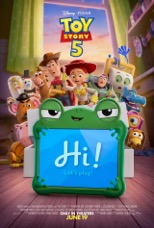
Having sufficiently bashed bad parents, let’s focus on the film’s true villain, the frog-themed computer tablet for kids called Lilypad (Greta Lee). Bonnie’s parents cave and buy her the popular device since all her friends have one. Bonnie becomes instantly addicted to Lily, spending hours a day playing games and conversing with her friends—selected by Lily, of course. Bonnie’s behavior and engagement with her family also radically changes…for the worse. She gets cranky when she has to wait for Lily to recharge and plays on Lily all the way up to bedtime. Bonnie becomes far more sedentary when she plays with Lily. Even worse, her vibrant personality is subdued to the point where she’s practically a zombie.
From these scenes, it’s easy to see how constant exposure to tech can negatively affect social skills and the ability to read social cues, while also numbing the pleasure centers in the brain. Many mental health issues in young people are either made by, or made worse by, the excessive use of tech. And the trend line continues to climb.
So, what makes Lily so malicious? The device chooses the wrong friends for Bonnie (something Lily admits to doing), but says it will do better in the future. Okay. So that makes up for the bullying and ostracism, right? Also, Lily thwarts Woody’s efforts to locate Jessie (the reason Lily can’t refuse Buzz’ commands is never explained—one of the movie’s only plot contrivances).
Lily’s most egregious action is hacking into Bonnie’s account and texting her father to pack up all the toys and put them in the garage. Yes, Lily helps the toys find Jessie and helps Bonnie become friends with Blaze (Mykal-Michelle Harris), but do these positive actions make up for its harmful ones? Lily never apologizes for posing as Bonnie, and manipulating Bonnie’s father, in its plot against the toys. Lily’s apparent transformation is unconvincing because we’ve seen its capacity to do evil, without hesitation or compunction, and know it’s more than capable of turning on its users in an instant. Message: beware the mercurial morality of the machine.
After an awkward introduction, Bonnie and Blaze become instant friends. That’s great for these two girls. But what about the scores of isolated kids out there? Is the happy ending, where tech decides to play nice with toys/kids/parents, disingenuous in light of the countless kids in the throes of digital obsession? Is the “tossing back one starfish at a time” approach enough to positively impact our society, or does wholesale change need to occur?
Unfortunately, the film takes the easy way out and doesn’t properly resolve its central question: What can parents do to help their kids put down their devices, go outside and make some friends? Toy Story 5 highlights a success story, but ultimately fails to deliver a plan for how parents can help their kids balance tech and real life.
Devices taking over our society—depicted in one scene as faces all around the neighborhood lit up by the green glow of electronic screens—is reminiscent of the subtle takeover of our planet by pod plants in Invasion of the Body Snatchers (1956). But is there a greater threat than tech looming on the horizon—AI? Will AI always have our best interests at heart? Doubtful. Skynet (The Terminator) could be right around the corner.
Thankfully, not all tech is portrayed as diabolical in the movie. There’s a charming subplot where older tech—devices that serve one specific function, like a pre-GPS roadmap device, or a handheld potty-training assistant for kids (which spews non-stop toilet humor)—comes to Jessie’s aid. Just as Jessie has been abandoned by Bonnie, the old devices have been relegated to junk drawers by their owners. In a twist of poetic justice, Jessie and the outmoded devices, team up to find Bonnie.
I anticipated a digital v analog showdown like the one in the reboot of Battlestar Galactica (2004), but, sadly, no such conflict occurred. It would’ve been amazing to see the older tech working together to outsmart the “smart” devices. Oh well, fodder for Toy Story 6.
Though radically different in theme and tone, this film is a kind of mirror image of Stanton’s WALL-E (2008). While the robot movie is a cautionary tale of a stark future we must work diligently to avoid, Toy Story 5 is a reprimand for the harmful societal influences that have been allowed to plague our young people. WALL-E is a deterrent; Toy Story 5 is a corrective.
Aside from its adult messages, there’s plenty to enjoy in this kids’ movie. Though merely there to service the story, the “big moment” for the Buzz army is pretty spectacular. There are some meaningful moments too—I got choked up a few times (it’s been known to happen to grown men while watching a Pixar movie), especially during the wedding scene.
So, will there be a Toy Story 6? If so, I hope it focuses more on the ancillary toys, who are largely superfluous here.
In the end, Toy Story 5 isn’t a great film, but it contains the most important message of any animated movie ever made.
Rating: 3 out of 4
Disclosure Day (PG-13)
26/07/26 22:57 Filed in: 2026
Starring: Emily Blunt
June 2026
Warning! This is NOT a movie review. This is a critique of the film. Intended to initiate a dialogue, the following analysis explores various aspects of the film and may contain spoilers. For concerns over objectionable content, please first refer to one of the many parental movie guide websites. Ratings are based on a four star system. Happy reading!
God gave us two ears and one mouth so we can listen twice as much as we speak. You’ve probably heard that aphorism. Sadly, our ability to listen to each other has been significantly impaired in recent decades, especially when the conversation turns to politics or religion.
The timeliness of director Steven Spielberg’s new thrill-fest, Disclosure Day, boarders on the preternatural. There are several hints in the movie that the world is on the brink of global upheaval. With the Russia/Ukraine, Israel/Hamas and U.S./Iran conflicts raging in real life, many believe we’re already in World War III—even if it hasn’t been officially declared as such. Coincidental parallel? Or art imitating life?
Also, the movie comes just weeks after the government declassified files/videos involving what are believed to be extraterrestrial (E.T.) phenomena. Again, is this serendipitous timing or governmental grooming, pre-conditioning people for an earth-shattering alien reveal? There’s plenty of fodder here for conspiracy enthusiasts or the average person who distrusts the powerful individuals that control our nation and the world.
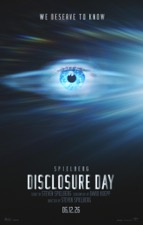
Regardless of whether external agencies influenced this movie’s subject matter or release date, its premise shouldn’t be underestimated: What would you do if you saw incontrovertible proof that aliens are living among us? Would you run to your nearest superstore and hoard supplies? Would you hunker down and hope to ride it out? Would you lose your faith? Or, like Margaret Fairchild (Emily Blunt) does in the movie, would you just roll with it?
The script, written by Spielberg and David Koepp (Jurassic Park), doesn’t waste time dwelling on how humans would respond to the announcement that non-human biologics are on our planet. Instead, they distill these various reactions into a simple binary, represented by Colin Firth’s Noah Scanlon and Colman Domingo’s Hugo Wakefield. Noah wants to conceal the truth at all costs for fear of what people will do to each other. Hugo believes that people deserve to know the truth, regardless of the consequences.
Of course, this reveal/conceal dichotomy represents the diversity of arguments people in positions of power have made for decades (long before Project Blue Book) to either trust people with the truth or keep them in the dark, so as not to create a mass panic. But in the story, this complex dyad is reduced to situational ethics, hypotheticals with no real-world repercussions since Disclosure is a thriller/sci-fi movie.
The film acknowledges the corruption that pervades the halls of power around the world and how an enterprising individual can topple their house of cards by releasing the truth; whether via TV news coverage (a bit passé in the new media landscape—more on this later) in this movie, or a newspaper article in Spielberg’s The Post (2017), which this film echoes in many ways.
Governments conspiring with the military or other private science/tech firms to conceal or explain away the existence of E.T. life is nothing new (Close Encounters of the Third Kind, 1977) in cinema. But here, Spielberg reverses the conspiracy polarity from government concealment (textual—inside the world of the movie) to government propaganda (extra-textual—in the real world). To put it a different way, in past decades, audiences viewed Spielberg’s alien movies as proof of the government’s complicity in covering up the existence of E.T.s. With Disclosure, today’s savvier spectators sense they’re being manipulated, conditioned for an impending eponymous event.
The director’s conspicuous backlog of films featuring aliens, coupled with the recent declassification of some UFO—or UAP (insert vomit emoji)—files by the U.S. government, makes one wonder if this movie was produced and released as part of a government psyop? Was it all pre-arranged, priming us to accept the reality of aliens? Is Spielberg himself an alien? If so, what’s he trying to tell us?
While we’re asking questions, is Disclosure intended to trigger certain behaviors in the audience? For instance, who benefits from the universal acceptance of aliens? Or conversely, who benefits from the widespread fear of aliens? It’s obvious who profits if the movie does well at the box office.
Several scenes offer fascinating insights into the human psyche, allowing us to wrestle with the extraordinary, reality-altering revelations in the movie. During one pivotal scene, a cardinal flies through a window into Margaret’s apartment. A mental connection is made between woman and bird (an alien in disguise). Soon after the encounter, Margaret starts speaking in foreign languages without realizing it. Then, during a live weather report, she speaks in an alien dialect—a series of clicks and pops. All who hear are amazed, confused or frightened. Her boyfriend questions her sanity. She gets impressions of where certain people are located or which direction they’re traveling. Margaret’s greatest superpower is her ability to look into someone’s eyes and immediately know their deepest desires or secrets. Based on what she reads in their minds, Margaret releases people from guilt, gives helpful advice and allows people to see long-lost loved ones. Margaret’s telepathic gift is similar to Sybok’s ability to free people from their pain in Star Trek V: The Final Frontier (1989).
Another interesting subplot involves Jane Blankenship (Eve Hewson), who hides out at a Catholic nunnery to avoid Scanlon’s agents. A former novitiate who walked away from the church, Jane asks Sister Maura (Elizabeth Marvel) if she would lose her faith if it was proven E.T. life existed. The nun says no, she doesn’t believe we’re alone in the universe and that it would be a tremendous waste if God made all of it just for humans. The movie unequivocally affirms that religious people wouldn’t walk away from their faith, and, what’s more, would be even more convinced of the existence of God.
It’s unknown whether real-life religious adherents would have a similar reaction to Sister Maura’s (the events in the movie are fictional, after all), but it’s an interesting point to ponder. It’s also curious that Spielberg, a Jew, chose Catholicism to represent religion in the film; to the exclusion of all other beliefs. Regardless, it’s refreshing to see religion treated so thoughtfully and respectfully in a major Hollywood movie.
Despite its many thrilling and thoughtful moments, the story is filled with plot holes and character decisions that defy credulity. It’s ironic that the strong suit of Spielberg’s thrillers, namely action sequences, are the weak link in this film. Many of the movie’s action beats are ill-conceived, like when Daniel Kellner (Josh O’Connor) steals a car and crashes through a fence, into a tree, into other cars and into the living room of a log cabin to rescue Jane. Then he tears off with a motorcade of sleek vehicles on his tail; the car is riddled with bullets from the pursuing agents.
Later, after sending the car over a cliff to fool Scanlon’s agents, Daniel and Jane head into the woods with the men in black standing just on the other side of a boulder. Wouldn’t the agents have spotted Daniel and Jane or, at the very least, heard their movements as they traipsed through the woods? Why didn’t the deer/alien create a diversion on the other side of the road to lead the agents away from Daniel and Jane? That, at least, would’ve been more realistic.
Though Disclosure is a mashup of Close Encounters, E.T. the Extra-Terrestrial (1982), and The War of the Worlds (1953), it’s “man on the run” plot most closely resembles Minority Report (2002), a darkly futurist film that far surpasses this year’s model. The whole “diving” into other people’s minds recalls the “Pre-Cogs” from Minority Report. In this movie, characters are able to create a mind link via a gray, metallic alien device.
Spielberg and Koepp use this alien Swiss Army gadget to produce all manner of Force-like effects, but it becomes a convenient crutch for the story. Though the device doesn’t have a name, its applications are manifold—just don’t squeeze it, for heaven’s sake. The fact that its abilities, and limitations, are never clearly defined, relegates this nifty artifact to the ranks of other shameless movie gimmicks.
It’s curious that Spielberg/Koepp didn’t turn these alien devices into MacGuffins. With the powers they possess, wouldn’t everyone want one? Indeed, wouldn’t most people kill to obtain one? The magical properties inherent in these devices are completely taken for granted in the movie, which is a head-scratching nitpick.
While Spielberg deserves his fair share of criticism for the story’s shortcomings, his directing is sure-handed and, on occasion, magical. The lively TV studio scenes and the flashback sequence, where Daniel and Margaret learn vital clues about missing moments from their childhoods, is equal parts frightening and beautiful. Spielberg is no stranger to action sequences set on trains, and the one here is appropriately pulse-pounding, shot with visual verve and nail-biting near misses.
The performances in Disclosure are terrific, especially Blunt and Domingo. Firth is reliably pitch-perfect as villain Scanlon. Wyatt Russell (son of Kurt Russell), is effective as Margaret’s fair-weather boyfriend, Jackson. Marvel lives up to her name as the wise nun (Yoda/Mr. Miyagi archetype). Due to his unconvincing acting and his character’s many dunderheaded decisions, O’Connell is the weak link in the cast—ironic since he plays the main character. Despite this miss, kudos goes to Spielberg (and his casting director) for assembling a fresh slate of actors he’s never worked with before.
Someone Spielberg is extremely familiar with is composer John Williams. Disclosure marks their 30th collaboration together. Disclosure isn’t Williams’ most memorable score, but it’s one of his finest at perfectly matching the emotions of the movie. The score is beautifully understated and only grows in intensity when absolutely necessary. Interestingly, one of the main themes of this movie (heard prominently in “listen…” on the soundtrack) has strikingly similar notes, sans syncopation and fortissimo orchestration, as the “Anakin Vs. Obi-Wan” track on the Star Wars: Episode III – Revenge Of The Sith soundtrack.
Williams reportedly toiled on the score for six months and, astoundingly, composed over two hours of music for Disclosure. At age 94, will this be Williams’ final score? I sincerely hope not, but if so, the music for Disclosure highlights his virtuosity and versatility—it contains none of the bombast or rousing fanfares that marked much of his earlier work. Either way, it’s a thrill to experience another masterwork from the maestro, especially after a non-disclosed health issue sidelined him a couple years ago.
While the accompaniment certainly does its job in establishing the overall mood, what’s the real heart of the movie? Some will say the key sequence is when Daniel and Margaret use the device to learn answers about their mysterious pasts. Hard to argue, but for my money, the movie’s most meaningful moment is the subtly stated reason for why humanity is headed for destruction—the “outside observers” living among us believe we’re doomed because we’ve lost our ability to have empathy toward others.
The veracity of this profound indictment comes into sharp focus every time we watch the news. As is the case in the movie’s fictional world, there are conflicts all over the globe today. In the real world, our society is plagued with national, political, ideological, racial, ecological and religious divisions. People kill innocent bystanders on subways and have no idea why. Are we devolving into animals? Are we any less destructive than the aliens we fear?
An outside force stepping into our world and confronting us with our moral deficiencies brings to mind a similar scenario in The Day the Earth Stood Still (1951), where Klaatu (Michael Rennie) warns humanity about the dangers of nuclear power. Obviously the message impacted audiences back then since humans never initiated a nuclear war (thankfully). But Disclosure is a salient reminder of the destructive power held by nations possessing nuclear bombs, which have the capacity to end all life on our planet in a flash.
So, will our collective fear of E.T.s finally bring about global unity? Instead of fighting each other, will we pool our resources to defend Earth from alien invaders, a la the humans in the original The War of the Worlds? Or will our disunity bring about our end, as aliens sit back and watch in bewilderment as we destroy each other, a la the Twilight Zone episode, The Monsters Are Due on Maple Street?
The movie ends with an alien’s admonition for us to “Listen.” This could mean to listen to the alien, but a more likely, and poignant, reading of the scene is that “the gray” is encouraging us to listen to each other, lest our handful of wars expand to embroil the entire globe in bloody conflict. But if we can’t find a way to listen to each other, would we listen to an alien? This brings us back to The Day the Earth Stood Still, which ended well because the aliens had our best interests at heart. But what if the aliens are more like the ones in The War of the Worlds, or in TV series like V, Earth: Final Conflict or Falling Skies? Or, most frighteningly, like the Kanamits in the Twilight Zone episode, To Serve Man.
What if we end up placing our faith in aliens who aren’t trustworthy? What if they have the ability to hypnotize us or cleverly fool us into believing illusions, a la the Talosians in the Star Trek two-part episode, The Menagerie? What if the aliens win us over with lying signs and wonders, a la the Antichrist in the Bible? If someone (or something) seems to have all the answers, humanity would likely follow that individual over a cliff (e.g., Jim Jones in Jonestown, Guyana and David Koresh in Waco, Texas).
The medium for reaching the entire planet with the truth of alien existence would certainly be the internet, right? Why then does Spielberg have the titular event take place at a TV newsroom…in Kansas City of all places (I actually applaud the director for spotlighting a city other than NYC, LA or Chicago)? Yes, there’s palpable synergy in the scenes where producers yell at switchers, who direct camera operators, or when station managers call larger affiliates, who put the “small town” footage on standby. The background business of a TV news production is fascinating, especially when displayed with this degree of urgency. Spielberg has done for TV news in this film what he did for printed news in The Post.
Isn’t Spielberg a few decades behind the times, though? It’s admirable that he chose to spotlight the profession of broadcast journalism, but many people, especially those under 30, don’t watch news on a TV, and may not watch traditional news at all (online commentary shows and podcasts have significantly winnowed the TV news audience).
But let’s suspend our disbelief and say that everyone on Earth would tune into a breaking news story revealing declassified footage that definitively proved the existence of E.T.s. Would people believe it or scoff at it—just another AI fake? Just as Spielberg proves he’s out of step when it comes to the media landscape, he’s also completely unaware of how cynical his audience has become since E.T. (1982), or even Indiana Jones and the Kingdom of the Crystal Skull (2008). Many would see the alien footage, roll their eyes and play the next YouTube video. It’s a sad reflection of who we’ve become, but many would ignore the story and go on living their lives. Not to mention how fractured we’ve become along ideological lines—if the news network showing the alien vids was conservative, the liberal half of the country would tune out the “fake news,” and vice versa. Though this TV newsroom climax would’ve worked decades ago, it doesn’t work in 2026.
The most important line in the movie is when Hugo says people are starved for the truth. People, especially young people, are sick of being lied to. By politicians. By the media. By teachers, religious leaders or even parents. Within the context of the line, Hugo means people are sick of the alien coverup, but in a broader, more keenly felt way, people are starving for real truth, not fake/slanted/reverse/activist/politically-motivated/deceptive truth (otherwise known as mis-, dis-, and mal-information).
In the final analysis, Disclosure is a big swing that asks some big questions, but barely scratches the surface of how humans would react to irrefutable proof (don’t we already have that?) that aliens exist. Far greater than the middling story are the movie’s themes and messages and their implications for the future. Disclosure isn’t a great movie, but it’s insatiably thought-provoking.
The movie may be a slick example of cultivation theory or just a straightforward sci-fi yarn. Either way, viewers are sure to have strong opinions about this movie. Despite its many narrative missteps, Disclosure’s evocative subject matter elevates it to the realm of heady art at best, watercooler entertainment at worst.
So, aside from another alien movie in Spielberg’s œuvre and another hit movie on his filmography, will Disclosure make a lasting impact on its audience or society as a whole? Will the movie be a blip on the radar? Or will it goad governmental and global powers into finally revealing the truth?
Full disclosure?
I have no idea.
Rating: 3 out of 4
Star Wars: The Mandalorian and Grogu (PG-13)
20/06/26 20:47 Filed in: 2026

Starring: Pedro Pascal
May 2026
Warning! This is NOT a movie review. This is a critique of the film. Intended to initiate a dialogue, the following analysis explores various aspects of the film and may contain spoilers. For concerns over objectionable content, please first refer to one of the many parental movie guide websites. Ratings are based on a four star system. Happy reading!
For several months before the release of Star Wars: The Mandalorian and Grogu, all I heard was how terrible it is. This prompts several questions about the film (aside from how so many people saw the movie before its premier). Is M&G amazing? Certainly not! Is it silly at times? Undoubtedly, especially the laughably unbelievable scene where an AT-ST walker sprints down the side of a snowy mountain. Is the movie heavy on action and thin on plot? Yep. But is it awful? No.
At 2 hours and 12 minutes, M&G plays like a glorified version of The Mandalorian TV series (2019-2023)—the uneven, episodic storytelling bolsters this notion. The action-packed opener on the Hoth-esque snow planet, the arena fight sequence, the jungle shootout and Dr. Grogu scenes and the climatic destruction of the Hutt fortress on Nal Hutta could easily be edited into 30-40-minute segments.
So, will M&G be chopped up into episodes for a possible Season 4 of the TV show? Would you put it past Disney+?
M&G is the first Star Wars movie since the final Skywalker Saga film in 2019, Star Wars: Episode IX – The Rise of Skywalker. That film had mixed reviews and fan reaction, but still made enough money to make Greedo green with envy. Will M&G be a hit, or will it continue the franchise’s trend of diminishing box office returns? TBD, but it is telling that Disney has no new Star Wars projects in production (other than Starfighter). Despite some hits, like Andor and Star Wars: Maul – Shadow Lord, most of the Star Wars TV offerings have been poor to middling, begging the question—is the franchise in decline?
Though more pedestrian than previous Star Wars movies, some of M&G’s jungle scenes are reminiscent of the slimy and grimy giant bug attack sequence in Peter Jackson’s King Kong (2005). To counterbalance the cute cuddliness of “Baby Yoda,” did writers Jon Favreau, Dave Filoni (who reprises his role as an X-wing pilot from the TV series) and Noah Kloor decide to dredge up every disgusting and vile creature they could find in the darkest corners of the “galaxy far, far away” to cater to the teenage boys in the audience? Regardless, many of these creepy scenes may be too intense for younger viewers.
A large swath of the Star Wars bestiary appears in this movie. In addition to three Hutts (Jabba’s rotund relatives), a bounty hunter (Embo) and his ravenous pet wolf, and a slew of other alien species from the earlier films and TV series, M&G features all manner of bugs, a scorpion and a giant alabaster dragon snake. Then there’s the arena on Shakari (the neon-tinged city has a decided Blade Runner vibe), where Mando (Pedro Pascal) and Rotta the Hutt (Jeremy Allen White) must fight the Dejarik (remember those holographic chess creatures in the first Star Wars movie?) menagerie in order to earn their freedom. The massive melee is another of the movie’s overlong, overblown action sequences aimed at the teen boy demo and fans of WWE or MMA matches. While I applaud the nod to the OG film, the sequence quickly becomes tedious, much like the creature clash in the arena on Geonosis in Star Wars: Episode II - Attack of the Clones (2002).
M&G’s cast is scant and, other than Mando, the most prominent characters in the movie are Grogu and Rotta—two CG characters. In fact, for a live-action movie, M&G has far more CG characters than flesh and blood ones. While the four Anzellan mechanics (remember Babu Frik from Episode IX?) will get lots of laughs, simian store owner Hugo Durant (voiced by famed film director, Martin Scorsese) steals the show.
So, what’s missing here that was in the TV series? For one thing, many of the characters we’ve grown to love are MIA: no Greef Karga because Carl Weathers has sadly passed away, no Cara Dune because Gina Carano was fired by Disney for her comments on Twitter during COVID. But where’s fellow Mandalorian, Bo-Katan Kryze (Katee Sackhoff)? And what about super villain, Moff Gideon (Giancarlo Esposito)? Or uproariously funny mechanic Peli Motto (Amy Sedaris)?
The new faces in M&G are the epitome of bit players. Garazeb “Zeb” Orrelios (Steve Blum) is on loan from the superlative animated series, Star Wars: Rebels. He’s in a few scenes, has a few lines, but has no volition or motivation apart from aiding Mando on his quest. Mando and Zeb are both pilots, so the latter’s inclusion on the mission is redundant. But I suppose Burger King needed another toy to give away with its BBQ Bounty Whopper meal (excellent, by the way), so sidekick Zeb was included in the cast.
Similarly, Colonel Ward (Sigourney Weaver) is in a handful of scenes where she critiques Mando’s “messy” missions or debriefs him on a new assignment—talky scenes that most lesser actors could’ve pulled off just fine. Ward is finally given something to do when she leads the attack against the Hutt hives on Nal Hutta during the climactic battle, but all she does is bark orders from her cockpit; an egregious underutilization of Weaver’s acting prowess.
As if the remedial dialog written for Weaver and the other performers isn’t bad enough, the cartoony plot is aimless and simplistic. The story focuses on a pair of random assignments for Mando that really don’t amount to anything. The contrived plot involving villain, Lord Janu (Jonny Coyne), is utterly daft. This supposedly devious, heartless criminal divulges key intel to the New Republic, presumably without even the threat of torture. No lies? No hedges? No erroneous information that sends the good guys on a wild goose chase? Upon further reflection, I must apologize to cartoons…many are written better than this film.
The major problem with the story is that there’s no significant character growth for Mando. He endures minor obstacles and hardships and gets by with a little help from his green friend. Grogu’s only character change is that he’s more adept at using the Force and can lift heavier objects than in the TV series. Tip for Favreau and Filoni: movies require more character growth than what Mando and company undergo here.
Still, all in not lost. The movie has a good mix of humor and action, and is well produced. Since the story is so simple, no familiarization is required to understand and enjoy the movie. Plus, M&G hits the bull’s-eye with its target demo. For better or worse, M&G has successfully introduced a new generation of fans to the franchise.
So, what does the future have in store for Mando? More TV seasons and movies? Some rumors before the movie’s release suggested that M&G would wrap up Mando’s story. It’s hard to see that being true since the movie’s resolution is so open-ended, and since die-hard fans would clamor for a better resolution.
In the end, what’s the point of the movie? There isn’t one. The sole purpose of the movie was to capitalize on the success of the TV series. But Disney’s timing is off. It’s been three years since the last episode of The Mandalorian aired. Interest in the property has waned in the intervening years to the point where this movie feels like an afterthought (or a desperate attempt at reinvigorating the TV series). Mando had his moment of glory during Seasons 1 & 2 of the TV series, but with the show in limbo and the release of this mediocre movie, it’s obvious the Force is no longer strong with Mando.
Or to put it a different way, the shine is off the beskar.
Rating: 2½ out of 4
A Great Awakening (PG-13)
19/06/26 14:52 Filed in: 2026
Starring: John Paul Sneed
April 2026
Warning! This is NOT a movie review. This is a critique of the film. Intended to initiate a dialogue, the following analysis explores various aspects of the film and may contain spoilers. For concerns over objectionable content, please first refer to one of the many parental movie guide websites. Ratings are based on a four star system. Happy reading!
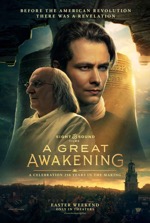
A Great Awakening spotlights two famous men from America’s colonial period: George Whitefield (Jonathan Blair) and Benjamin Franklin (John Paul Sneed). The fiery evangelist and inventor/newspaper editor/statesman, respectively, struck up an unlikely friendship. It was a symbiotic relationship—Franklin used his printing press to help spread awareness of Whitefield and his message, and Whitefield provided sensational headlines for Franklin’s newspaper every time he traveled to Philadelphia.
Though their beliefs were completely different, both men were motivated by the pursuit of truth: Whitefield promulgated the Gospel of Truth; Franklin pursued journalistic truth. Whereas Whitefield used the spoken word to communicate with his audience, Franklin used the printed word to reach his. Both men were orators: Whitefield’s rousing words helped unify scores of Pre-Revolutionary War colonists; Franklin’s wise words helped unify quarreling delegates at the Continental Congress, the seething cauldron of viewpoints that eventually produced the Declaration of Independence.
The two men had opposite career paths—Whitefield trained to be an actor but ended up a preacher, while Franklin’s father wanted him to be a pastor, but he ended up a businessman. Also ironic is that Franklin, a deist, recommended congress should begin each day with a prayer…a practice that continues to this day.
One of the most memorable scenes in the movie is Whitefield’s first visit to the City of Brotherly Love, when he spoke to a large crowd from the courthouse balcony. Whitefield’s homily is electric and Franklin’s attempt at determining the size of the crowd (an estimated 30,000 people) is highly entertaining.
From candles to lightning rods, the movie is packed with symbols and metaphors. The film also offers some keen observations of human nature, like the brutal conditions of British coal mines of the period, and the indignance of staunch religious leaders who rejected Whitefield’s spirited, and often abrasive brand of preaching. Other insightful commentary comes from Franklin, who quips that whether soothing or stoking fears, both types of headlines sell papers.
As is often the case in life, a person’s greatest asset also can be their greatest liability. Whitefield’s ability to project his voice over large crowds eventually lead to respiratory issues—he died of asthma at age 55.
Another example of the greatest strength/greatest weakness paradox is the movie’s historical content. While it’s admirable that writers Jeff Bender, Jonathan Blair and Joshua Enck (who also directed the movie) have foregrounded the spiritual aspects of colonial America, the film’s accuracy is occasionally dubious. For instance, Whitefield’s relationship with John Wesley was far more contentious than what’s portrayed in the movie; the thorny doctrine of “predestination” significantly contributed to this rift.
Another drawback is that the accounts of Whitefield and Franklin are highly sanitized—Whitefield owned slaves and Franklin was a womanizer. Of course, this is a conservative flick, so we’re only allowed to see highly-idealized versions of these men, which diminishes the movie’s veracity and potential dramatic impact.
In the end, A Great Awakening is a well-made biopic that captures the flavor of the colonial period without fully immersing us in it. Still, it’s important for us (especially young people) to be reminded of the some of the leading figures and events of this pivotal period in our nation’s history.
The movie effectively raises awareness of how two prominent men of the past, despite different backgrounds and beliefs, forged a deep, enduring friendship. If only people of different backgrounds/beliefs/political parties could achieve the same today.
With the upcoming 250th Anniversary of our country on July 4th, the movie’s greatest success is its timing.
Rating: 2½ out of 4
Project Hail Mary (PG-13)
12/04/26 22:12 Filed in: 2026

Starring: Ryan Gosling
March 2026
Warning! This is NOT a movie review. This is a critique of the film. Intended to initiate a dialogue, the following analysis explores various aspects of the film and may contain spoilers. For concerns over objectionable content, please first refer to one of the many parental movie guide websites. Ratings are based on a four star system. Happy reading!
A man awakens from an induced coma to find himself in a sleek hospital room, where fussy robotic arms tend to his every medical need. He has no idea where he is, and more importantly, who he is. Ripping himself free from myriad IVs and wires, the man climbs a ladder and opens a circular hatch door. Now he’s in a high-tech lab. He continues exploring the various rooms until he comes to a cockpit—his jaw drops when he looks through the windows and sees the inky black expanse of space.
Occasional moments of clarity break through his muddled mind; these flashbacks reveal his identity and his involvement with a top-secret project to save the Earth. The brightest scientific minds were tapped. Multi-national financing was secured. A gigantic spaceship was constructed and launched to determine what’s killing our sun and how to stop it. But why he’s on the ship, which is presently hurdling through deep space, remains a mystery. As the only surviving member of the expedition, the man quickly realizes the fate of humanity hangs on what he does next.
Based on the 2021 sci-fi novel of the same name by Andy Weir (The Martian), Project Hail Mary—an epic scale, hard science space capade—came ready-made for the big screen. Practically from the moment the book was released, there was interest in adapting it into a movie. But, to do the story justice, who in the universe could bankroll such an FX-heavy venture? In stepped Amazon MGM Studios, who put up a staggering $108 million (estimated) to bring Weir’s vision to life…a massive gamble considering the diminishing box office returns over the past few years (really, ever since COVID).
Having read the book a few years ago, I was ecstatic when I saw the trailer during the Super Bowl. Not only was it exciting to see that Weir’s brainchild was finally going to be adapted into a movie, but it also looked amazing. I hooted and hollered more at the trailer than the entire lackluster (yes, Cris Collinsworth, we get that it was a “defensive struggle”) gridiron championship.
Weir’s novel boasts the best opening of any novel I’ve ever read. As the reader, I had no idea what was going on. Due to his retrograde amnesia, neither did Ryland. As he learned things about his past, and vital clues about why he’s in space, so did I. It’s a tricky narrative device. Reveal things too quickly and you ruin the mystery and fun; reveal things too slowly and you run the risk of boring the audience. In the hands of a lesser writer, Ryland’s adventure would’ve been a colossal wreck. But, fortunately, Weir is an exceptional craftsman who delivered a masterful cross-cutting story structure that’s effective both in print and on film.
Though slight in size, the entire cast delivered exceptional performances. While Ryan Gosling as Ryland Grace (kudos to the casting director for matching the initials of the star with the story’s protagonist) wasn’t really what I envisioned of the lead character, based on descriptions of him in the book, I wasn’t averse to the casting choice. After viewing Gosling’s sometimes quirky, sometimes brilliant acting choices (especially the way he uses his eyeglasses), it’s hard to imagine anyone else in the role. Gosling, who’s no stranger to the sci-fi genre (Blade Runner 2049), imbues Ryland with just the right balance between reticence & courage, self-doubt & competence, and stoicism & emotionalism. Despite his flaws, or perhaps because of them, Ryland is an excellent representative of the human race—and Gosling’s deft portrayal of the reluctant hero is spot-on.
The cast is rounded out with some familiar faces: Ken Leung (of Lost fame) and Milana Vayntrub (of AT&T commercial fame) both play astronauts. There are also unfamiliar faces, like German actress Sandra Huller, who plays the leader of the titular project, Eva Stratt. The voice of alien Rocky, so named by Ryland, is provided by James Ortiz. In a clever cameo, we briefly hear the voice of Meryl Streep.
Project is co-directed by Phil Lord and Christopher Miller, the tandem who brought us such animated delights as Cloudy with a Chance of Meatballs (2009) and The Lego Movie (2014). Fans of the “galaxy far, far away” will also remember that the duo were in the middle of directing Solo: A Star Wars Story (2018), when, due to creative differences, they were replaced by Ron Howard. One of the reasons Lord and Miller were relieved of their directing responsibilities on Solo was that they kept veering off script (Howard intimated this in an interview). Perhaps it’s due to the author’s involvement in this project—Weir co-wrote the script with Drew Goddard—but the directors have shown the upmost reverence in hewing close to the source material.
Lord and Miller’s extensive background in animation has paid huge dividends in Project, a movie that’s largely told with sounds and visuals. Though it never quite reaches the stature of the deep space exemplar, 2001: A Space Odyssey (1968), there’s some real art here, like when Ryland meets Rocky and when Ryland takes a spacewalk.
British composer, Daniel Pemberton, has delivered a diverse and textured soundtrack for Project. One minute we’re listening to a country tune, the next a classical number, followed by a rock jam. Particularly effective are the choral sounds that the composer laces through moments of mystery and discovery, and the sprightly cues that accompany the scenes where Ryland works in the lab. Pemberton’s atmospheric, ethereal, and deeply-affecting score adds immeasurably to the film’s mood without upstaging the action.
Last general comment about the film before plunging into weightier topics: a recent trailer totally spoiled the film, right down to who Ryland is, who the alien is, what their mission is and how they’re going to save their planets. I was incensed when I saw it. Still am. I’ve railed against trailers before, but this was one of the most egregious examples I’ve ever seen. It literally disclosed everything about the story and left nothing to the imagination, except for the movie’s ending. As evidenced by my extremely restrained story synopsis at the top of this review, it is possible to tease a story without giving away all the details. Hollywood, please stop ruining movies by divulging the entire story in trailers!
As Mr. Gump famously stated, “That’s all I have to say about that.”
Spoiler Alert!
Some of the main themes in the movie focus on the need for companionship and the power of synergy. When Ryland meets and befriends Rocky, what unfolds is a kind of extra-species buddy story. The mismatched partners must rely on each other in order to survive. Awkward teamwork eventually leads to deep friendship between the pair. At different points in the story, both Ryland and Rocky are willing to sacrifice themselves for the other…absolutely inspiring!
In a heartwarming moment, Rocky calls Ryland brave. However, Ryland doesn’t see himself that way. He believes that some people are failures because they don’t rise to the challenge. He even jokes that he put the “not” in “astronaut.” Yet, when push comes to shove, Ryland always comes through. He’s the perfect definition of the everyday hero, the average person who prevails against all odds. And, since it’s so easy to sympathize with Ryland’s plight, his courageous actions are a type of wish fulfillment for the audience; after all, who wouldn’t want to be revered as the savior of the world?
A stark vision of human nature in crisis situations is posited by Eva, who projects that when the Earth starts freezing over, starving people will kill each other for food and supplies. It’s a sad commentary on the human predilection for extermination over cooperation in post-apocalyptic scenarios (look no further than dystopian movie series like Divergent and The Hunger Games and zombie TV shows like The Walking Dead for numerous examples of this). Though it might be convenient to excuse such behaviors while in the midst of life-and-death situations, the immorality of these practices should be obvious to those living in pre-apocalyptic, ostensibly civilized societies. Though barely hinted at in the film, this thorny prognostication is, as the pointed-eared guy would say, fascinating.
As in The Martian (2015), Project features a man who uses his knowledge of science to survive. Also like The Martian, nations from around the globe pool knowledge and resources to create a spaceship, which, in this case, represents the last, best hope for humanity. This kind of international cooperation is aspirational, but perhaps a bit too idealistic, especially in light of the many conflicts raging across our planet at present. You’d be hard-pressed to find a timelier message.
In the final analysis, Project is a high-stakes, high-octane thrill ride with terrific performances, stellar direction, and mind-blowing production design and visual effects.
But does the ending do justice to the movie’s strong setup?
My greatest concern with the translation from novel to script was that the ending would be botched. The book leaves things open-ended, allowing the reader to draw their own conclusion as to which fate Ryland chooses. Something about the novel’s ending reminded me of the resolution in Bradbury’s The Martian Chronicles.
As Project wound down to its final scene, I held my breath in a mixture of worry and anticipation…and then experienced a euphoric release when the story stuck the landing. The movie’s perfectly-executed coda is the ultimate grace note in one of the finest examples of sci-fi high art in cinema history.
Project completed.
Rating: 3½ out of 4
I Can Only Imagine 2 (PG)
03/04/26 22:42 Filed in: 2026

Starring: John Michael Finley
February 2026
Warning! This is NOT a movie review. This is a critique of the film. Intended to initiate a dialogue, the following analysis explores various aspects of the film and may contain spoilers. For concerns over objectionable content, please first refer to one of the many parental movie guide websites. Ratings are based on a four star system. Happy reading!
I must admit, I was skeptical when I first learned there would be a sequel to I Can Only Imagine (2018). First, how could directors Andrew Erwin and Brent Mccorkle improve on the original movie—easily one of the Top 5 Christian movies ever made? Second, with Bart Millard’s (John Michael Finley) back story and initiation into stardom established in the first film, how could a sequel about a band going on tour after winning a trophy case full of awards for the titular song sustain audience interest for two hours? Or, maybe I was just fretful that the sequel wouldn’t live up to the original, a rational apprehension considering Hollywood’s track record.
I’m glad I was wrong about Imagine 2. It’s one of those rare instances where the sequel is a worthy follow-up to the original.
Early in the film, Bart receives a frantic call from his wife while he’s on the road. Rushing to the hospital, Bart learns that his young son, Sam (Jagger Amor), has diabetes and will need to take insulin shots the rest of his life. At first, Bart, who was physically abused by his father, Arthur (Dennis Quaid), can’t bring himself to stick a shot into Sam’s stomach. But when he sees another couple lose their son with the same condition as Sam’s, Bart quickly gets over his reticence of jabbing his son with life-sustaining medicine.
A decade later, Sam (Sammy Dell) is a teenage boy, who, like most teenage boys, is wrapped up in his own world—and consistently forgets to take his medication. This creates resentment between Bart, who’s trying to be a loving but firm parent, and Sam, who wants the freedom to pursue his dream of being a musician. Bart tells his wife he’s the wrong father for Sam; his feelings of inadequacy stem from a deep-rooted fear that he’ll become like his father.
Scott Brickell (Trace Adkins), the manager of Bart’s group, MercyMe, has a wild idea—bring Sam on the road for the upcoming tour. Though the radical decision creates plenty of drama and a near-tragic moment, it allows Bart and Sam to connect in new and unexpected ways.
Also joining the tour as the concert opener is Tim Timmons (Milo Ventimiglia), who fills the role of “new guy” in the group (a long-standing war movie trope). The band’s initiation of the newcomer, when Tim uses the bathroom on the bus, is uproariously funny.
Initially, there’s competitive friction between Bart and Tim, which serves as a protagonist/antagonist dynamic in a movie without a true villain. But Bart’s attitude toward Tim radically changes when Tim reveals he has a rare illness. Tim, who just wants to reach people with his songs, asks Bart to complete a lyric he’s stuck on. When finished, Bart and Tim’s song, “Even If,” becomes one of MercyMe’s biggest hits.
As the band’s outsiders, Tim and Sam quickly develop a rapport. The unlikely pair are kindred spirits—they both play guitar, they both love music, and they both have serious health conditions. Early in the tour, Tim asks Sam to play guitar for his opening set, which brings Sam one step closer to his dream.
One of the movie’s main themes is grief vs. gratitude. Tim makes an X (also the symbol for the cross) with a Sharpie on his wrist every morning as a reminder of his gratitude for another day of life. It’s a beautiful symbol that recurs throughout the movie. Tim is fixated on the tragic story of Horatio G. Spafford, who wrote the traditional hymn, “It Is Well with My Soul.” It’s a message Bart needs to be reminded of as he’s still haunted by his traumatic childhood.
In a heartwarming flashback, Bart helps Arthur move some chairs found along the roadside out of his father’s pickup truck. Later that night, while sitting in the “new” chairs around a campfire, Arthur tells Bart he’s proud of him. This is the first of two father/son reconciliation scenes.
There’s another campfire scene under a bridge after the tour bus breaks down. During the light-hearted conversation, Sam reveals what he fears most in life—needles. It’s a sobering reminder of the teen’s daily battle for his health.
Setup: in a meaningful father/son scene in a café, where Bart and Sam play a game of 20 Questions, Bart learns that Sam has never seen a shooting star.
Payoff: in a later scene, as father and son spend some quality time on top of the broken-down bus, a shooting star streams across the expansive night sky.
There are many such emotional high points in the movie, like when Bart gives his son Arthur’s guitar, when Sam fills in for an ailing Tim during sound check and crushes it, or when Bart visits Tim in the hospital as a thunderstorm rages in the distance—symbolic of the internal storms both men are facing.
Fittingly, the movie’s climax is the final concert of MercyMe’s tour at the Red Rocks amphitheater in Colorado. Bart calls an audible and concludes the concert with “Even If.” He asks Sam to accompany them on guitar. After the song, Bart hugs Sam on stage; it’s a touching culmination of the father/son storyline.
Unfortunately, what should’ve been a satisfying ending is ruined by the final scene of the movie; Bart and his wife sneak onto the bus, presumably to do what married couples do. It’s a strange ending to an otherwise moving and inspirational movie.
So, in a few years, when Sam has a child who becomes a professional singer, I guess we can look forward to I Can Only Imagine 3.
Rating: 3 out of 4
Solo Mio (PG)
01/04/26 21:57 Filed in: 2026
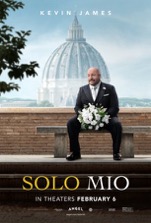
Starring: Kevin James
February 2026
Warning! This is NOT a movie review. This is a critique of the film. Intended to initiate a dialogue, the following analysis explores various aspects of the film and may contain spoilers. For concerns over objectionable content, please first refer to one of the many parental movie guide websites. Ratings are based on a four star system. Happy reading!
Man is left at the altar.
Man meets a new group of friends who help him grieve and heal.
Man finds a new woman.
Man falls in love with the woman and lives happily ever after.
Okay, so the storyline to Angel Studio’s new movie, Solo Mio, isn’t quite that simplistic. And yet, there isn’t anything revolutionary about this standard romance movie either.
Kevin James (The King of Queens) plays Matthew Taylor, a likeable 50-something art teacher who proposes to Heather (Julie Ann Emery). She says yes, and now the couple is in Rome for their wedding and honeymoon. Then comes Heather’s no-show at the wedding and Matthew’s discovery of the note she leaves for him.
With a stiff upper lip, Matthew tries to recover from his heartache by embarking on day trips for honeymooning couples; they’re pre-paid and non-refundable, so why not take advantage of them? Overcoming the embarrassment of riding by himself on a tandem bike, Mike is befriended by two couples: Jules (Kim Coates) and Meghan (Alyson Hannigan), and Neil (Jonathan Roumie) and Donna (Julee Cerda). These couples attempt to console Matthew during his period of grief, often providing comic relief when their well-meaning advice ends up creating more drama and ridiculous situations.
Just days after being jilted by his fiancée, Matthew meets café manager Gia (Nicole Grimaudo); Jules and Neil encourage him to explore the potential new relationship. You’d think Donna, a professional therapist, would be a voice of reason and at least recommend that Matthew take things slow during the recovery process. Nope. The movie doesn’t engage in that kind of common sense…or common decency.
Aside from a minor twist involving the note Heather leaves in the church before she bails, the rest of the plot is paint-by-numbers predictable.
Directed by Charles Kinnane and Daniel Kinnane, Solo Mio is a disappointment for several reasons. With well-known comedians like James and Hannigan in the cast, you’d expect the movie to be funnier than it is. Though Coates and Roumie (Jesus in The Chosen) deliver a few humorous lines, this film doesn’t even remotely resemble the riotous romcom presented in the trailer.
Up until now, Angel Studios has produced faith-affirming and family-friendly films. Solo Mio, with its pervasive alcohol consumption, a promiscuous woman at a nightclub, Matthew dancing with his imaginary fiancée in his underwear, and handful of profanities, is quite a departure from the squeaky-clean fare typically associated with the studio. Viewer beware.
Though contrived to the point of absurdity, the cameo by Andrea Bocelli (who sings a few songs in the movie) is a decided boon to the story. After all, what’s more quintessentially Italian than Bocelli?
But this stunt casting reveals the movie’s Achilles’ heel. Aside from its schmaltzy subplots (pretty much every scene involving the bike tour); the unbelievable, instant romance between Matthew and Gia; and the gimmicky twist involving the composition of the breakup note, the worst aspect of the movie is the way every problem is resolved with crowd-pleasing convenience. Writers Patrick Kinnane, John Kinnane and James have delivered a bevy of romance film tropes, but haven’t posited a single new thought or forwarded the genre in any significant way. The film resolves much too quickly and the new equilibrium for the characters at the end is an egregious farce—Matthew will leave his job and his country to live with a woman he just met?
But all is not lost. James delivers a believable performance and the supporting cast is solid. The movie’s saving grace is its foreign locations; the villas and vistas shot in and around Rome. But without its foreign flair, would the movie even be half as good as it is? Or half as memorable?
In the end, this movie isn’t nearly as funny or romantic as it should’ve been. Much like the woman who leaves poor Matthew at the altar, Solo Mio is an underachieving mess.
Rating: 2 out of 4
David (PG)
25/02/26 22:09 Filed in: 2025

Starring: Brandon Engman
December 2025
Warning! This is NOT a movie review. This is a critique of the film. Intended to initiate a dialogue, the following analysis explores various aspects of the film and may contain spoilers. For concerns over objectionable content, please first refer to one of the many parental movie guide websites. Ratings are based on a four star system. Happy reading!
As a kid, my favorite Sunday School story was “David and Goliath.” Though considerably time-compressed from the Biblical account, history’s most lopsided showdown is thrilling, inspiring and told with visual verve in Angel Studios’ animated David.
The aesthetic choices made by directors Phil Cunningham and Brent Dawes in this sequence are a mixed bag: whereas the aerial shot of David (voiced by Brandon Engman) walking through a field of red flowers is a striking visual, the pasty-skinned Goliath (the 10-foot-tall giant, voiced by Kamran Nikhad) is an unusual element. There’s also a Zemeckis-style flourish (feather in Forrest Gump and golden ticket in The Polar Express) in the film—a butterfly flits in and out of key sequences in the movie.
As the centerpiece of the movie, which fittingly takes place close to the middle of the action, the David vs Goliath spectacle is both the most well-known and most interesting part of David. Unfortunately, the rest of the film, which is dominated by David’s flight from Saul’s army, isn’t nearly as riveting or cinematic.
For those wondering how the story of young David would be adapted for a kids’ film, have no fear. Writers Dawes, Kyle Portbury and Sam Wilson have wisely avoided some of the more graphic elements from the Bible narrative. Raising Goliath’s helmet, rather than his decapitated head, was one wise choice. Also, the movie’s combat sequences are completely bloodless . . . we don’t even see sword clashes or arrow strikes.
However, despite the writers’ best efforts to make David a family-friendly film, there are some concerning elements to consider. Though the stone striking Goliath’s forehead and Saul throwing a spear at David are indispensable parts of the Biblical story, they may be too intense for young viewers. Also, the Amalekites, adorned with sticks and skulls, are a curious choice by Cunningham and Dawes—will the creepy-looking adversaries be too frightening for some kids?
I’m not a huge fan of musicals (or songs in movies, in general), but the handful of songs here work quite well within the story; though they’re nowhere near as emotional or memorable as the ones in The Prince of Egypt (1998). Many of the movie’s songs are written and performed by Christian singer, Phil Wickham, who also provides the speaking voice of the adult David.
Though a sequel seems unlikely (story elements involving Bathsheba, Uriah, Absalom, etc., are far too mature for a kids’ movie), the Young David (2023) series, created by Cunningham, serves as a prequel for this film and may be of interest to those who want to dive deeper into David’s early life.
In the end, this is a finely-rendered, fairly reverent animated retelling of select moments of David’s life from the book of Genesis in the Bible.
So, how will David perform against other major studio films released concurrently with this film? Though some will maintain it doesn’t have a prayer of succeeding, I believe it has a legitimate chance of toppling the competition.
Rating: 3 out of 4
Zootopia 2 (PG)
15/01/26 22:27 Filed in: 2025
Starring: Ginnifer Goodwin
November 2025
Warning! This is NOT a movie review. This is a critique of the film. Intended to initiate a dialogue, the following analysis explores various aspects of the film and may contain spoilers. For concerns over objectionable content, please first refer to one of the many parental movie guide websites. Ratings are based on a four star system. Happy reading!
Q: What do Zootopia and the Hawaiian Islands have in common?
A: They don’t allow any snakes inside their borders.
Zootopia 2 picks up a short time after the first Zootopia (2016), with ZPD Officers Judy Hopps (Ginnifer Goodwin) and Nick Wilde (Jason Bateman) hot on the trail of a criminal, who gets away but leaves behind an important clue—a piece of molted skin from a snake. Since slithering serpents were banished from Zootopia long ago by a powerful Lynx family, is this evidence a harbinger of grave danger…that snakes will return to Zootopia?
The result of the reckless pursuit is widespread damage across the city, which lands Hopps and Wilde in hot water with Police Chief Bogo (Idris Elba), who formally reprimands them for their unsanctioned undercover operation. As part of their punishment, the mismatched pair must attend a support group for struggling police partners. Hopps, who lives in a perpetual state of denial, rejects the notion that she and Wilde have problems; a belief that’s constantly challenged throughout the rest of the film. In the end, the characters are forced to confront who they really are; a fox who uses humor as a way of coping with childhood trauma and a rabbit who’s driven to succeed because she’s plagued with self-doubt and the feeling that she’ll never measure up. Not exactly stock characters for an animated feature.
But that’s what makes these movies (as well as many of the early Pixar features, which surely served as inspiration for the Zootopia films) so thoroughly brilliant; dual-purpose stories that entertain kids while emotionally engaging parents. Satisfying a broad audience is a real challenge, especially in our polarized society (and world), but writer and co-director (with Byron Howard) Jared Bush has found a way to walk that narrative tightrope, keeping everyone entertained and reasonably happy with multilayered stories aimed at a multigenerational audience.
At the heart of both Zootopia movies is a mystery that becomes more dangerous the closer the characters get to the truth, which is cleverly concealed by powerful players in politics and business. Also, both films employ killer twists near the end that kids—and probably most adults—won’t see coming.
Part of what makes this film successful is the way it integrates popular characters from the first film—loveable sloth Flash (Raymond S. Persi), shady sheep Bellwether (Jenny Slate) and Godfather-ish shrew Mr. Big (Maurice LaMarche)—into the story. Rather than simply relegating these characters to the role of gimmicky props in token cameos, they’re each given important scenes that advance the plot. In addition to returning favorites, there are some new characters in the sequel, including: Milton Lynxley (David Strathairn), Mayor Brian Winddancer (Patrick Warburton), Jesús (Danny Trejo) and Gary De’Snake (Ke Huy Quan).
Another wise choice by Bush and Howard was to have the characters explore some of the many habitats inside Zootopia (a la, desert and arctic zones); a narrative technique that was executed to perfection in the Star Wars franchise, which sent its heroes scrambling from one planet/habitat to another (often contrasting) planet/habitat in the same movie. As the series continues, what other terrains and environments will Hopps and Wilde visit: grassland, swamp, forest, savanna, volcano, underwater? The possibilities are as intriguing as they are diverse.
So, how does Z2 compare to the first film? While it never quite achieves the kinetic brilliance of Z1, Z2 is an extraordinarily well-made sequel that deepens our knowledge of the main characters and the world they live in, while advancing the mythos with a compelling, stereotype-shattering origin story. Z2 also ratchets up the conflict (both internal and external), presents a perplexing puzzle and is bursting at the seams with internal gags and reverential references (like the humorous homage to the Hungry Hippos game, the tongue-in-cheek “Burning Mammal” festival, and the uproariously funny allusion to Pixar’s Ratatouille).
Disney has hit its stride with Z2, producing a film that would make sister animation studio, Pixar, green with envy. As long as Z3 doesn’t go the way of the Ewoks, these Zootopia films are poised to become the best animated trilogy in studio history.
Tip: Be sure to stay all the way through the ending credits for a hint at what type of animal will be spotlighted in the next movie.
Rating: 3 out of 4
The Senior (PG)
14/01/26 20:11 Filed in: 2025

Starring: Michael Chiklis
September 2025
Warning! This is NOT a movie review. This is a critique of the film. Intended to initiate a dialogue, the following analysis explores various aspects of the film and may contain spoilers. For concerns over objectionable content, please first refer to one of the many parental movie guide websites. Ratings are based on a four star system. Happy reading!
When it comes to “based on a true story” movies, the premise behind The Senior has got to be one of the least likely and most outlandish in cinema history. Having never completed his senior year of college, Mike Flynt (Michael Chiklis) tries out for the football team at Sul Ross State University in Alpine, TX, and, against all odds, makes the team…at age 59!
And if that isn’t unbelievable enough, Mike, who is injured in training camp and rehabs all season, finally gets some snaps at the very end of the final game of the season—making Mike the oldest player in college football history.
Though there’s plenty of on-field action here to rivet football fans, The Senior (a clever double entendre) is much more than a sports movie; it’s a top-shelf “follow your dreams” flick with a strong moral undercurrent to please the faith and family crowd.
The emotional center of the movie is its poignant subplot involving two generations of fathers and sons. Flashback scenes of Mike’s father (James Badge Dale), teaching him how to be a man by bashing him with boxing gloves until he gets a bloody nose, are rough to watch. Other flashbacks show Mike repeating the cycle of violence with his own son, who, not surprisingly, is estranged from Mike as an adult.
The success of the movie fell largely on Chiklis’ broad shoulders (figuratively and literally: he’s built like a tank). Fortunately, the veteran TV (The Shield) and film (Fantastic Four, 2005) actor was more than up to the challenge, delivering a believable performance as a man who just wants a chance to redeem his violent past and set an example by finishing what he started decades earlier.
Some of the movie’s most meaningful moments involve Mike’s wife, Eileen (Mary Stuart Masterson). In one well-acted scene, Eileen names the conditions that must be met before she backs Mike’s rekindled desire to return to college football. Eileen’s deep concern and reluctant support of Mike’s dream help ground the film. Indeed, she gives voice to what we’re thinking—that this is a crazy idea that can’t possibly end well.
The other well-known cast member is Rob Corddry (Hot Tub Time Machine), who delivers a wonderfully restrained performance as laconic Coach Sam Weston. The “follow my lead” scene, where Coach Weston yells at the team and storms out of the locker room, is not to be missed.
Though the movie has certain similarities with Rudy (1993)—and even knowingly references the gridiron classic when Coach Weston says, “He’s like a 59-year-old Rudy”—The Senior is a unique entry into the annals of unlikely sport’s hero films.
So, is The Senior a schmaltzy biopic or inspirational true tale? You decide.
For me, this feel-good football flick (shrewdly released at the outset of football season), resembles its main character, a scrappy underdog that gets the job done.
Rating: 2½ out of 4
Superman (PG-13)
04/08/25 20:35 Filed in: 2025
Starring: David Corenswet
July 2025
Warning! This is NOT a movie review. This is a critique of the film. Intended to initiate a dialogue, the following analysis explores various aspects of the film and may contain spoilers. For concerns over objectionable content, please first refer to one of the many parental movie guide websites. Ratings are based on a four star system. Happy reading!
Shocker: Superman (David Corenswet) loses his first fight!
Superman’s super-canine sidekick, Krypto, drags his broken body back to the Fortress of Solitude, where an army of robots tend to his injuries.
Meanwhile, on some foreign continent, a war is brewing between the Russian-esque Boravians and Middle East-style Jarhanpurians.
In Metropolis, the recuperated Superman battles a Godzilla-sized, fire-breathing alien that’s wreaking havoc on the city’s citizens and skyscrapers. The Man of Steel is assisted by the Justice Gang, comprised of Mr. Terrific (Edi Gathegi), Hawkgirl (Isabela Merced) and the Green Lantern (Nathan Fillion).
Atop a skyscraper in a different part of the city, supervillain Lex Luthor (Nicholas Hoult) plays overzealous puppeteer to dozens of computer experts, who work in tandem to devise a way to destroy Superman.
Later, over at the Daily Planet newspaper, Clark Kent (Superman in his ordinary citizen guise) and Lois Lane (Rachel Brosnahan) bicker over the ethics of journalism. When Lois returns home at the end of the workday, she finds Clark cooking dinner in her flat. We learn, as they make out, that they’ve been dating for a few months.
Huh?
Yep. You’ve guessed it…this isn’t your father’s Superman movie (much to its detriment).
Spoiler Alert!
The latest film—simply named Superman—based on the eponymous, indestructible Kryptonian created by comic book legends Jerry Siegel (writer) and Joe Shuster (artist), is an absolute abomination. Aside from the meaningless “Godzilla-esque” sequence, ill-advised love story involving Clark/Superman and Lois (a sure-fire way to kill romantic tension is to have the couple finally get together—reference TV’s Moonlighting), stereotypical “country folk” portrayal of Ma (Neva Howell) and Pa Kent (Pruitt Taylor Vince), high-flying/low-IQ dog Krypto, incongruous sci-fi trappings (Lex’ high-tech setup that operates the movie’s mystery villain Ultraman, robots in Superman’s Fortress of Solitude, Mr. Terrific’s ball-like spaceship, a black hole, a pocket universe and an antiproton ribbon), goofy Justice Gang that constantly upstages Superman, panoply of generic villain sidekicks, low-stakes action sequences, thinly-veiled political commentary, aimless plot, utter dearth of star power, and instantly forgettable soundtrack by David Fleming and John Murphy (that only features a few minor refrains of John William’s masterful OG main title), one of the movie’s most controversial aspects is Superman’s morally reprehensible parents, Jor-El (Bradley Cooper) and Lara (Angela Sarafyan).
The key story element missing from this movie, that always worked in previous iterations of the Kryptonian myth, is Superman’s origin story. Here, we jump into the action with no context and no real reason to sympathize with Superman—especially since he’s portrayed as a loser right out of the gate, and does little to change that opinion during the rest of the movie.
Why did director/writer James Gunn eschew Superman’s powerful backstory? Maybe he didn’t want to commit the extra screen time, or maybe he felt the origin tale is passé, or maybe he felt others had already done a better job than he could. Whatever the reason, this movie starts out in a hole, with respect to audience empathy for the title character, that it never quite climbs out of. A massive narrative misfire by Gunn.
Nitpicks, you ask? The movie’s packed with ‘em. For starters, the Man of Steel now bleeds? And needs to pop his elbow back in place? Totally daft and inconsistent with what’s been established in earlier movies (I know nothing about the comic books).
And when is Superman going to install a better security system in his Fortress? Seems like Lex waltzes into the crystalline palace in every other movie. Maybe Baldie found the hide-a-key behind the third crystal pillar on the right?
Then there’s the well-worn contrivance of Metropolis being ravaged by some outside force. Here, an expanding rift cuts a swath through city streets. But the good guys figure out how to reverse the effect (with computers?) and the city is made whole once again. Huh? No structural damage to any of the buildings? No possibility of the loose soil creating sinkholes under the streets?
But even more egregious than all these tenuous story elements or oversights is that the characters are just plain lazy. Superman doesn’t even lift a finger to help the Justice Gang in their efforts to defeat a dimensional imp because he wants to spend a romantic evening with Lois. Lois listens to Cat Grant (Mikaela Hoover) gab on while watching the gigantic alien demolish a section of the city on TV. What? The real Lois would grab her tape recorder and head into the fray faster than you can yell, “It’s a bird!” Then there’s Jimmy Olsen (Skyler Gisondo), who refuses to spend time with his ex-girlfriend, Eve Teschmacher (Sara Sampaio), even though she’s willing to give him an exclusive scoop on Lex’ many illegal activities.
These people aren’t heroes. They’re self-centered twits. Unfortunately, as awful as the characters are, the actors portraying them are equally abysmal. I normally don’t disparage actors, but the only cast members who turned in halfway decent performances are Brosnahan and Fillion. As the star of the show, Corenswet is singularly horrendous, and doesn’t deserve to wear the cape and tights. Hoult is pathologically melodramatic. The other cast members walk through their scenes like cardboard cutouts (Exhibit A: Wendell Pierce looks lost and bored as the normally-fiery Daily Planet editor, Perry White). Whoever played the mustachioed tech nerd on Lex’ team should go back to waiting tables.
The cringe-worthy acting makes enduring this rudimentary story even more unbearable. Granted, all of these Superman movies contain cartoony elements, but this film lowers the bar to a ridiculous level. Put simply, this isn’t a serious film. Or to flip the coin, it’s utterly silly.
And what’s even more silly than the movie itself, is the pre-release comments made by Gunn. Clearly intended as a dig against ICE agents, who are currently rounding up criminal non-citizens in our country, Gunn referred to Superman as an “immigrant.” The comment caused a firestorm in the media and, when given the opportunity to revise or retract his remark, Gunn doubled down, claiming the moral high ground.
This is a colossal unforced error. Why would you intentionally alienate (pun intended) half your audience with a controversial statement before the movie even opens? It wasn’t that long ago that studios produced movies that appealed to the broadest demographic possible, to make as much money as possible. Today, in the age of Dylan Mulvaney, ideology and advocacy are more important than money—perhaps because such in-your-face social experiments are being underwritten by moguls of the Soros ilk. Is this why Gunn didn’t flinch in the face of conservative backlash over his statements…because he’ll make his millions no matter what?
Another problem with Gunn’s comment is that it’s based on a flagrant misnomer. According to Merriam-Webster dictionary, an “immigrant” is “a person who comes to a country to take up permanent residence.” No part of that definition applies to Superman. He isn’t a person from Earth (human). He didn’t come to Earth—or America—of his own volition. Also, Superman takes up permanent residence on Earth because he has nowhere else to go.
Which brings us to a much more apropos word to describe Superman’s plight…orphan. Again, Merriam-Webster defines “orphan” as “a child deprived by death of one or usually both parents.” In Superman’s case, he lost his parents and planet in one tragic event. So, why does Gunn use the less accurate “immigrant” rather than the more accurate “orphan?” Because “orphan” doesn’t fit his political agenda as well as “immigrant.”
As for Gunn’s directing, it’s nothing earth-shattering. The shots of Superman flying through the air are much more kinetic than those in earlier movies. The wind whips through his hair and the camera moves around to reveal different aspects of his chiseled physique. The slo-mo shot of Superman protecting the little girl from flying projectiles is well done, but certainly isn’t a pioneering visual. Another slo-mo shot, when Superman punches a villain and his teeth fly toward the camera, looks like something you’d see in a video game. Superman cutting down an army of enemies with his Heat Vision is a gratuitous, jeopardy-free yawn-fest. Way too easy.
So, what’s this movie about?
According to the summary on IMDB, “Superman must reconcile his alien Kryptonian heritage with his human upbringing as reporter Clark Kent. As the embodiment of truth, justice and the human way he soon finds himself in a world that views these as old-fashioned.” (Note: “human way” not the traditional “American way.”)
Okay, so what’s the movie about?
This reveals the film’s inherent identity crisis. The story is a jumbled mass of heroes, villains, plot strands and action sequences that ultimately have nothing to say about anything. What’s painfully obvious here is Gunn’s insatiable desire to mold one of the greatest heroes in pop culture into his own image.
How ironic that the movie’s Kryptonite is Gunn’s bloated ego.
Though the movie’s main theme is a muddled mélange of moral messages, there are a few ancillary topics that can be plumbed for meaning, such as…
Anger
Clark/Superman and Lex are angry for much of the movie. They shout their dialog and frequently resort to violence, which makes it hard to decipher which is the hero and which is the villain. After Lex ransacks Superman’s Fortress, a hostile Superman crashes into Lex’ office, violently tosses Lex up against and desk and smashes furniture and computer terminals. Strangely, Superman isn’t riled up over Lex invading his arctic retreat, but because he mistakenly thinks Lex stole his dog. What was this Superman like as a teen?
Aside from such petulant behavior, unbefitting of a hero, the most disturbing aspect of this scene is that it holds up a mirror to our society at present. Seems like everyone is outraged these days. Some may be fired up over a specific cause, but many are just mad because it feels good…their amygdala has been hijacked by fearmongering news outlets that pit one half of the country against the other and frequently use words like “racist” and “Hitler.”
Anger is the easiest emotion to default to when things are going bad. That’s why infants and kids throw temper tantrums when they don’t get their way. But when adults regress to childish behaviors, society starts ripping itself apart at the seams…as we’ve witnessed in our inner cities in recent months.
Slavery
The movie uses the term “metahumans” to describe any individual living on Earth that exhibits superpowers (this includes Superman, the Justice Gang and Lex’ superpowered cronies). In the X-Men universe, these individuals are referred to as “mutants.” And, just as the mutants are rounded up in one of the X-Men movies, so too are the metahumans in this film. Of course, the subtext here is that deporting undocumented migrants is inhumane. But there’s a huge difference between Superman (not an alien, but an alien lifeform) and the millions of people (including thousands of criminals) who’ve illegally entered our country over the past few years, right?
The metahumans are transported to the pocket universe, where they’re incarcerated in translucent cells reminiscent of those in Escape Plan. When Superman finally escapes his cell, with the help of fellow metahuman Metamorpho (Anthony Carrigan), you’d expect him to do the heroic thing and release the other captives. Instead, this self-serving Superman flees the pocket universe and leaves the other imprisoned metahumans to fend for themselves. Just another head-scratching scene in the aimless movie.
So, is Superman the worst film in franchise history? Without a doubt.
As awful as Superman IV: The Quest for Peace is, this movie still edges it out. And before you bring up Superman III, consider that it actually had some semblance of a plot, a diverting return to Smallville, one of the most compelling subplots of any Superman movie when the Man of Steel turns evil, and, as an added bonus, many of Richard Pryor’s jokes are funny—unlike the “humorous” lines in this film, which land like lead balloons (I only laughed once).
Superman III was a serious attempt at making a lighter, more comedic (counterbalanced with the dark subplot) film. This Superman seeks to modernize the franchise, and in its wholesale attempt at appealing to Gen Zers, the movie is unwittingly reduced to something far worse than silly…it’s utterly meaningless.
Though this certainly isn’t the first vacuous action flick ever made, it’s disappointing that someone of Gunn’s directorial eminence would churn out such a soulless movie; rife with misguided messages that masquerade as the truth.
Gunn has given us the kind of self-absorbed hero our narcissistic society can identify with…and deserves. His version of Superman seethes with anger, lacks moral courage, is indecisive when faced with simultaneous crises, is overly concerned with his self-image (he spends his downtime thinking up soundbites he can use in interviews), is selfish (he chooses a romantic evening with Lois over defending the city) and incompetent (he gets beat up by himself).
In fact, this Superman, much like the movie itself, is anything but super.
Rating: 2 out of 4
The Last Rodeo (PG)
09/07/25 19:02 Filed in: 2025
Starring: Neal McDonough
May 2025
Warning! This is NOT a movie review. This is a critique of the film. Intended to initiate a dialogue, the following analysis explores various aspects of the film and may contain spoilers. For concerns over objectionable content, please first refer to one of the many parental movie guide websites. Ratings are based on a four star system. Happy reading!
Can eight seconds feel like an eternity? It can if you’re holding on for dear life as a seething bull violently jostles your body in a dozen different directions.
Three-time bull-riding champion, Joe Wainwright (Neal McDonough), blows off multiple invitations to ride in the Legends bull-riding event in Tulsa, OK. But when his grandson is diagnosed with a brain tumor, Joe chooses to put his body on the line by signing up for one last rodeo.
Brought to us by Angel Studios (Homestead), The Last Rodeo is a faith and family focused film directed by Jon Avnet (Fried Green Tomatoes). As its name suggests, Rodeo is also a sports film, with roughly a quarter of its action centering on bull-riding. The pulse-pounding cinematography is superb, riveting viewer interest with ferocious, nail-biting action sequences. These scenes provide some much-needed action to counterbalance the movie’s many somber moments.
Avnet co-wrote the script with McDonough and Derek Presley. Though heartwarming and crowd-pleasing, the film often feels like a Lifetime drama, especially during the talky character moments. Fortunately, these emotional scenes aren’t unbearably sentimental. This is largely due to the realistic, restrained performances of the stellar core cast, which is comprised of McDonough, Sarah Jones as Joe’s daughter Sally, Mykelti Williamson as Joe’s long-time friend Charlie, and Christopher McDonald as the opportunistic rodeo organizer Jimmy Mack.
The film explores several themes, including: the power of friendship, doing whatever it takes to provide for family, the reconciliation of an estranged father and daughter, an old veteran vying against a field of young upstarts (a la Cars), and a man who stopped believing in God after the death of his wife eventually finding his way back to faith (a la Signs).
In the end, Rodeo is a fairly uncomplicated, largely predictable movie with a plot built on farcical elements (Joe competing for a championship in his upper 50s) and contrivances (Charlie tells Jimmy about Joe’s ailing son and Jimmy spills the story to news agencies, which help raise awareness and financial support to help cover the boy’s exorbitant surgery).
But it’s also an inoffensive, inspiring film that should leave audiences feeling uplifted and hopeful—that despite what’s transpired in our inner cities in recent months, our society might just survive if we pull together to help the less fortunate among us.
Otherwise, this might be America’s last rodeo.
Rating: 2½ out of 4
Mission: Impossible - The Final Reckoning (PG-13)
26/06/25 20:46 Filed in: 2025

Starring: Tom Cruise
May 2025
Warning! This is NOT a movie review. This is a critique of the film. Intended to initiate a dialogue, the following analysis explores various aspects of the film and may contain spoilers. For concerns over objectionable content, please first refer to one of the many parental movie guide websites. Ratings are based on a four star system. Happy reading!
“The world is changing, the truth is vanishing, war is coming.”
Mission: Impossible - The Final Reckoning picks up almost immediately after the events of the previous film, Mission: Impossible - Dead Reckoning (2023). When we last saw Ethan Hunt (Tom Cruise) and his team, they were faced with the daunting task of outwitting an advanced AI (lamely named “the Entity”). Now, to prevent a nuclear holocaust, Ethan must use a cruciform key, an object he acquired in the previous movie, to unlock a computer drive containing the source code that can destroy the Entity.
Acting as the Entity’s liaison is Gabriel (Esai Morales), an assassin who tries his best (but fails miserably) to be a top-tier villain. Gabriel always seems to be several steps ahead of Ethan and his team, which is no surprise since he’s receiving instructions from the Entity. So the question becomes, will Ethan’s plan to do the exact opposite of what the Entity expects actually work? And, to add a ticking time bomb element to the plot, Ethan’s team must figure out how to stop the AI before it hacks into every nation’s nuclear arsenal and obliterates the planet.
Sound like an impossible task?
Don’t sweat it.
Even though it takes Ethan and his team nearly three hours to complete their mission (it only took 2 hours for them to save the world in the first film), doomsday is averted and life goes on as if nothing happened; which is ironic, since after watching this film, your life will go on as if nothing happened too.
That isn’t to disparage the movie’s two protracted, well-crafted action sequences—one takes place in the depths of the ocean and the other occurs high in the sky—but the balance of the film is a retread of earlier Missions. Indeed, a couple of the movie’s montages recycle clips from previous films; one dispenses brief images to refresh the audience’s memory and another is used to produce feelings of nostalgia.
In an attempt at bringing the series full circle, the story hearkens back to a few key characters and objects from the earlier movies. For starters, CIA analyst William Donloe (Rolf Saxon)—viewers will remember him as the poor fellow who took several trips to the bathroom while Ethan made his pulse-pounding descent into the computer room on wires in the first film—has a significant role in this movie. Also, U.S. Intelligence agent, Jim Phelps Jr. (Shea Whigham), is the son of Jim Phelps (Jon Voight), the villain Ethan bested in Mission: Impossible (1996). Another allusion to the OG movie is the NOC list; the item multiple parties vied to possess.
Mission: Impossible III (2006) gets some love with a mention of villain Owen Davian (Philip Seymour Hoffman), montage clips of Ethan’s wife Julia (Michelle Monaghan) and a reference to that film’s destructive MacGuffin…the Rabbit’s Foot.
There are also many similarities between Dead Reckoning and The Final Reckoning since the films are a continuous, 2-part adventure. Many actors have reprised their roles in The Final Reckoning including: Morales as villain Gabriel, Hayley Atwell as uber-thief Grace, Pom Klementieff as the aptly named French assassin Paris, Angela Bassett as President Erika Sloane, Henry Czerny as CIA director Eugene Kittridge, along with many others.
Also returning for this film is director Christopher McQuarrie. McQuarrie excels at realizing the movie’s action sequences, but struggles to sustain viewer interest during slower, talky scenes. To break up the monotony, the director employs various storytelling strategies, including montages and flash forwards (a technique used in heist films like Ocean’s Eleven or action films like Avengers: Endgame to depict what the characters will do when they carry out the intricate capers being discussed during the long-winded planning session). Unfortunately, these gimmicky attempts at punching up the action, along with the overly dramatic music by composers Max Aruj and Alfie Godfrey, make the scenes play out like those on a typical TV procedural. McQuarrie’s most annoying directorial choice is his fixation on the “poison pill”—he cuts to closeups of the flash drive countless times, especially during the biplane scene.
Writers McQuarrie and Erik Jendresen have churned out a story that never quite takes off. There are some decent story elements here—both new and rehashed—but there’s an apparent abandonment of character development since the writers assume the audience already knows the IMF team by now. The series’ tropes are so well-established they’ve become hackneyed; and yet, the writers do little to divest themselves of these expected elements (i.e., the ole latex mask gag) or predictable patterns (i.e., defeating the enemy with milliseconds to spare). And the dialog they’ve written, especially the voiceover narrations for Ving Rhames’ Luther Stickell, is rife with stilted speech and fortune cookie platitudes. Examples: “Our lives are the sum of our choices,” and, “Those we never meet.” President Sloane says Ethan is “the best of men in the worst of times.” Okay, that one’s kind of cool.
As the star of the show, the success of the Mission movies lands squarely on the shoulders of Cruise, who always rises to the occasion, regardless of what the writers and directors throw at him. The 62-year-old actor is in amazing shape (as evidenced in the treadmill scene) and still does his own stunts. Though some throw shade on Cruise’s skill as an actor, no one can question his dedication to the craft. And if they do, I dare them to dangle from an upside-down plane with only a seatbelt to hold onto like he does in this movie.
The main theme of The Final Reckoning is the same as in the previous film: fear of AI and its destructive potential. To avoid being tracked by the Entity, global intelligence agencies unplug and go dark. Ethan receives his mission briefing on an old VHS tape. Gabriel flies a vintage biplane, which can’t be controlled by the Entity. This reversion to analog over digital is reminiscent of the Battlestar Galactica reboot (2004), when survivors of the Cylon onslaught use older, non-hackable Colonial Vipers to repel enemy forces.
These movies aren’t typically known for their dramatic character interchanges, but there are two meaningful scenes where Ethan makes amends with those he’s hurt in the past. When Ethan apologizes for ruining Donloe’s career, the CIA analyst, who was reassigned to an arctic outpost after Ethan hacked into the database on his watch, forgives Ethan without hesitation. Not only did the demotion rescue Donloe from a career spent in mindless tedium, it changed the trajectory of his life when he met his wife. Donloe returns the knife Ethan accidentally dropped onto his workstation decades earlier, effectively burying the hatchet between them.
The other individual Ethan hurt, though indirectly, was Jim Phelps Jr. Phelps could be angry that Ethan’s actions lead to the death of his father, but his motivation isn’t revenge. When Ethan extends his hand to propose a truce, Phelps transfers the gun from one hand to the other and shakes Ethan’s hand in a gesture of forgiveness. A touching moment.
The globe-trotting story was shot in Norway, South Africa and London. As with the other Mission films, the production elements in The Final Reckoning are superb, especially during the major set piece action scenes.
In the final analysis, The Final Reckoning is a rote doomsday scenario that could’ve been transplanted from any other spy/thriller/action movie. It goes overboard with fan service and is a “Best Hits” pastiche of the earlier Mission movies. It’s a predictable, safe series capper that doesn’t deliver the kind of bang such a storied franchise deserved. Sadly, not even the exciting final 30 minutes can make up for the movie’s slow start and standard, cookie-cutter plot.
Still, The Final Reckoning is one of the cleanest action movies I’ve seen in recent years. And, I’d go back to the theater just to see the heart-stopping biplane confrontation…one of the most ingeniously storyboarded and executed action sequences I’ve ever had the pleasure of beholding.
Bruce Geller’s Mission: Impossible first aired on TV in 1966, and the first movie was released in 1996. Now, after 29 years and 8 films, Cruise’s movie mission has finally come to an end. But will the mission continue with other actors?
As we’ve learned from watching these movies, anything is possible.
Rating: 2½ out of 4
Survive (Not Rated)
13/02/25 23:09 Filed in: 2025

Starring: Emilie Dequenne
January 2025
Warning! This is NOT a movie review. This is a critique of the film. Intended to initiate a dialogue, the following analysis explores various aspects of the film and may contain spoilers. For concerns over objectionable content, please first refer to one of the many parental movie guide websites. Ratings are based on a four star system. Happy reading!
A family of four enjoys a vacation aboard a yacht in Caribbean waters near Puerto Rico. After an incident where the mother almost drowns, the family celebrates the son’s birthday and takes a family photo. The peaceful moment is soon shattered by a violent sea storm that rocks the boat and knocks the family unconscious.
When the family rouses the next morning, they realize their lives have been turned upside down…literally. The boat now sits atop a cliff overlooking an expansive desert. Calling for help on the marine radio, the family reaches a scientist who tells them the Earth’s poles have reversed, and will reverse back in a matter of days.
Embarking on a perilous journey to find the scientist’s submersible craft, the family soon discovers that this new Earth is as strange, and deadly, as an alien planet.
Okay, I can suspend my disbelief with the best of them, but the nitpick alarm was blaring in the back of my head for much of the movie. First of all, what family takes their pre-teen son out on a boat in the middle of the ocean for his birthday? Maybe consider a backyard barbecue instead? Or Chuck E. Cheese?
Second, what would it do to human physiology if the Earth’s poles were suddenly reversed? At the very least, wouldn’t it throw off the equilibrium? Produce headaches? Nausea? The characters in the movie carry on as if functioning in a reversed polarity world was an everyday occurrence.
Most egregiously, from a scientific standpoint, the characters assume that because the Earth’s polarity was reversed, landmasses and oceans also traded places. I’m no science expert, but this concept is utterly daft. How can there be an even swap of land to water and vice versa when the Earth is roughly 70% water and 30% land? If I called my science geek buddy and told him this plot element, I’d bet all my money I’d get at least a snicker out of him, if not an outright guffaw.
Further stretching the film’s credulity is the large crabs, which pursue the survivors like a swarm of earth-bound locusts (for Stargate SG-1 fans, the crabs rapidly advance like an army of Replicators). Is this behavior scientifically accurate? No idea. But, like the rest of the movie, the creepy crabs seem contrived; deposited into the story merely to create dramatic tension.
So, what kind of movie is Survive? Well, as can be inferred from the title, it’s a survival movie…as well as a disaster movie. It’s a family adventure flick with shades of TVs Land of the Lost, sans dinos. It also has fantasy/sci-fi elements. Strangely, Survive has a slasher film subplot. Also, there are a few callbacks to Jaws (1975), including an underwater shot of a woman swimming in the ocean and the name of the boat, Orca. The final shot of the demolished city recalls similar tableaus in a myriad post-apocalyptic movies ranging from the Divergent series (2014-2016) to The Day After Tomorrow (2004).
Though the story deals with polarity shifts, its plot is riddled with bizarre tonality shifts. It’s like the movie can’t make up its mind what it wants to be. Or, perhaps it seeks to attract a wider audience by mashing up elements from many genres into its narrative potpourri. But, like the movie’s main plot device, this strategy achieves an opposite effect than desired, leaving the audience out to sea.
Produced by several French companies, Survive noticeably lacks the sheen of a major Hollywood release. Its production elements are wildly uneven. Major debits include the subpar music and use of fade to black edits when transitioning from one scene to another, which makes Survive feel like a TV movie. To its credit, the movie boasts gorgeous desert locations and excellent cinematography.
The acting is also hit or miss. As would be expected, the adults turn in better performances than the kids; but they’re all forced to make the most of the script’s remedial dialog. Oddly, the characters mostly speak English in the first half of the film, but mostly speak French in the second half of the film. Maybe the effects of the polarity switch finally caught up with them.
It’s extremely disappointing that this ostensibly family film is pervaded with profanities. The movie is Not Rated, which probably has to do with its foreign production. However, judging by U.S. standards, this almost certainly would be an R-rated film.
There are several bloody and gory scenes in the movie, including a protracted sequence where one man stabs another in the chest and then in the throat, causing blood to overflow his mouth. The same man brutally attacks a woman, who survives the encounter and later gets her revenge in an uber-bloody sequence where she viciously stabs the man several dozen times—spatters of blood gush into the air with each thrust. The next morning, we glimpse a trail of entrails leading to the fly-ridden corpse. To complete the macabre scene, a crab skitters out of the man’s face, a la the scarab crawling out of Imhotep’s face in The Mummy (1999). Not recommended for those with a weak stomach.
The movie’s views on science are evident from the start: we’re told that there have been five mass extinctions in Earth’s history and that the sixth is about to begin. This teases the movie’s close adherence to Darwin’s theory of “natural selection.”
When we first learn that Earth’s poles have been reversed, the father quips that the conspiracy theory nuts were actually right. The captain of the submersible vehicle confirms this, saying, “Maybe the Earth has decided to eliminate men before they destroy it.” This is a similar sentiment to what Ian Malcolm (Jeff Goldblum) espoused in Jurassic Park (1993), “Dinosaurs had their shot and nature selected them for extinction.”
This presupposes that Mother Nature has the power to wipe out entire species, or all life on Earth, at a whim (the recent, tragic, fires in Los Angeles would seem to be further evidence of this). Though the threat of natural disasters is always present, and bad things happen to people all the time, should we live in fear of Mother Nature’s wrath? If it’s our time to go, there’s nothing we can do to stop it, so might as well live each day as if it’s the last, right?
While on the topic of Mother Nature, Survive slyly weaves an environmental message into its narrative. As the movie opens, the camera frames a discarded sandal at the bottom of the ocean. Later, when the ocean floor becomes a desert, we’re shown various ways humanity has impacted nature: we see a large dump of toxic waste, a crashed plane, cargo containers surrounded by strewn items, and sections of the desert littered with empty water bottles, kids’ desk chairs (strangely without legs), and toilet bowls. The latter is a clever reminder that the movie’s post-apocalyptic world has literally gone to pot.
The movie also makes commentary on how ill-prepared we—particularly our screen-bound young people—are as a society to deal with the exigencies of survival situations. In two instances, a teen girl, who is listening to music with her headphones, is completely oblivious to life-and-death emergencies happening nearby. Later, she forgets to tighten the lid on the canteen, depleting the family’s supply of drinking water. This forces her younger brother to drink water out of a brackish pool, which makes him sick. At one point, the young woman loses hope and repeatedly yells, “We’re all going to die!” These examples beg the question, how well would civilization function in a post-apocalyptic world without Siri to provide practical guidance?
For the most part, the movie exhibits good parenting. A father patiently teaches his son how to cast the line from a fishing pole. The idolizing son expresses confidence in his father’s ability to get them out of their predicament. He quotes one of his dad’s favorite sayings, “Every problem has a solution.”
The mother’s unwavering focus is the safety of her kids. On several occasions, she proves her willingness to sacrifice herself for them. In a movie bereft of meaning, this heartening example of maternal love serves as its saving grace.
The most merciful aspect of this movie is its ninety-minute runtime. Adding another half hour to this predictable, irredeemable mess would’ve been a special form of torture.
So, what does the film accomplish? In its attempt at cramming tropes from many different genres into its story, the movie ends up saying nothing. Due to its incessant profanities and graphic elements, it isn’t even an enjoyable popcorn flick. It’s the type of substandard story that gives B-movies a bad name. In fact, it’s more like a C-movie (C for Crabs).
It’s a shame to think of all the good movies out there that never get made because of financing when a meaningless piece of schlock like this film gets released. Maybe Darwin’s theories also work backwards in a reverse-polarity world. As this movie proves—in terms of its characters, story, and overall production—there is such a thing as “survival of the unfittest.”
Rating: 1½ out of 4
Homestead (PG-13)
25/01/25 01:19 Filed in: 2024

Starring: Neal McDonough
December 2024
Warning! This is NOT a movie review. This is a critique of the film. Intended to initiate a dialogue, the following analysis explores various aspects of the film and may contain spoilers. For concerns over objectionable content, please first refer to one of the many parental movie guide websites. Ratings are based on a four star system. Happy reading!
The film opens with a doomsday scenario—a nuclear bomb is detonated just off the coast of Los Angeles. The aftermath plays out in a series of taut, well executed vignettes as characters scramble to get out of the city, which is blanketed by a dense layer of noxious, rust-hued air that’s just a few shades darker than the typical rush hour smog.
The next phase of the film brings us to the Rocky Mountains and a large estate owned by Ian Ross (Neal McDonough). We’re introduced to Ian’s family and a group of ex-military hoorahs, led by Jeff Eriksson (Bailey Chase), Ian has hired to guard his property. When food, water and supplies run out in the town below, the homeless and hungry amass at Ian’s main gate, hoping for a handout or an opportune moment to storm the gate (as does a SWAT team during the movie’s climax). Aside from security challenges, one of the most pressing problems, with winter approaching, becomes how to feed and shelter a growing number of people.
Homestead comes to us courtesy of the crowd-sourced Angel Studios (The Chosen), and is essentially a 2-hour pilot for a future web series. The early stages of the film are really good and feel like a legitimate big-screen release. However, when the action shifts to the titular locale, the movie begins to feel more and more like a CW TV series. Other dead giveaways that Homestead isn’t up to the standard of a major studio film is the music by Benjamin Backus. In addition to aggressive underscoring during conversations to heighten the drama, the music was mixed for the small screen rather than the big screen. What gives this away? There are several instances where the music is too loud, drowning out dialog, including several key voice-over narrations near the end of the film.
Despite its technical shortcomings, Homestead is a unique vision of a post-apocalyptic America. Told from a conservative POV, the story foregrounds the complex issue of isolationism vs amnesty for all in survival situations. Ian’s front gate and property lines are an analog for the U.S./Mexico border. Ian’s wife, Jenna (Dawn Olivieri), urges her husband to invite the refugees inside their expansive property, but abacus-bound Ian refuses, stating they barely have enough to sustain their own family and hired security men.
But when Ian is sidelined by a stray bullet, Jenna completely disregards his wishes and admits everyone camped out at the front gate. In a predictable twist, the skills and knowledge possessed by the newcomers helps solve many of the problems Ian has been stressing over. This compassionate, liberal action provides a solution to the immediate problems facing the homestead, and provides a happy resolution for the movie.
As the series progresses, my major request is that the producers/writers make Ian more heroic and less of a stick in the mud. McDonough is a terrific actor, but his character here is downright annoying at times. He frets over everything and doesn’t seem to have the faintest modicum of faith, which is ironic since this is supposedly a faith-based film (it’s actually a faith-lite film).
Though Ian clearly constructed his estate with the apocalypse in mind, he seems ill-equipped to deal with the challenges that arise during the film, which is uber frustrating. He’s indecisive, uninformed and eternally pessimistic. He’s also cold. We rarely see him provide emotional support for his wife or daughter. Ian’s pride in the abilities of his own people to defend the compound is woefully unfounded, as a war games scenario with the new security forces makes abundantly clear.
Ian’s inability to make sound decisions creates a strange power dynamic in the film. As the de facto main character, Ian should be the protagonist, but due to his weak leadership, Jeff’s supreme competence and Jenna’s moral convictions make them the real power brokers in the movie.
Angel Studios, please make Ian the true leader of the series. Also, make him the emotional and spiritual leader of his family and those under his care. Accomplishing that will make Homestead feel more like home.
Note: While putting the finishing touches on this piece, I learned that McDonough will not appear in the series. This type of bait-and-switch gimmick, employed to increase viewership, is distasteful and disingenuous. A similar casting ploy was used for TV’s Invasion, which billed Sam Neill as its main star. Annoyingly, Neill only appeared for a few minutes in the first episode. This is a devilish move from the purportedly seraphic studio.
Rating: 2 ½ out of 4
The Lord of the Rings: The War of the Rohirrim (PG-13)
24/01/25 00:48 Filed in: 2024

Starring: Brian Cox
December 2024
Warning! This is NOT a movie review. This is a critique of the film. Intended to initiate a dialogue, the following analysis explores various aspects of the film and may contain spoilers. For concerns over objectionable content, please first refer to one of the many parental movie guide websites. Ratings are based on a four star system. Happy reading!
Set nearly 200 years before J.R.R. Tolkien’s The Lord of the Rings books, The Lord of the Rings: The War of the Rohirrim is an animated adventure helmed by journeyman anime director Kenji Kamiyama. This foray into Middle-Earth focuses on the King of Rohan, Helm Hammerhand (voiced by Brian Cox), and his family, who fight to defend their realm against an army of bloodthirsty avengers known as the Dunlendings.
The story—written by Jeffrey Addiss, Will Matthews and Philippa Boyens—is based on narrative elements found in the appendices of The Return of the King, the final book in Tolkien’s The Lord of the Rings trilogy. Other than brief run-ins with a handful of fantasy creatures that later appear in Peter Jackson’s The Lord of the Rings movies, the bulk of the story involves warring human (humanoid?) tribes, whose petty and violent actions completely justify Elrond’s pessimistic appraisal of men in The Lord of the Rings: The Fellowship of the Ring (2001): “scattered, divided, leaderless.” The largely human-centric, magic-free story makes Rohirrim a unique chapter in the Middle-Earth saga.
Though the animation in Rohirrim is consistently superb, the hand-drawn characters tend to clash against the near-photorealistic landscapes. Many familiar locations from the Rings movies appear here, including Edoras, Isengard and Helm’s Deep. All are finely-rendered and may produce feelings of nostalgia for fans of Jackson’s Rings films.
While its efforts to transform young ingenue, Hera (Gaia Wise), into an action hero (a la the younger Galadriel in The Lord of the Rings: The Rings of Power) are overdetermined, the story, on balance, is quite good. Rohirrim is a reverent attempt at portraying the fantasy, characters, trappings and tropes Tolkien first created in The Hobbit (1937).
Though fairly appropriate for kids, the movie doesn’t cater to them. To its credit, the film doesn’t employ a Disney-style sidekick to infuse the story with comic relief. To its detriment, the film is serious to the point of being dire. An animated movie need not be kiddie, but shouldn’t it at least be a little fun? Rohirrim is devoid of anything that even hints at levity and, from all indications, its characters are allergic to humor.
The film’s strong suit is its well-executed action sequences. Powerful and perfectly paced, without becoming protracted, the movie’s action beats help move the story forward without dominating it or detracting from it. Though decidedly violent, the action scenes here are surprisingly less bloody than those in the earlier animated The Lord of the Rings (1978).
Composer Stephen Gallagher turns in an excellent score for Rohirrim, which briefly employs Howard Shore’s main theme and The Riders of Rohan motif from the Rings films. While capturing the essence of Shore’s work, Gallagher creates a wholly original, dynamic and effecting sound tapestry.
Though far less goofy than the animated movies produced in the late 70s and early 80s based on Tolkien’s works, Rohirrim lacks the charm, whimsy and magic of those other animated efforts. Still, Rohirrim serves as a quality prequel to The Lord of the Rings trilogy, and is a worthy entry into the Middle-Earth mythos.
Will this film earn enough money to justify a sequel? Time will tell. But for the moment, Middle-Earth is at peace.
Rating: 3 out of 4
Bonhoeffer: Pastor. Spy. Assassin. (PG-13)
08/01/25 22:41 Filed in: 2024

Starring: Jonas Dassler
November 2024
Warning! This is NOT a movie review. This is a critique of the film. Intended to initiate a dialogue, the following analysis explores various aspects of the film and may contain spoilers. For concerns over objectionable content, please first refer to one of the many parental movie guide websites. Ratings are based on a four star system. Happy reading!
Based on the true story of author, musician, pastor and spy, Dietrich Bonhoeffer (Jonas Dassler), Bonhoeffer is a predominately somber biopic that begins during the titular character’s childhood and ends with his tragic death—2 weeks before the end of WWII.
By now, it’s been well established that the German military, body politic and even general population were complicit in supporting and facilitating Hitler’s rise to power. Lesser known is the German church’s full-throated support of the Chancellor in pulpits from Berlin to the hinterlands.
Upon hearing a priest publicly elevate Hitler to the status of Christ, Bonhoeffer became incensed; his scathing criticism of such blasphemous speech dared to call out high ranking clergy members for their heretical espousal. Bonhoeffer’s divisive words effectively split the church along ideological lines—and put a bull’s-eye on his back by both pro-Hitler sympathizers and the dreaded Gestapo.
According to the movie, kid Bonhoeffer had an uncanny ability to evade capture in games like hide-and-seek. Ironically, when presented with an opportunity to escape from prison, adult Bonhoeffer chose to stay and face certain death rather than fleeing and taking a chance at life. This decision was proof positive that Bonhoeffer trusted God’s plan more than his own abilities…and his own life. Indeed, it would’ve been much safer to stay in America and simply wait out the war. But Bonhoeffer submitted himself to God’s will, essentially saying what Christ did at Gethsemane, “Not my will, but thy will be done.”
One of the subplots involves a failed assassination attempt of Hitler, who sniffs out the plot and arrogantly tells the would-be killer he lacks courage. Historians tell us that Hitler saw each failed attempt on his life as further evidence that he was doing God’s work. This demonstrates just how easy it is for someone to deceive themself, and others, with lies that sound so much like the truth, the error of their way may not be revealed until 6 million people have been exterminated. Though the phrase is often employed from a positive or aspirational perspective, this is the true “human condition.”
In spite of its slow pacing, Bonhoeffer is a well-produced period piece that tells a familiar story (the ascendency of Hitler) from a unique angle (the ecumenical embrace of evil). It contains a compelling character study of a deeply concerned citizen who sounded the alarm, a la Paul Revere, to warn his countrymen of the impending dangers of fascism and the Nazi movement.
Bonhoeffer possessed unwavering conviction and courage during one of the darkest periods in human history. With the resurgence of socialism around the globe and even in the American government, we could certainly use more people of high moral character—like Bonhoeffer—in the world today.
A sobering reminder of the atrocities of the past, Bonhoeffer challenges us to remain vigilant in an increasingly evil age.
One thing’s for sure; I’ll never look at strawberries that same way again.
Rating: 2 ½ out of 4
Here (PG-13)
26/11/24 20:41 Filed in: 2024

Starring: Tom Hanks
November 2024
Warning! This is NOT a movie review. This is a critique of the film. Intended to initiate a dialogue, the following analysis explores various aspects of the film and may contain spoilers. For concerns over objectionable content, please first refer to one of the many parental movie guide websites. Ratings are based on a four star system. Happy reading!
The movie opens during the prehistoric age with volcanoes belching lava and a pack of dinosaurs pursuing their prey. After the dust from an asteroid crash causes an ice age, we’re brought forward in time to when indigenous people settled the forested region we now call North America. But then, quicker than you can say “Mayflower,” the forest is cleared and a large estate is erected during America’s colonial period.
Years later, a humble home is built across the street from the mansion, and that abode becomes the locus of action for the rest of the movie. The main storyline picks up after WWII when returning soldier, Al Young (Paul Bettany), and his young wife, Rose (Kelly Reilly), move into the house. When Al and Rose’s adult son Richard (Tom Hanks) marries Margaret (Robin Wright), the newlyweds move into their house to save money.
With the exception of a few minor events that transpire in other time periods, the balance of the movie focuses on the Young family during several decades of their lives together.
This film comes to us courtesy of some of the top names in Hollywood. Here is directed by Robert Zemeckis of Back to the Future, Contact and Cast Away fame. In the leading roles are Hanks and Wright, who also starred in the director’s smash hit, Forrest Gump. Another frequent contributor to many of Zemeckis’ films is composer Alan Silvestri, who delivers a tender, deeply-affecting score here that rivals his best work. The screenplay was written by Zemeckis and Eric Roth, based on the 2014 graphic novel of the same name by Richard McGuire.
Here tells an unusual story of the many lives that inhabit the same physical space (plot of land and the house built on it) over the course of many centuries. As outlined in the synopsis, this multigenerational story begins during prehistoric times and ends in present day America. Though it boasts an undeniably novel concept—that seems better suited to a sci-fi epic than an intimate family drama—will the movie’s constant jumping between timelines confuse or exhaust its audience?
The visual cue that lets us know when we’re transitioning from one era to another is a simple rectangle, which can vary in size and appear at random places on the screen. A different timeline coalesces inside the new rectangle and, after an indeterminate interval, the shape expands to fill the entire screen, replacing the previous scene. In this way, these window panes serve as time portals through which we visit the many historical periods featured in the story. Since it’s used throughout the nearly 2-hour movie, will this visual device become tedious for the audience?
Also, since most of the story takes place in the same room (and is shot in the same direction), the bulk of the claustrophobic film comes off like a glorified stage play. Plus, will those who watched the trailer, which mostly focuses on the Young family and sells the movie as a straightforward drama, feel cheated by the sprawling story replete with period-hopping crosscutting?
Another questionable creative choice is the use of de-aging software (in this case, a new AI tool called Metaphysic Live was employed) on some of the key actors. This technology works well enough in dimly-lit interiors and in medium shots, but is less convincing in close-ups. I’m no FX expert, but in observing mocap or deep fake shots (especially of well-known actors) in TV series and films, a la Rogue One: A Star Wars Story, it seems like these CGI shots grow more conspicuously fake as time passes.
But all is not lost, the movie’s acting is stellar…in any time period. Though Bettany and Reilly play second fiddle to Hanks and Wright, they turn in excellent performances; Bettany’s portrayal of the hard-of-hearing, shell-shocked Al is finely attenuated. Also impressive, in a meager role, is Michelle Dockery, who plays the fretting wife of an airplane pilot in the early 1900s.
Of course, I’d be remiss if I didn’t mention the other generation-spanning film Hanks starred in, Cloud Atlas. Fortunately, Here has little in common with that jumbled mess of celluloid. That’s all I have to say about that.
It’s been observed that Zemeckis has a penchant for foregrounding existentialism in his films. This can be observed in the way a feather randomly floats on the wind in a handful of scenes in Forrest Gump and in the circuitous journey of the lost train ticket in The Polar Express. In Here, the existential symbol is a hummingbird that flits in and out of several scenes.
So, what are the key takeaways from Here? The film centers on several meaningful aspects of life including family, legacy, memories, and major events such as marriage, the birth of a child, and the loss of a parent.
One of the main themes in the movie is the fleeting nature of life; Richard frequently makes statements like, “time sure does fly.” This is a sobering reminder of the brevity of life and that it’s vital to make the most of every opportunity. Watching the generations fly by can serve to remind us of our own mortality and cause us to consider what we’re passing on to the next generation.
Some of the characters live with regret that they never got a chance to pursue their dreams (Richard wanted to be a painter, Rose wanted to be an accountant, and Margaret wanted her own house), because they had to make money and raise a family. One of the hardest things to accept is when the plans we have for our life don’t work out.
It’s ironic that when Margaret is a young mother, she hates Richard’s parent’s house, yet at the end of the movie she says she loves it; not because of the physical space, but because of the people that inhabited it and the wonderful memories they made together. This is a poignant principle: a house is just a structure, it’s the people that make it a home.
Another topic the film briefly touches on is worry. For years, Richard thought worrying would keep painful things from happening to him and his family. Later, he admits to Margaret that existing in a perpetual state of worry prevented him from really living.
Richard’s excessive worrying and refusal to move out of his parent’s house causes a rift in his marriage. Eventually, Richard and Margaret part ways. It’s unclear whether the couple is separated or divorced. Also unclear is if they ever reconcile their relationship by the end of the story. At the very least, they seem to be friends again, which paves the way for a happy ending.
Here is a decent drama delivered by some of Hollywood’s finest talent, both in front of and behind the camera.
Though it has many moving moments (like the montage depicting Al’s passing or the final scene when Margaret remembers finding her daughter’s blue ribbon in the couch) the movie, as a tapestry of disparate plot threads, isn’t nearly as beautiful or indelible as it could’ve been. The major detractor here is the underdeveloped sidebar stories. Excising these extraneous elements could’ve produced a stronger story about the Young family; more time spent on the ancillary kids and grandkids may have forged a deeper empathy for the entire family, which could’ve created a richer cinematic experience.
In the end, Here is an ambitious effort that capitalizes on superb directing and acting and frequently hits the nostalgia button with its period-appropriate clothes, cars and interior decorations, but ultimately falls short of being a cinematic achievement.
If you’re looking for something a little less scattershot and a little more substantive, you might have better luck at the neighbor’s house…‘cause you definitely won’t find it here.
Rating: 2 out of 4
The Wild Robot (PG)
30/10/24 21:34 Filed in: 2024
Starring: Lupita Nyong'o
September 2024
Warning! This is NOT a movie review. This is a critique of the film. Intended to initiate a dialogue, the following analysis explores various aspects of the film and may contain spoilers. For concerns over objectionable content, please first refer to one of the many parental movie guide websites. Ratings are based on a four star system. Happy reading!
In some far-flung forest, frolicking animals accidentally activate a robot inside a busted crate. Following its programming, the robot, Rozzum unit 7134 (voiced by Lupita Nyong’o), tries to assist the skittish animals, but ends up doing more harm than good in many instances. In a fateful moment, Roz falls onto a bird’s nest, killing the mother and crushing all but one of the eggs.
Roz’ mission becomes protecting the egg at all costs, especially from a wily fox named Fink (Pedro Pascal) who fancies the egg as his next meal. As if fending off ferocious beasts isn’t enough of a challenge, Roz’ task gets far more complicated when the egg hatches, revealing an adorable little chick that follows the robot around as if the mechanical being is its mother. Reprogramming itself to learn how the various creatures communicate, Roz seeks advice on how to deal with this “crushing obligation” from a possum mother, who simply recommends patience.
But how can a robot programmed to serve a human family raise a tiny gosling on a hostile island where everything wants to eat it?
Welcome to the wondrous world of The Wild Robot.
Based on the book of the same name by Peter Brown, The Wild Robot is directed by Chris Sanders (How to Train Your Dragon) and produced by DreamWorks Animation and Universal Pictures. The final animated movie to be produced entirely in-house by DreamWorks, The Wild Robot is a real gem. Visualized in a similar style to Hayao Miyazaki’s celebrated animated features, The Wild Robot has a gorgeous, painterly aesthetic that gives it a dreamy, fairy tale quality.
The movie boasts several magical sequences, like when Roz touches a butterfly-blanketed tree and the myriad insects explode into a swarm of color and scintillating beauty, or when Roz teaches young Brightbill (Kit Connor) how to fly down a leaf-covered stonework runway, or when Roz holds onto a tree with one arm and leans out over the edge of a cliff to watch the migrating geese fly away into the sunset. In contrast to these “big moment” sequences, even the movie’s quiet passages are deeply affecting, like the shot of a melancholy Roz sitting in the forest as snow gently falls to the ground. The “story time” sequence, which is animated in a different style than the rest of the movie, is sheer genius. In short, the lovingly crafted and brilliantly realized animation in this film creates an alluring, immersive and unforgettable visual experience that favors traditional, handcrafted animation over the pristine, photorealistic CGI of most modern animated features.
As with the assorted forest animals, the movie’s cast is equally diverse. In addition to Nyong’o, Pascal and Connor, many notable stars lend their voice talents to the film, including: Bill Nighy as elder goose and migration leader Longneck, Ving Rhames as the falcon Thunderbolt, Mark Hamill as the bear Thorn and Catherine O’Hara as the possum mother Pinktail.
Spoiler alert: Though populated with colorful characters and buttressed by an engaging and moving story, there’s very little that’s new here. The “swapping sympathies” plot—where an individual from a more advanced society falls in with the natives, identifies with them, and defends them against aggressive members of their own race—has been employed in many movies, including: Enemy Mine (1985), Dances with Wolves (1990) and Avatar (2009).
Also, there’s an oblique reference to Rudolph the Red-Nosed Reindeer (song and 1964 TV special) in the movie. When Brightbill is first reunited with the other members of his species, they call him names and ostracize him. Later, when the geese come under attack by robots, Longneck places Brightbill in charge of leading the birds to safety. When the geese arrive back home, they praise Brightbill for his leadership and courage under fire. Like Rudolph, Brightbill goes from outcast to hero (a similar redemptive story arc is also present in Happy Feet).
Allusions aside, the story (adapted by Sanders from Brown’s book) contains several adult topics that add a deeper dimension to the film. This isn’t the first story to depict a robot walking through nature, but that visual foregrounds the impact of technology (specifically AI) on nature. Can technology and nature peacefully coexist, as the movie suggests? Time will tell.
Another fascinating subplot involves predetermined responses vs free will. In a desperate attempt at dealing with the complexities of parenting, Roz alters its programming. This decision gives Roz the capacity to feel, and eventually love. But when Roz encounters another of its kind, the other robot determines that by altering its programming, Roz has become defective. This is an ironic viewpoint since the capacity to override our programming (learn and grow) is what makes us human…and makes life worth living.
Yet another of the movie’s many themes is isolationism vs social integration (the animals are only able to defeat the invaders when they work together). But isn’t this topic a tad advanced (and uninteresting) for most kids? And, is this just an innocuous subplot or a thinly-veiled attempt at indoctrinating our children with a pernicious form of idealism (wolves and bears don’t pal around in the real world)? Hollywood’s track record on such matters would point toward the latter.
For a kids’ movie, The Wild Robot contains an inordinate number of references to death. Indeed, the dialog is saturated with words like “dead/die/dying,” “expire,” “kill/killed,” “murder,” “terminated,” and other morbid terms like “squish you into jelly.” Alarmingly, much of this fatalistic dialog comes from young characters.
It’s unclear why such dire dialog is infused into this ostensibly family film. Perhaps it’s Sanders’ way of underscoring the predatory, “survival of the fittest” aspect of life in the great outdoors. But is an animated film the appropriate place for this macabre topic?
Despite minor quibbles over the appropriateness of its speech and subject matter, The Wild Robot should appeal to a wide audience, including kids and adults who enjoy well-told, finely-rendered animated movies. It joins the small set of stellar robot animated flicks, which represent some of the finest animated features ever made: The Iron Giant (1999), WALL-E (2008) and Big Hero 6 (2014). Regardless of where it ranks, The Wild Robot justly deserves to be placed alongside these other animated greats.
The movie’s coda sets up the possibility for another story with these lovable characters. But whether or not a sequel is ever produced, by DreamWorks or some other animation studio, this movie is a wild ride worth taking.
Rating: 3 out of 4
Reagan (PG-13)
25/09/24 22:46 Filed in: 2024

Starring: Dennis Quaid
August 2024
Warning! This is NOT a movie review. This is a critique of the film. Intended to initiate a dialogue, the following analysis explores various aspects of the film and may contain spoilers. For concerns over objectionable content, please first refer to one of the many parental movie guide websites. Ratings are based on a four star system. Happy reading!
March 30, 1981 – Washington, D.C.
Ronald Reagan (Dennis Quaid) wraps up his speech at an AFL-CIO meeting with an amusing anecdote about baseball and diapers. Though the sky is gray, the mood is light as Reagan shares a joke with several staffers on the way to the motorcade. He approaches the open door of the presidential limo. Shots ring out. Secret service agents rush to protect the president. President Reagan has been shot!
Present Day – Moscow
A young man visits the home of former KGB officer, Viktor Petrovich (Jon Voight). 30 years ago, Petrovich studied everything about Reagan, from his younger years as a football player, lifeguard and radio reporter to his career as a movie star and eventual rise to the highest office in America. Petrovich educates the young man about the major historical happenings during the Cold War, many of which he witnessed firsthand, and how the “Crusader” (Reagan) brought about the downfall of the Soviet Union.
Which wouldn’t have happened if the assassin’s bullet had proven fatal to the newly-elected president. Coincidence or providence?
Before I dive into such provocative questions in my analysis of the new biopic, Reagan, I need to issue a disclaimer: while I always try to be fair and balanced in my reviews, my objectivity may be compromised in this instance since I esteem Reagan as the finest president of my lifetime.
That said, the story, written by Howard Klausner, is reverent in its portrayal of the 40th President of the United States, but feels rushed at times…perhaps because Reagan accomplished so much during his extraordinary life. However, while focusing on Reagan’s more heroic qualities, Klausner breezes past such negative events as the Iran-Contra scandal and disingenuously suggests that Reagan’s bout with Alzheimer’s disease didn’t become pronounced until after he was out of office (in reality, Reagan’s Alzheimer’s became progressively worse during the latter stages of his presidency).
Though Klausner checks all the boxes of the noteworthy events and achievements in Reagan’s life, he only gives us a few glimpses of the actual person. These include quiet moments when Reagan shares his self-doubts with wife Nancy (Penelope Ann Miller) or when he takes time out of his busy schedule to compose handwritten notes to a world leader or a young boy whose goldfish died. But these scenes only give us a quick peek behind the curtain at the real person, while the balance of the picture is enamored of the historical figure. In short, Klausner’s inability to humanize a very human man is a significant shank.
Unfortunately, the film’s directing is also a miss. Sean McNamara (The Miracle Season) is adequate to the task, but the story of such a beloved American president deserved more than just adequate treatment. With its lengthy establishing shots of city skylines and punchy score that tries too hard to infuse slower scenes with energy, the movie often feels like a glorified TV mini-series. Still, the movie is an admirable effort since it didn’t have the financial backing of a major Hollywood studio.
If the film has a strong suit, it’s the cast. Quaid is the movie. If his portrayal had fallen flat, the film would’ve too. Though he isn’t a dead ringer for the president, Quaid’s speech and mannerisms approximate Reagan’s without drifting into caricature. Also, Quaid pulls off Reagan’s twinkle in the eye charm with comparative ease.
The transformation of Quaid to look like Reagan over the decades is remarkable, so kudos to the makeup department for pulling off one of the most realistic aging processes I’ve ever seen in a film (of course, it helps that Quaid is in amazing shape for his age).
It’s ironic that Quaid’s star was rising in Hollywood during the same years Reagan was president. Now, Quaid is playing the famed president at age 70 (Reagan was 69 when he took office).
In another casting coup, Voight is absolutely superb as Petrovich. His Russian accent is credible and his performance is skillfully understated. Instead of being bitter and angry over losing to Reagan, Petrovich has developed respect, perhaps even admiration, for the American president. Why else would Petrovich devote so much of his life to studying Reagan’s exploits? Profiling Reagan, from his early years to his golden years, is more than a job…it’s an obsession. All of this is conveyed through Voight’s masterful performance without a single line of dialog to explain Petrovich’s psychology.
Though many of the supporting actors don’t have prominent parts, they make the most of their allotted screen time. The eclectic collection of journeyman performers includes: Mena Suvari, C. Thomas Howell, Amanda Righetti, Kevin Dillon, Xander Berkeley, Lesley-Anne Down, Robert Davi, Mark Moses and many others. In a pair of blink-and-you’ll-miss-‘em cameos, Kevin Sorbo plays Reverend Ben Cleaver, Reagan’s childhood pastor, and Pat Boone plays Reverend George Otis, the man who predicted (or prophesied?) that Reagan would become president.
Spoiler warning: some may find it odd that the story of one the most highly regarded American presidents is told by a Russian. This narrative device is certainly compelling from an artistic perspective, but how will audiences (largely conservative, one would assume) react to this more liberal story choice? Perhaps I’m making a mountain out of a molehill, but time will tell.
In a medium that’s typically hostile toward religion, it’s refreshing to see faith foregrounded, and positively portrayed, in a modern movie. In addition to glimpses of corporate worship and scripture reading, several people are baptized in a local river in one scene.
From the early stages of the film, we’re shown how church attendance and participation was a significant part of Reagan’s life. Even as a young boy, Reagan recited Bible passages from memory (a skill that would later help him learn lines as an actor and memorize speeches as the president) in front of the congregation of the First Christian Church of Dixon, IL. It’s also encouraging that young Reagan sought advice from Reverend Cleaver, who, by many accounts, became like a second father to the boy.
It’s plain to see how such a strong moral upbringing paid dividends in Reagan’s adult life, especially when he was faced with ethical and existential challenges as commander-in-chief. While his record reflects many successes, it wasn’t spotless. The Iran-Contra affair remains a black mark on his presidency. As if exploiting a loophole to sell arms to Iran in order to fund the Contras in Nicaragua wasn’t bad enough, Reagan lied about it when questioned by the press. Later, when the word “impeachment” was being tossed around by many politicians on Capitol Hill, Reagan apologized for lying to the American people in a national TV address. Though he eventually made the right decision, Reagan shouldn’t have allowed things to escalate before coming clean to the public.
The result of this admission of failure was that, by and large, the American people forgave Reagan his transgression. When recounting the event, Petrovich tells his young protégé, with a hint of amusement, that the American people “forgive you every time.”
Even before getting into politics, Reagan’s life was marked by hardship. Aside from growing up with an alcoholic father, life dealt Reagan a haymaker when a child he conceived with his first wife, actress Jane Wyman (Suvari), died on the day she was born. Soon after that tragic event, the couple was divorced.
In the wake of the divorce, a dispirited Reagan tells his mother (Jennifer O’Neill) he “missed the boat on that whole purpose thing.” This exposes the danger of tying our purpose in life to a spouse or career. Reagan’s mother admonishes him to “remember who you are and who you serve.” These wise words help Reagan reevaluate his life and career.
A short time later, Reagan met his second wife, Nancy (Miller). When Reagan tells Nancy he’s divorced, she graciously replies, “We’re all damaged goods.” Feeling the weight of his purpose, Reagan tells Nancy, “I just want to do something good in this world…make a difference.” Nancy’s reply is her commitment to stand by his side: “[That’s] hard to do alone.”
Another devastating blow came in 1976, when Reagan lost the Republican party nomination to Gerald Ford. Reagan accepted the loss as part of God’s will, but it also was a matter of timing. Whereas the nation could’ve benefited from Reagan’s leadership in the late 70’s, it was desperate for his guidance and moral clarity in the 80s. In retrospect, Reagan was the right leader during one of the most dangerous periods in our nation’s history.
Of course, the most harrowing moment of Reagan’s presidency was the assassination attempt by mentally ill gunman, John Hinckley Jr. This brings us back to the question posed above: was Reagan’s life spared by God or was it just fate? From the proximity of the bullet to Reagan’s vital organs, there can be little doubt that it was a miracle he survived the shooting (especially at his age). During his convalescence, Reagan said everything happens for a reason and that the shooting was “part of the divine plan” for his life. It could be said that Reagan’s brush with death served to solidify his purpose and fuel his tireless fight for freedom during his presidency. And, some would argue, that the hand of providence was on Reagan, and the nation, during his time in office.
In the end, this movie is about a man who loved God, his country, his wife and his horses. It isn’t overly complicated, but then again, neither was President Reagan. Compared to today’s Machiavellian and morally murky politicians, Reagan was a straight shooter. Perhaps that’s why he’s so well-loved.
Reagan is a very timely movie, not only because of the upcoming election, but also because of the recent failed assassination attempt on President Trump’s life. The two presidents share more than this unfortunate distinction. Many of Trump’s policies were taken directly from Reagan’s playbook. Both presidents focused on freedom, faith and family rather than petty politics, personal power grabs and polarizing propaganda, as did many of their political adversaries. Also, they believed in a stronger, freer, more prosperous and more moral (though certainly not perfect) America. That’s just as much (if not more so) Reagan’s lasting legacy as it is Trump’s.
As opposed to the “odor of mendacity” that permeates the current administration, the optimism inherent in Reagan’s administration was a refreshing breath of liberty, but also a sobering reminder that, as he once stated, “Freedom is never more than one generation away from extinction.”
Tip: Be sure to stay through the end credits—if the actual footage of Reagan’s funeral and archival photos of various moments of his life aren’t enough to move you, the closing letter is sure to leave you misty-eyed.
Rating: 3 out of 4
Deadpool & Wolverine (R)
28/08/24 23:57 Filed in: 2024
Starring: Ryan Reynolds
July 2024
Warning! This is NOT a movie review. This is a critique of the film. Intended to initiate a dialogue, the following analysis explores various aspects of the film and may contain spoilers. For concerns over objectionable content, please first refer to one of the many parental movie guide websites. Ratings are based on a four star system. Happy reading!
“Is nothing sacred anymore?”
That saying is extremely relevant to the proceedings in the third Deadpool movie, Deadpool & Wolverine.
As crass and crude as the previous two films were (and they were…to a superlative degree), D&W plunges us into new depths of degradation. We’ve become so desensitized to violence (at least since the advent of 80s action flicks) that we just keep laughing during the movie’s multiple splatter-fests, especially the graphic visuals of soldiers having their skull and spine ripped from the rest of their body (video games are complicit here too) or when a man is reduced to a pile of blood and entrails. Worse still, one character describes, in explicit detail, how he’ll kill his enemy and have sex with the corpse.
Have we become ISIS?
Was the debauchery and thirst for bloodshed in ancient Rome any more pervasive, any more pernicious, than what’s evident in our society today?
But we keep coming back for more. Which allows the studios—regardless of whether it’s 20th Century Fox or Marvel (some of the best jokes in the movie involve the studio swap)—to finance future films containing even more detestable language and lewd, crude and socially unacceptable behavior. And so the downward spiral goes until we eventually lose our country (a la Rome), and more importantly…our souls.
So, why do we continue watching such grisly, graphic and gratuitous movies (that, in turn, produce deranged citizens)? Because the guy in the red suit is really charismatic, and really funny; he’s less a superhero than a stand-up comic (but one that would make George Carlin blush). Another reason is that the overblown, uber-gory fight scenes appeal to our inner barbarian. These sequences recall the brutality of the Roman gladiatorial games, Medieval tournaments, Old West showdowns, gangster-era shootouts, and Asian blood sports; all haunting reminders of our savage past.
Question: do these murderous melees help exorcise our inner demons (by providing a cathartic release when our heroes slaughter an army of enemies) or unleash them (by reinforcing evil desires that can lead to aggressive or heinous behaviors)? If the nightly news is any indication, the answer is definitely the latter.
And then there’s the off-kilter stories in these Deadpool movies, which are essentially loose associations of plot ideas held together by humorous dialog and heavily-choreographed action sequences. The story in D&W is one step above abysmal. It’s fitting that a movie so filled with filthy language and raunchy dialog would spend a significant portion of its screen time in a trashed-out realm that contains allusions to Mad Max (ramshackle motorcade) and Star Wars: Episode VII – The Force Awakens (half buried ships protruding from the desert sand).
Once inside the enemy fortress, which is built out of a gigantic Ant-Man suit, we’re introduced to Cassandra Nova (Emma Corrin, who was exceptional in A Murder at the End of the World). She claims to be Charles Xavier’s sister, but looks like his granddaughter. Normally, the villain is the most over-the-top character in an action movie, but here, Cassandra is the most constrained and realistic person in the film (other than Wolverine—Hugh Jackman is eternally reliable as the gruff, laconic adamantium-man).
Sadly, Corrin’s talents are wasted on a second-rate story that dispenses with her character before we even get to know her. Also wasted are the cameos of Wesley Snipes and Jennifer Garner, who reprise their roles as Blade and Elektra, respectively. However, the scenes with Chris Evans boast a really nice twist and represent the only hint of writing acumen in the entire film.
The most underserved character in D&W is Wolverine. He doesn’t show up until about 30 minutes into the movie and merely serves as the straight man to Deadpool’s flamboyant (all aspects of the word) funny man. The titular characters become embroiled in not one, but two fight scenes. These conflicts are utterly meaningless other than to fill up the screen time with more action beats to help gloss over the fact that there’s very little story here.
Ironically, the finest aspect of the film is its self-reflexive comments about how awful Marvel’s multiverse movies have been. The inference is that this movie is the exception…it isn’t. Also, anyone who hasn’t watched Loki on Disney+ might be thoroughly confused when the TVA agents arrive and attempt, but fail, to inject some narrative complexity into the listless story.
In the final analysis, D&W is morally reprehensible in every way imaginable (and in many ways you couldn’t possibly imagine before subjecting your brain to the movie’s rancid and putrid subject matter). With dialog that flows like sewage on tap, D&W is crass, rank and vile for the sake of being crass, rank and vile. Aiming at being controversial, irreverent and vulgar, the movie tosses three bull’s-eyes.
Much to our detriment and shame, D&W represents the high art of our crooked and depraved generation. It has glorified and normalized every form of sin, including vicious bloodletting and necrophilia.
In a time when evil is called good and we’ve become so enamored with the vain and profane, D&W’s steady diet of dung tastes like a five course meal from a five-star chef.
But don’t be fooled…that brown liquid flowing from the fondue fountain isn’t chocolate.
Rating: 1 out of 4
Twisters (PG-13)
22/08/24 23:06 Filed in: 2024
Starring: Daisy Edgar-Jones
July 2024
Warning! This is NOT a movie review. This is a critique of the film. Intended to initiate a dialogue, the following analysis explores various aspects of the film and may contain spoilers. For concerns over objectionable content, please first refer to one of the many parental movie guide websites. Ratings are based on a four star system. Happy reading!
Avid storm chaser, Kate Cooper (Daisy Edgar-Jones), leads a team of fellow enthusiasts in a coordinated effort to dissipate a twister by releasing chemicals inside the swirling cloud of debris. When her experiment goes awry, the team frantically flees the raging tornado on foot, but only Kate survives the tragic run-in with nature’s fury funnel.
Five years later, Kate is working in the weather department of a major news outlet in New York City. One day an old friend, Javi (Anthony Ramos), pays her a visit. Javi entices her to return to Oklahoma, which is experiencing a record summer for tornadoes. Still haunted by her earlier failure, Kate only agrees to a one-week excursion because newer technology might aid her research and help validate her experiment—which has the potential to save millions of lives.
What ensues is a series of close encounters with the titular terrors.
In case the name of the movie wasn’t a dead giveaway, yes, Twisters is a loose sequel to Twister (1996). I say “loose” because none of the characters or actors from the earlier film appear here. In fact, the only direct reference to the original film is the sensor-dispensing bucket, named Dorothy V (Dorothy I-IV were deployed by the weather wizards in the first film).
That isn’t to say the films have nothing in common. On the contrary, both movies take place in Oklahoma and spotlight rival groups of storm chasers; Kate’s chief competitor, Tyler (Glen Powell), is a cocky social media star who seems more concerned with sensationalism than science. Also, both films feature a number of deadly tornadoes and show the wreckage left behind in their wakes, i.e., demolished crops, farms and small towns (including a drive-in theater in Twister and brick-and-mortar cinema in Twisters).
Another area of connective tissue between these movies is how both heroines were traumatized by tornadoes in the past. This psychological scarring causes both Dr. Jo Harding (Helen Hunt) and Kate to become obsessed with the awesome power of twisters. There’s a clever allusion to Moby-Dick here; Jo and Kate are stand-ins for Captain Ahab and the twisters they chase are their version of the white whale (indeed, the inciting incidents that trigger their persistent perilous pursuits are when the whale chomps off Ahab’s leg and the tornado wounds Kate’s leg). Unlike Ahab, however, Jo and Kate create experiments to help them better understand tornadoes and give individuals in harm’s way advanced notice of an approaching twister. In other words, Ahab turned his pain into revenge, while Jo (who lost her father to a tornado) and Kate (who lost three friends to a tornado) turn their pain into purpose.
Kate exhibits a sixth sense about the movements of tornadoes. This is a trait she shares with Bill Harding (Bill Paxton) from Twister. In similar scenes, both Bill and Kate step away from the main group of characters to scrutinize the storm clouds on the horizon (Bill tests the direction of the wind by releasing a handful of dirt into the air; Kate does the same with a handful of dandelion seeds).
Where the films diverge is in their casts and story elements. Hunt and Paxton were established movie stars when they made Twisters, but Edgar-Jones (Where the Crawdads Sing) and Powell (Top Gun: Maverick) are hardly household names. Also, the supporting team members here are far less colorful and memorable than those in Twister (especially Philip Seymour Hoffman and Alan Ruck as “Rabbit”).
In a story dominated by heart-stopping chases, multiple scrapes with death and maximum destruction, there’s little time for characters to stop and reflect on the deeper meaning of life. Still, despite its furiously-paced plot, the movie does explore a few meaningful themes. Sadly, none of them are as weighty as the one that hovers like an angry thundercloud over Twister—namely, divorce.
Twister begins with Bill serving divorce papers to Jo (which would never happen in real life) and Jo finding every excuse in the book not to sign the documents. Bill gets swept up into chasing storms with his old crew and discovers he has far more in common with Jo than his new, prim and proper fiancée (Jami Gertz). At the end of the movie, Bill and Jo kiss and appear to be well on their way toward rekindling their marriage.
Interestingly, another disaster movie from the same year, Independence Day, includes a subplot where a divorced couple, David Levinson (Jeff Goldblum) and Constance Spano (Margaret Colin), is reunited after the devastating alien attack. At the end of the movie, they embrace and seem to be back together as a couple.
These two movies represent a rare, and brief, trend in modern movie history where Hollywood offered positive examples of couples pushing through hard times and giving their relationships another shot.
An ancillary topic in Twisters, that avoids being whisked away by drilling its augers deep into the action-centric plot, is greed. An unscrupulous businessman swoops in after a town has been leveled by a tornado and offers to purchase the property from people who’ve lost everything—in essence, making a profit off the misery of others. When given the choice between lending aid to the citizens of a town ravaged by a twister or making shady deals, one of his employees says, “I don’t care about the people.” Those whose sole focus is financial gain will surely lose in the end, because, as the saying goes, “You can’t take it with you.”
Though the entire story revolves around characters chasing tornadoes, woven into the fabric of the movie’s subtext is the more meaningful matter of what the characters are really chasing in life. Early in the movie, Kate chases a grant that will allow her to attend a prestigious meteorological program. Later, she chases her dream of saving lives by “choking tornadoes.” At the beginning of the movie, Tyler is chasing fame and thrills. Later, once he comes to see what’s really important, he chases Kate. Javi chases a career where he makes really good money helping people, or so he thinks. Javi’s boss and righthand man are chasing money…at all costs.
So, what’s the point? Everyone is chasing something. The question is, are we chasing things that serve self or others?
Ironically, some people’s evil ambitions are more dangerous than chasing a tornado.
One area where the new film has a clear advantage over the original is in the visual effects department. Granted, the FX in Twister were excellent for the time, but they can’t compete with today’s CGI. The technology in Twisters is also a quantum leap ahead of what was used in Twister: crude computer graphics displayed on bulky laptop screens have been replaced by high-definition digital images projected on 4K monitors. The coolest piece of new tech in Twisters is the drone that’s in the shape of a small plane—the images it captures as it approaches a tornado are breathtaking.
In honor of the original film, Twisters was shot on Kodak 35mm film to capture the rich colors of the various Oklahoma locations. This is a really nice touch that helps unify the overall look and feel of both movies.
Some may criticize Twisters for hewing too close to the OG film. However, though occasionally paying homage to the 90s disaster film, this is an original story that makes a concerted effort to cut its own path. And, other than its fits of foul language, Twisters is fairly clean and will appeal to a broad audience.
Though Twisters probably won’t win any awards for writing or acting, it is entertaining. And, at the end of the day, that’s all most people who go to see this movie will care about.
So, is Twisters as good as Twister? No, but it’s a pulse-pounding popcorn flick with a serviceable plot and some really good visual effects. Though admittedly influenced by its heavy dose of nostalgia, Twisters was the most fun I’ve had at the cineplex in quite some time.
It remains to be seen whether or not this movie will blow away audiences, but if a sequel is in the offing, I’ll see you at Twisters 2—a surefire winner over at Rotten Tornadoes.
Rating: 2 ½ out of 4
Horizon: An American Saga - Chapter 1 (R)
11/07/24 23:24 Filed in: 2024

Starring: Kevin Costner
June 2024
Warning! This is NOT a movie review. This is a critique of the film. Intended to initiate a dialogue, the following analysis explores various aspects of the film and may contain spoilers. For concerns over objectionable content, please first refer to one of the many parental movie guide websites. Ratings are based on a four star system. Happy reading!
1859
San Pedro Valley
Some Caucasian settlers mark off property boundaries near a river. Two indigenous boys assume the strange behaviors are part of a game.
Sometime later, an old man rides up to the river and finds the dead bodies of the settlers. He buries them and moves on.
Montana Territory
A woman shoots a man with a rifle, puts a baby in her carriage, and rides away.
Back at the first location, an Apache war party burns down a village that’s sprung up near the river, brutally killing men, women and children. Only a handful of people survive.
Wyoming Territory
A man arrives in a mining town and immediately finds trouble when he befriends a local prostitute, who unwittingly maneuvers him into a deadly shootout.
And on and on the story goes…meandering like one of the movie’s many rivers.
From this scattershot synopsis of Kevin Costner’s Horizon: An American Saga – Chapter 1, you’ve probably guessed that the story is a loose association of Western vignettes, some of which eventually merge, while others remain standalone subplots. Costner, who served as actor, director, co-writer and producer on the movie, sunk $38 million of his own money into this passion project. The first of a planned four-movie series, Horizon returns the renowned Yellowstone actor to familiar terrain (Silverado, Dances with Wolves, Wyatt Earp) and is the first Western film he’s directed since the truly fine range war drama Open Range (2003).
When standing behind the camera, Costner’s goal was to match the quality of the Westerns from Hollywood’s classical period…a tall order. He adopts many elements from Golden Era films (continuity editing, cause and effect storytelling and “invisible style” framing) for his character scenes. By contrast, Costner employs many modern cinematic techniques (swish pans, quick cutting and handheld camera filming) for the movie’s handful of fight scenes. While the film’s locations are absolutely spectacular, my preference would’ve been for Costner to let the vista shots “breathe” a little more (like the many exquisite prairie shots in Dances with Wolves) instead of immediately cutting back to the characters. But maybe he was trying to trim action where he could due to the movie’s interminable length.
Costner’s performance, as drifter Hayes Ellison, is typically understated and typically solid. Joining Costner onscreen is a panoply of veteran stars and character actors. Sam Worthington (Avatar) is particularly good as the leader of a cavalry troop. While Michael Rooker (The Walking Dead) delivers a fine performance as a cavalry soldier, his thick Irish brogue makes it difficult to understand what he’s saying. Sienna Miller (American Sniper) and Jena Malone (Sucker Punch) make the most of their limited parts. Other familiar faces pepper the cast, like Will Patton, Tim Guinee, Danny Huston, and Giovanni Ribisi. For my money, the two best performances in the movie come from Luke Wilson, who plays the unelected leader of a wagon train who’s just trying to keep the peace, and Abbey Lee, who portrays Mary, the duplicitous prostitute who selects Hayes as her mark.
With so many superlative aspects of the film, why such a low rating? It’s all about the story, or lack thereof. The script, written by Costner, Jon Baird and Mark Kasdan, is deficient on nearly every level. Simply put, if you like movies with intricate plots, finely-crafted dialog and at least a little levity, Horizon isn’t for you. (Also, if you have bladder issues, Horizon definitely isn’t for you.)
Despite scant character development, we’re just expected to join Costner on his joyless journey into a ferocious frontier. Problem is, we barely get to know one set of characters before he shifts focus to another group of characters, and so on. When the Apaches attack the settlers, we’re sorry that they’re slaughtered, but we have no emotional investment in the characters since we just met them and know nothing about them.
Compounding this issue, we’re often dropped into the middle of a scene with characters we don’t know. By the time we kinda’ figure out what’s going on, we jump to another storyline. Rinse and repeat. It was literally halfway through the film (when Mary decides to leave with Hayes) when I first felt some forward momentum in the plot.
The strangest aspect of Horizon is that it ends with a dialog-free montage of clips from future movies in the series. This stunt reminded me of the preview of Back to the Future Part III at the end of Back to the Future Part II. But here, there isn’t any on-screen text or a voice-over narration to explain what’s happening. The movie ends with Ribisi peering out a shop window with a look of bewilderment on his face. After investing three hours in this substandard jaunt into the Old West, we know exactly how he feels.
Though faith was a significant part of most people’s lives during this period of American history, Horizon is extremely dismissive in the way it treats religion; it presents Judaism, Catholicism and Christianity as relics from the past, dead and buried in the sin-stained wilderness. Sure, we occasionally encounter a Christian symbol, like the cross that stubbornly stands atop the only remaining wall of a dilapidated mission, or when a man buries a trio of bodies and places three wooden crosses above their graves, but that’s about the extent of anything overtly religious in the movie.
The only direct reference to the Bible is when a woman reads from Psalm 23 right before she ignites a keg of gunpowder and sends everyone (her family and the encroaching Apaches) in the immediate vicinity to kingdom come. Ironically, she doesn’t adhere to the very scripture she quotes, which admonishes her to “fear no evil.”
If Costner’s goal with Horizon was to portray the true history of the American West for modern audiences and future generations, he’s failed miserably. His version of the Old West is replete with bitter, vile and unsavory characters who lack even basic morality, with nary a God-fearing soul to be found in the rascal-ridden realm.
We’re taken inside several bars and brothels, but does Costner’s camera cross the threshold of a church? Nope. The movie has plenty of bullets, but does it have any Bibles? Nope. One of the main characters is a prostitute, but is there a priest among the cast? Nope.
In short, Costner’s Hollywood-ized, revisionist history of the American West eschews accurate portrayals of faith and family in favor of all manner of wanton acts committed by vain, profane and lecherous individuals. Even protagonist Hayes’ actions are far from heroic. It’s frightening to think that many impressionable young people who see this film will accept it an accurate account of the Old West.
The hymn “Amazing Grace” is sung (rather poorly) over the end credits. This seems like a makeup call for a movie that grossly underrepresents the beliefs of the era it seeks to depict.
In the end, Horizon is an exceedingly barbaric, yet terminally boring, tale that comes complete with cardboard characterizations, confusing crosscutting, unexplained time jumps and a jarring montage at the end of the film.
On the plus side, Costner’s historical epic is well-acted and beautifully filmed. However, it’s marred by shallow character development and a threadbare plot. So, what’s the end result of all these elements? Horizon is the greatest Western live-action cartoon ever made. Indeed, you’d be hard pressed to find a more pedestrian, less enjoyable Western than Costner’s clunker.
And the really bad news…with three more three-hour Costner pics in the works, there appears to be no relief on the horizon.
Rating: 2 out of 4
The Watchers (PG-13)
11/07/24 23:23 Filed in: 2024

Starring: Dakota Fanning
June 2024
Warning! This is NOT a movie review. This is a critique of the film. Intended to initiate a dialogue, the following analysis explores various aspects of the film and may contain spoilers. For concerns over objectionable content, please first refer to one of the many parental movie guide websites. Ratings are based on a four star system. Happy reading!
Mina (Dakota Fanning) is a bored pet store employee who prefers vaping and doodling in her sketchbook to doing actual work. Her boss asks her to deliver a golden parakeet to a nearby town in Ireland. She reluctantly agrees, probably figuring a drive through the country would be preferable to staring at lizards and snakes all day. Most people would question their GPS when finding themselves on a single-track dirt road in the middle of a dense forest, but not Mina.
When her car dies, Mina strolls into the forest to find help, but immediately gets lost. As night approaches, she encounters Madeline (Olwen Fouéré), an old woman who tells her to get inside a concrete bunker before vicious creatures (Watchers) come out to hunt. Once safely inside the large rectangular room, Mina meets the other survivors, Ciara (Georgina Campbell) and Daniel (Oliver Finnegan). They mindlessly recite the rules as if in a trance: don’t open the door after dark, don’t turn your back on the mirror, don’t go near the burrows (giant holes in the ground), etc.
During the day, the four survivors go outside to hunt for small game, collect medicinal herbs and venture out as far as they dare in every direction to make a map of the region…but they must always return by sundown. One night, there’s a banging at the door. It’s Ciara’s husband John (Alistair Brammer), who’s been missing for several days. His urgent cries for help are soon drowned out by the shrieking howls of the rapidly approaching Watchers.
Should they risk letting him in?
This is just one of several really good suspense scenes in the lost-in-the-woods thriller The Watchers, which marks the directorial debut of Ishana Shyamalan, daughter of M. Night Shyamalan (The Sixth Sense). Ishana also wrote the script, which is based on the book of the same name by A.M. Shine.
The movie starts out well with an intriguing mystery, restrictive rules and compelling iconography (especially the “Point of no return” signs), all set in an immersive, eerie environment. Unfortunately, the story fails to capitalize on its strong premise by relying too heavily on horror movie gimmicks, which really aren’t that scary.
In addition to mimicking other horror films, The Watchers infuses a heavy quotation of The Time Machine (1960) into its narrative. In that film, based on H.G. Wells’ seminal sci-fi tale, the surface-dwelling Eloi must retreat indoors before dark or risk being eaten by the cave-dwelling Morlocks. In The Watchers, the titular creatures live deep underground and access the surface through large burrows in the ground. Similarly, in The Time Machine, characters access Morlock caves by entering cone-like openings on the surface and climbing down a long ladder. Not exactly the same, but close enough for the sake of comparison.
The whole bit with delivering the bird, the scenes where flocks of birds fly overhead, and the action beat where a bird dive-bombs one of Mina’s friends, are all reminiscent of the gags used in Alfred Hitchcock’s The Birds. Also, there’s an allusion to the hatch in Lost, but I’m not going down that rabbit hole.
To its detriment, the movie is riddled with nitpicks and plot holes. Spoilers: for instance, what happens to all the cars left behind by those who get lost in the woods? Does the forest just swallow them up (that seems to be the case with Mina’s car)? Also, during their many months spent in confinement, no one thought to look under the rug; and it’s only when the Watchers are banging down the door that they discover the hatch? C’mon! And would you really trust a pet store parakeet to guide you through the woods to a lake? Grade A ridiculousness. And then there’s the most egregious plot blunder; Madeline should’ve insisted on being the one to collect the documents from the professor’s office since she previously had a relationship with him. Though Mina learning about the origins of the Watchers helps keep the audience up to speed, it reveals the truth the Watchers have kept secret for centuries. Shoddy plotting.
Another downside is that the third act keeps stringing us along but never delivers the “Aha!” moment we’ve been anticipating since the start of the film. Perhaps Ishana was leery of employing a climactic twist since that story device proved to be such a fickle feature of her father’s films. Probably a wise precaution since a poorly-executed surprise ending could’ve tanked an already middling movie.
On the plus side, Ishana makes the most of her locations; the film was shot entirely in Ireland. It isn’t much of a stretch to say the creepy forest serves as an additional character in the film. In a very real sense, the hair-raising atmosphere is more dynamic than many of the characters, which have all the charm of the terrified trees that shiver each time a Watcher crawls past them in the dead of night.
But enough about the movie’s production elements. Let’s take a look at the film’s socio-political aspects...
Before I saw The Watchers, I jotted down some general thoughts about the movie’s most striking image: four people trapped inside a glass-walled room surrounded by a foreboding forest at night.
Symbolically, the image may represent our…
- Fear of the surveillance state. Pervasive paranoia from always being watched. The government listening in on our phone conversations—the Patriot Act. TVs Person of Interest.
- Fear of the weaponization of governmental agencies. People jailed over the Jan. 6th riot, some of whom weren’t even in D.C. that day. The IRS targeting conservative groups (Lois Lerner). FBI labeling parents at school board meetings as “domestic terrorists” and targeting “radical-traditionalist Catholics.”
- Fear of the loss of personal privacy. Identity theft. Prevalence of social media…everything we post is searchable. We can be cancelled for what we say/believe. May make us feel like we’re living in a glass house…like animals in a zoo.
- Fear of another lockdown. People trapped inside their homes. Loss of the freedom to go about their normal daily lives. Physically shut off from other people.
Of all the potential plot points listed above, the movie only addresses the “animals in a zoo” element (one character thinks the whole thing is a test, that the Watchers are observing them to see “what can drive a person mad”). It’s a shame that the movie chooses hokey pseudo-mythology over cultural relevance; signs and symbols (the blatantly obvious analogy of the bird in the cage and the four people inside the bunker) over substance. Any meaning derived from the movie is done so by accident rather than by design (i.e., is Mina’s apartment number “2B”—as in “to be or not to be”—a knowing nod at her existential crisis, or am I way ahead of the director…or just plain off my rocker?).
The movie does pose an interesting, unspoken question though, “Who watches the Watchers?” The answer is: the audience. We’re watching the Watchers watch their captives. This fascinating meta perspective underscores the notion that all film spectatorship is voyeuristic by nature. Hitchcock explored this theme from various angles in such movies as Psycho, Vertigo and Rear Window. I suppose if Ishana had to borrow from someone it might as well have been from the master of suspense (sorry pops).
In another meta level subplot, Mina and the others watch old episodes of a reality series called Lair of Love (a made-up series in the mold of Big Brother) on DVD. Lair follows a dozen people around an isolated house and focuses on their frequent romantic escapades. Unlike the TV show, there are only four people shut into the bunker in the movie and, fortunately, none of them fall in love with each other.
Indeed, there’s very little love in The Watchers (and, sadly, very little to love). By contrast, there’s a palpable, almost oppressive, feeling of evil in the film. This feeling is accompanied by many depictions of evil, like the winged skeleton made out of bones and sticks that sits atop a warning sign and the drawings/paintings of shadowy or tall, pale creatures in books or wall paintings in a professor’s office. The physical manifestations of evil in the movie are the Watchers themselves, which come in different shapes, sizes and temperaments (indeed, the movie never properly classifies the mythical beings, referring to them as fairies, changelings, winged people, and halflings—send royalty checks to the Shire, Middle Earth).
Halflings are the result of a Watcher male mating with a human female. According to the movie, in the distant past Watchers and humans lived in harmony, some more so than others, it would seem. Though this story point sounds kind of out there, it does have literary precedent: gods (most notably Zeus) mated with human women in Greek mythology, and spiritual beings mated with human women in the Bible—producing giant humans known as the Nephilim. The movie eschews a thorough explanation of Watcher/human relations in favor of the supposedly shocking revelation that halflings are living among us. Big deal! The newer Battlestar Galactica did that with Cylons, to far better effect.
The Watchers squanders solid directing and decent acting with contrived and derivative story elements including a muddled faux-mythology. Other than a few meaningful character moments and a couple good scares, the story doesn’t really accomplish anything.
In the end, it’s unfortunate that Padawan Shyamalan spent too much time thinking about the Watchers on the screen and not enough time thinking about the watchers in the theater.
Rating: 2 out of 4
Unsung Hero (PG)
22/05/24 22:44 Filed in: 2024

Starring: Daisy Betts
April 2024
Warning! This is NOT a movie review. This is a critique of the film. Intended to initiate a dialogue, the following analysis explores various aspects of the film and may contain spoilers. For concerns over objectionable content, please first refer to one of the many parental movie guide websites. Ratings are based on a four star system. Happy reading!
David Smallbone (Joel Smallbone), an Australian music promoter, has had some success in bringing contemporary Christian bands from America to the land Down Under in the late 80s. Despite sound advice to the contrary, David turns down a “lesser act,” DeGarmo & Key, and signs a major deal to bring over emerging superstar Amy Grant for an extensive concert tour.
Then the nation suffers an economic downturn, resulting in Grant performing for crowds of hundreds rather than thousands. Since David’s name appears on the contract, he ends up losing his job and foreclosing on his beautiful home.
In an act of desperation, David takes a job in America and moves his wife, Helen (Daisy Betts), and six kids (with one in the oven) to Nashville, TN. Showing up to work on the first day, David learns that his position was given to someone else. Since his work visa prohibits him from getting another job, David resorts to doing landscaping work for cash with his older kids just to afford their unfurnished house. When David solicits work at a nearby mansion, guess who opens the door? Yep, you guessed it…Eddie DeGarmo!
Right off the bat, the movie gives us a poignant lesson in the dangers of pride. David considered it beneath him to bring DeGarmo’s band over to his country. Now he’s in DeGarmo’s country scrubbing his toilet bowl. How the mighty have fallen.
Pride rears its ugly head when David is shamed by generous neighbors and fellow churchgoers. He pushes them away right when his family needs them most, when child #7 arrives. David’s inability to find a job and provide for his family sends him into a state of debilitating depression.
In yet another act of pride, David shuns the advice of his loving father, James (Terry O’Quinn). During a phone conversation, David hangs up on his dad; an act that comes back to haunt him just days later when James unexpectedly dies.
Of course, this film isn’t about debased David, his long-suffering wife or his ever-encouraging dad, it’s about the Smallbone children—three of whom would grow up to become Grammy Award-winning performers.
They say kids are resilient, and this movie certainly proves that aphorism true. Without beds, batteries for toy robots or even much to eat (Ramen again?), the kids found ways to stay busy helping the family and somehow managed to have fun despite their limited means and humble circumstances. This spotlights the movie’s main theme, which is that the most important things in life are faith and family—an ethic exemplified by the Smallbone clan.
The most famous Smallbone is the eldest daughter, Rebecca St. James (Kirrilee Berger). Her younger brothers, Joel and Luke, are members of the group For King & Country. In an ironic feat of casting, Joel (who also co-wrote and co-directed the film) plays his father, who was about his age during the early 90s, when the movie is set.
There are many highlights in the film, including the two-hanky Christmas scene when neighbors show up with everything on the Smallbone’s wish list; furniture, washer and dryer, Christmas tree and presents.
The movie’s culminating moment comes when seventeen-year-old Rebecca auditions for DeGarmo, with her younger brothers singing background vocals (the tryout comes complete with edited home video footage projected onto a large screen by another of the Smallbone boys). Rebecca’s original song, “You Make Everything Beautiful,” has a lilting quality and a catchy, hum-all-day melody.
So, who’s the titular agency? Is it the unidentified benefactor who pays the Smallbone’s hospital bill after the birth of their youngest child? Or is it some unseen guiding hand that, through all their hardships, has been leading the Smallbone family to exactly where they need to be? Depends on what, or who, you believe. But there’s no mystery as to what the Smallbone family believes.
Unsung Hero is an inspirational, follow-your-dreams biopic that reminds us of the power of courage, kindness and perseverance.
And to honor God, country, family and all the other heroes in our lives.
Rating: 2 ½ out of 4
One Life (PG)
03/04/24 23:21 Filed in: 2024

Starring: Anthony Hopkins
March 2024
Warning! This is NOT a movie review. This is a critique of the film. Intended to initiate a dialogue, the following analysis explores various aspects of the film and may contain spoilers. For concerns over objectionable content, please first refer to one of the many parental movie guide websites. Ratings are based on a four star system. Happy reading!
One Life chronicles the extraordinary true story of Nicholas “Nicky” Winton (Johnny Flynn), a young stockbroker at a London bank, who rescued hundreds of children from the streets Prague on the eve of World War II.
From a young age, Nicky’s mother, Babette “Babi” Winton (Helena Bonham Carter), instilled in him a desire to help those in need. This “If you see a need, lend a hand” mentality compelled Nicky to help the refugees in Prague. All told, his efforts led to the rescue of 669 children who were transported on eight trains—a ninth train, with over 200 children aboard, never arrived because Hitler’s invasion of Poland ignited World War II. The children from the failed mission, many of whom ended up in concentration camps, weighed heavily on Nicky’s conscience for the rest of his life.
Nicky’s nagging melancholia over the people he wasn’t able to save mirrors the titular character’s plight in Schindler’s List (1993). In a haunting scene at the end of that film, Oskar Schindler (Liam Neeson) laments the fact that he could’ve rescued more people; he calculates how many more lives could’ve been saved had he sold his watch and car. Despite the crushing weight of underachievement, both men secured a lasting legacy, namely the descendants of the people (largely Jewish) they saved.
Fifty years after the rescue effort, old Nicky (Anthony Hopkins) reflects on his earlier exploits, which are dramatized in a series of flashbacks. Nicky’s wife Grete (Lena Olin), tells him it’s time to let go of the past. While she’s away on a trip, Nicky drags dozens of file boxes from his study to the front yard, where he turns the mound of historical documents into a bonfire (an ironic twist on Nazi book burning).
The one item from the past Nicky just can’t bring himself to part with is a leather briefcase that contains a scrapbook of all the children he helped rescue. Nicky presents the scrapbook to a local London newspaper, but a decades-old account of Jewish children being rescued from another country fails to pique the editor’s interest.
When Nicky meets with a museum director, she says the scrapbook is too important for her collection, but asks if she can borrow it. That decision creates a chain of events that brings Nicky face-to-face with his legacy.
I must admit, I knew nothing about this film before I went to see it; Anthony Hopkins was on the poster and I’d gladly pay to hear him read binary code (formerly: from a telephone book) for two hours. A consummate craftsman, Hopkins is, in my estimation, the finest living actor on planet Earth. And, despite only appearing in about half the movie, the octogenarian delivers an authentic portrait of a man tormented by the lives he couldn’t save.
Bonham Carter is also impressive. Unfairly typecast for her off-kilter roles in many of Tim Burton’s films, Bonham Carter is a really good dramatic actress. Here, her “Not gonna’ take no for an answer” characterization is finely-calibrated—Babi’s assertiveness could’ve come off as bullying.
The rest of the cast, including Jonathan Pryce as Nicky’s long-time friend, Martin, and Romola Garai as the spirited leader of the refugee committee in Prague, is also excellent. Flynn has the movie’s most pivotal role as the younger version of Hopkins; fortunately, he’s up to the task and credibly, if not slavishly, mimics the speech and mannerisms of the veteran actor.
Despite a slow start, the story begins picking up steam when young Nicky visits Prague. The crosscutting between the movie’s two time periods helps sustain viewer interest; the mostly urgent, mission-driven scenes set in the late 30s serve as an appropriate counterbalance to the largely contemplative, character-driven scenes set in the late 80s.
Director James Hawes makes the most of his UK and Czech Republic locations, but never quite elevates the look of the film above its modest budget. Still, with a story (written by Lucinda Coxon and Nick Drake, based on the book If It’s Not Impossible…: The Life of Sir Nicholas Winton by Barbara Winton) this strong and performances this good, a bigger budget and more lavish production would’ve upstaged the film’s poignant message.
Though set decades in the past, the movie has more than just a little relevance to current events. With antisemitism on the rise and wars raging in Ukraine and Israel, this film is a timely reminder of the dangers of placating evil and vilifying any race or group of people.
One Life boasts tremendous performances and a riveting true story of courage in the face of unspeakable evil. It’s also a powerful reminder of how many people can be positively impacted by just one life.
Despite its disturbing themes and images, One Life is an inspirational movie that should be seen by everyone…lest we forget the horrors of war and repeat the mistakes of the past.
Rating: 3 out of 4
Dune: Part Two (PG-13)
03/04/24 23:13 Filed in: 2024
Starring: Timothee Chalamet
March 2024
Warning! This is NOT a movie review. This is a critique of the film. Intended to initiate a dialogue, the following analysis explores various aspects of the film and may contain spoilers. For concerns over objectionable content, please first refer to one of the many parental movie guide websites. Ratings are based on a four star system. Happy reading!
Previously on Dune: Paul Atreides (Timothee Chalamet) and his mother Lady Jessica Atreides (Rebecca Ferguson) set out across the deserts of Arrakis with Stilgar (Javier Bardem), Chani (Zendaya) and a host of nomadic Fremen.
Dune: Part Two picks up where the first film left off, with Paul and Lady Jessica learning the ways of the Fremen culture. One by one, Paul fulfills each part of an ancient prophecy, and though he’s reticent to accept such a mantle, the Fremen people revere him as their messiah (“Lisan al Gaib”). Things are also looking up for Lady Jessica, who becomes the new Reverend Mother for the Bene Gesserit sisterhood.
Meanwhile, the nefarious members of House Harkonnen are scheming to control all spice (mélange) production on arid Arrakis. When Rabban (Dave Bautista) fails to rout the Fremen, who are blowing up Harkonnen harvesters and spice depots with terrorist-style sneak attacks, Baron Vladimir Harkonnen (Stellan Skarsgard) commissions his brash nephew, Feyd-Rautha Harkonnen (Austin Butler), to find and destroy the Fremen stronghold to get spice production back on schedule.
When Padishah Emperor Shaddam IV (Christopher Walken) and his daughter Princess Irulan (Florence Pugh) arrive at Arrakeen, the major city on Arrakis, the board is set for a catastrophic battle between the Emperor’s Sardaukar soldiers, the Harkonnen army and the Fremen freedom fighters (and let’s not forget the giant sandworms).
So, who wins the massive melee? Do Paul and Chani tie the knot? Does Paul get revenge for the murder of his father, Duke Leto Atreides (Oscar Isaac)?
Well, you don’t expect me to ruin everything do you? (Of course, if you’ve read Frank Herbert’s titular tome, you already know the answers to these questions.)
As you’ve probably guessed from the title, this is the second movie based on Herbert’s sci-fi masterwork, which was first published in 1965. With the smashing success of the first Dune (2021), this sequel was all but assured. But does Part Two live up to the previous film?
Some of my main criticisms of the first film were that it’s expansive sets and gigantic ships made the characters seem insignificant by comparison and that the many frenetic ground battles felt impersonal since we really knew nothing about the soldiers charging into the fray. In Part Two, director Denis Villeneuve corrects these complaints by utilizing more closeups of the characters (especially the comely Irulan/Pugh) and by thrusting characters we’ve come to know (Paul, Stilgar and Chani) into the cataclysmic conflagrations. Villeneuve flips the script in several other key ways in the sequel.
For instance, much of the first film took place in and around Arrakeen (indoors). In this movie, most of the action transpires in the planet’s deserts (outdoors). In a similar vein, the first Dune focused on the Atreides family, while Part Two centers on the Fremen people (and Paul and Lady Jessica’s rise among their ranks).
Another contrast is that the first film’s narrative was infused with Machiavellian machinations (a few instances remain here, like when Baron Harkonnen plots his nephew’s demise, or when Princess Irulan manipulates her father into saving Paul’s life), while this film is more concerned with the Fremen culture and how they seek to become “one with the desert.” In essence, the political intrigue of the first film yields to the religious fervor of the second film.
The new cast members shine, especially Pugh and Butler. Walken, however, seems weak and doesn’t have the bearing of a galactic ruler. Bautista, who reprises his role as the Harkonnen henchman, continues to be underserved. In a paper-thin characterization, Rabban does little more than bark orders (“Kill them all!” and “Strike!”) and take out his frustrations on unsuspecting servants (a la Vader). Disappointing.
For all its divergences with the first Dune, this film shares some similarities as well. The movie’s design elements (ships, costumes, weapons, etc.) are all finely-crafted. Also, as with the former film, Part Two boasts some gorgeous sets and captures some stunning desert vistas.
Since Dune won six Academy Awards (for Best Cinematography, Editing, Score, Visual Effects, Production Design and Sound), the sequel seems poised to match or supersede that statuette haul.
At nearly 3 hours in length, Dune: Part Two is a protracted yarn that skillfully builds to the climactic battle, but disappoints with an abrupt ending.
The sequel is more intimate, yet less epic than the first film. Ironic!
Though this movie wraps up Herbert’s first book, will this be the last Dune adventure to grace theaters? Not if Villeneuve has any say in the matter. He’s expressed interest in adapting Herbert’s Dune Messiah for the big screen.
So, is a trilogy in the offing?
Keep your ear to the sand.
Rating: 2 ½ out of 4
American Fiction (R)
03/04/24 22:57 Filed in: 2023
Starring: Jeffrey Wright
December 2023
Warning! This is NOT a movie review. This is a critique of the film. Intended to initiate a dialogue, the following analysis explores various aspects of the film and may contain spoilers. For concerns over objectionable content, please first refer to one of the many parental movie guide websites. Ratings are based on a four star system. Happy reading!
American Fiction is just that…a work of fiction. And, as with any decent work of fiction, it weaves many themes into its narrative tapestry.
It’s a coming home story; a plot device that always yields dramatic tension and character conflict.
It’s the story about the loss of a sibling and the slow decline of an aging parent in the advancing stages of Alzheimer’s.
It’s also a canny examination of the current state of book publishing, which, according to the movie, is shamelessly imitative, hopelessly addicted to virtue signaling and solely focused on the bottom line (what else is new?).
The most obvious, and potentially controversial, theme here is the dangers of racial stereotypes.
Professor/author Thelonious “Monk” Ellison (Jeffrey Wright) tells his sister over the phone that he doesn’t see things in terms of race. That claim is immediately tested when a white man takes the taxi he was hailing.
While visiting a local bookstore, Monk rails at an employee for placing his book in the African American Studies section. “The blackest thing in this book,” Monk tells the frazzled young man, “is the ink.”
Monk’s guiding philosophy, which is overtly stated in the early stages of the film, is that the “black experience” in America isn’t solely characterized by gangster rap and kids raised by a single mom or grandparents. But his worldview is challenged at every turn, by his family, colleagues, and even one of his white students who takes offense when he writes the “N” word on the whiteboard. Monk tells her, “If I can get over it, so can you.”
Such statements land Monk in hot water with the school board, which forces him to take a leave of absence. This turns out to be a blessing in disguise as it allows Monk to focus on his fading mother. Another unexpected boon comes when Monk meets his mother’s neighbor, Coraline (Erika Alexander). He starts dating Coraline, but as with every relationship in Monk’s life, things get complicated.
Putting his time off to good use, Monk churns out a book. Written on a lark, Monk sends his book—a derivative, pandering tale of a black ex-con who guns down his own father (Keith David)—to his agent, Arthur (John Ortiz). After reading the manuscript, Arthur doubts he’ll be able to find a publisher for the book. He’s proven wrong when one publisher offers to pay handsomely for rights to the book.
Now Monk is caught in a moral dilemma: will he hold firm to his convictions and turn down the deal, or sell out to make bank, which will help defray the exorbitant costs of his mother’s nursing home? This is yet another of the movie’s many themes: how unforeseen circumstances can force us into becoming the very thing we despise (often for financial gain).
Monk’s younger brother, Clifford Ellison (Sterling K. Brown), recently divorced his wife and now dates men. Cliff is a plastic surgeon who claims to be cash-strapped, yet always seems to have as much blow as he wants. It’s ironic that all the money he makes from fixing noses goes up his own. If there’s such a thing as a “functional deadbeat,” Cliff would definitely qualify.
Though he plays a fairly unsympathetic character, Brown gives a terrific performance (and wow is he cut). His character is redeemed during a wedding reception scene when Cliff tells Monk that people want to love him. It’s a touching scene between two brothers whose personalities are as diametrically opposed as Earth’s poles.
Ortiz infuses some much-needed levity into the largely glum proceedings. The scenes where Arthur and Monk talk to the book editors via speakerphone are uproariously funny. The movie boasts fine acting all around, and Wright is the glue that holds everything together. He delivers a finely-modulated, Oscar-worthy performance.
There are other pluses here too: the beautiful Atlantic coast locations, the brilliant light jazz score and the “choose your own ending” story device.
So, amid its many themes, what does the movie really tell us?
Perhaps that many modern black families are different than the stereotypes often portrayed in movies, TV shows, books and the media?
Perhaps that some black people don’t see their lives, or even society as a whole, through a racist lens?
Perhaps that our nation isn’t as divided as some would have us believe?
If you find any of these statements offensive, don’t worry.
It’s all just fiction.
Rating: 3 out of 4
The Marvels (PG-13)
24/12/23 00:57 Filed in: 2023
Starring: Nia DaCosta
November 2023
Warning! This is NOT a movie review. This is a critique of the film. Intended to initiate a dialogue, the following analysis explores various aspects of the film and may contain spoilers. For concerns over objectionable content, please first refer to one of the many parental movie guide websites. Ratings are based on a four star system. Happy reading!
Marvel’s The Marvels is a bizarre blend of The Powerpuff Girls and Fantastic Four: Rise of the Silver Surfer (2007). What in the universe does Marvels have to do with those other, disparate properties? As with the trio of female superheroes in this movie, The Powerpuff Girls animated series features three females who use their superpowers to fight evildoers. More germane to Marvels is the second Fantastic Four flick; Johnny Storm/The Human Torch (Chris Evans) makes contact with the titular Surfer’s “flux,” which allows the Torch to switch powers with his other three teammates by touching them.
Here, the movie’s main gimmick is that Carol Danvers/Captain Marvel (Brie Larson), Captain Monica Rambo (Teyonah Parris) and Kamala Khan/Miss Marvel (Iman Vellani) are linked through a quantum level incident (administer 2 ccs of David Gerrold’s “bolognium”), which forces them to switch realities with each other every time one of them uses their superpowers. At first, this location-swapping gimmick is an exhilarating plot device. But then the novelty wears off and we realize that, behind the veneer of slick CGI, there’s very little story here.
The movie gets a little dramatic mileage out of Capt. Rambo’s bitterness toward Capt. Marvel. Capt. Rambo was a young girl when Capt. Marvel told her she’d be right back…now she’s a grown woman. But in a universe where 5-year “blips” occur, shouldn’t people expect the periodic absence of their heroes?
A more enjoyable story element is Miss Marvel’s idolization of Capt. Marvel—the former’s bedroom is a veritable shrine to the latter. However, as with the randomized reality-jumping gag, this hero worship subplot grows tired midway through the movie. At least Miss Marvel apologizes to Capt. Marvel at one point, saying, “I didn’t give you enough space to be a person.” Guess Miss Marvel is a budding psychiatrist.
For my money, the most engaging part of the story is when Dar-Benn (Zawe Ashton, who plays one of the weakest villains in the Marvel panoply) uses quantum singularities to steal air from one planet, water from another and sunlight from still another planet, in order to restore her devastated planet. To quote Spock, this is a “fascinating” concept. Most Marvel movies feature the destruction of cities and planets. Here, it’s about ravaging worlds by siphoning their natural resources. It’s like water, horse or cattle theft in the Old West, but on an epic scale.
Other than exuberant Vellani and her lively Pakistani-American family (who steal the show), most of the actors sleepwalk through the film. Larson looks bored. And why wouldn’t she be…her character is virtually indestructible (the “Superman Paradox” but without even a shard of kryptonite to serve as a check to her invincibility). Parris does her best to look miffed, but Capt. Rambo’s anger toward Capt. Marvel feels forced and petty.
The most tenured member of the troupe, Samuel L. Jackson, delivers a “wooden” performance that’s redefined the meaning of the term. His acting is as stiff as his gait. The writers (Nia DaCosta, Megan McDonnell and Elsa Karasik) also fail Jackson since much of Nick Fury’s dialog consists of snarky one-liners, most of which land with all the subtlety of Thor’s hammer.
The biggest laughs in the movie involve the alien cats (relax, this isn’t a spoiler since we’ve seen one of them in an earlier Marvel movie). Though the frenetic feline fire drill on the space station provides some much-needed levity, their role in saving the station’s passengers is as obvious as Capt. Rambo’s fate at the end of the film (a major nitpick since, as an astronaut, she should know that spatial rifts have two sides).
Though the film’s “girl power” aspect will appeal to some audience members (but is this movie really just a corrective to the largely male-dominated Avengers movies?), there isn’t anything ground-breaking here. Sadly, the movie’s amazing production values are offset by a weak script and uninspired acting. It’s another mediocre outing by a studio that, more times than not in recent years, has failed to live up to its name.
Rating: 2 out of 4
A Haunting in Venice (PG-13)
24/12/23 00:57 Filed in: 2023
Starring: Kenneth Branagh
September 2023
Warning! This is NOT a movie review. This is a critique of the film. Intended to initiate a dialogue, the following analysis explores various aspects of the film and may contain spoilers. For concerns over objectionable content, please first refer to one of the many parental movie guide websites. Ratings are based on a four star system. Happy reading!
Master detective, Hercule Poirot (Kenneth Branagh), is settling into his post-retirement life when an old friend, Ariadne Oliver (Tina Fey), visits him at his exquisite residence in Venice, Italy. In an attempt at snapping the detective out of his funk, Ms. Oliver tells Poirot she’s arranged for him to attend a séance with the sensational spiritualist, the “Unholy” Mrs. Joyce Reynolds (Michelle Yeoh). Confident he can expeditiously expose Mrs. Reynolds as a charlatan, Poirot accepts Ms. Oliver’s invitation.
Arriving at a large mansion (which has all the hallmarks of a haunted house) on Halloween night, Poirot is introduced to Mrs. Reynolds. The detective is in the process of explaining his distrust of the supernatural when a giant chandelier crashes to the floor behind him. When Poirot begins hearing and seeing things that aren’t there, a fascinating question arises: are these paranormal occurrences part of an elaborate ruse, or is Poirot losing his mind?
Based on Agatha Christie’s 1969 novel Hallowe’en Party, A Haunting in Venice is Branagh’s third outing as renowned Belgian detective Poirot, the central character in many Christie mysteries. Unfortunately, the third time isn’t the charm for Branagh, who also serves as the film’s director. In addition to Branagh, Fey and Yeoh, the cast is rounded out by some fine actors including Jamie Dornan (Fifty Shades of Grey), Kelly Reilly (Yellowstone) and Camille Cottin (Killing Eve).
The opening sequence of establishing shots—which focus on such subjects as ancient statues, quaint European alleys, and pigeons pecking away at stray seeds lost among the cobblestones—are artfully framed and help to establish the film’s melancholic atmosphere. Also, several gorgeous Italian vistas (as seen from Poirot’s expansive rooftop) bookend the film. Sadly, there’s far too little of this excellent location work in the film.
The bulk of the story takes place in the ominous mansion (palazzo) with events transpiring over the course of one night. With such confined action, the story feels like a glorified stage play—Christie’s penchant for stuffing a large ensemble of characters into a claustrophobic setting was also on full display in Branagh’s earlier two movies in the series, Murder on the Orient Express (2017) and Death on the Nile (2022).
Haunting is a dark film, both artistically and spiritually. Symbolically, the middle (heart) of the movie is saturated with evil. It’s filled with scary tales, a séance, murders, and a creepy imaginary kid…the only thing missing is a black cat.
The lighting and cinematography combine to create a moody environment where dim-lit faces float in front of indistinct backgrounds and characters are dwarfed by expansive halls with vaulted ceilings. Branagh’s work behind the camera is meticulous, but he employs high angle and canted shots a bit too often.
Though appropriate to the story, the movie’s relentlessly bleak atmosphere may detract from the enjoyment of the film for some, and may be inappropriate for younger viewers. To wit, while watching a shadow puppet show about kids killing their parents, Poirot asks if the presentation is too frightening for children. An ironic question that also applies to the movie’s malicious and macabre subject matter.
Haunting is the worst of Branagh’s three Christie movies, which is disappointing since it squanders superb performances and excellent production values. Though the psychological thriller aspects are intriguing, the steady stream of cheap horror movie gimmicks (shattering saucers, slamming doors, bursting lightbulbs, squawking parrots and bees flying out of a skeleton’s mouth) fail to frighten…or entertain. Bottom line: Haunting is too drab and dire, without a hint of fun.
In one scene, Ms. Oliver quips that a brooding young boy has “all the charm of chewing tin foil.” Sadly, the movie has a similar appeal.
Rating: 2 ½ out of 4
Oppenheimer (R)
20/08/23 17:44 Filed in: 2023
Starring: Cillian Murphy
July 2023
Warning! This is NOT a movie review. This is a critique of the film. Intended to initiate a dialogue, the following analysis explores various aspects of the film and may contain spoilers. For concerns over objectionable content, please first refer to one of the many parental movie guide websites. Ratings are based on a four star system. Happy reading!
A while back, I blasted director Christopher Nolan’s Dunkirk (2017) for being an all action/no story WWII tale. Though set on another continent, and radically different in theme and tone, Oppenheimer also focuses on an inflection point in the war. However, Oppenheimer is the mirror image of Dunkirk; it’s all story with no action.
The film’s nonlinear story crosscuts between J. Robert Oppenheimer’s (Cillian Murphy) rapid ascent during his collegiate years, his shepherding of the teams developing the atomic bomb in New Mexico, and his appearances at two governmental inquiries years after the war had ended. Keeping all the various storylines/timelines straight might be a challenge for some audience members. Wading through stretches of dense dialog dealing with physics or quantum mechanics also may be a challenge for those who just squeaked by in high school Science classes. However, the greatest challenge facing the film’s spectators, especially those approaching middle age, is the three hour running time.
So, the big headline leading up to the film’s release is that this is the first Nolan film to contain sex scenes. Unfortunately, they’re completely unnecessary. As with any sex scene in any movie or TV show, it’s possible to show the act without showing the goods. Here, Nolan flaunts his new-found filmic freedom by staging a naked couple sitting in facing armchairs as they carry on a post-coital conversation, or, far worse, by showing the same couple in the throes of passion during an official state meeting. The latter is a very inappropriate, very unsexy sex scene.
But enough about butts; let’s talk about the eponymous figure. Murphy was perfectly cast and his performance doesn’t hit a single false note. The actor deftly modulates between science professor, pick-up artist and tortured soul post-bomb drop. But this portrait is the first area where the film is disingenuous.
The movie, written by Nolan, Kai Bird and Martin Sherwin, exalts Oppenheimer as the “father of the bomb,” a man whose brilliance brought about the end of WWII. In contrast, the real Oppenheimer, according to many accounts, was a womanizer and glory hog.
Buttressing this opinion is the fine TV series on WGN America, Manhattan, which portrayed Oppenheimer as a creepy weirdo who did none of the work but took all the credit for creating the bomb. The latter point is obliquely verified by Nolan’s film, which doesn’t give any credit for the bomb to the other teams operating around the country, or to the army of scientists, physicists and engineers tirelessly laboring at the NM facility. The movie focuses on Oppenheimer and his contributions to the project to the virtual exclusion of everyone else’s (even Einstein (Tom Conti) is a mere footnote in the story). It’s as if Oppenheimer did all the work himself. Ridiculous!
The movie’s other, major disingenuous note deals with the bomb itself…and there’s a lot to unpack here. In short, while the movie lionizes its hero, it sanitizes the bomb. To its eternal discredit, the movie only briefly mentions Hiroshima and Nagasaki and fails to show even one still image (much less archival video clips) of the unimaginably devastating results of the atomic bombs: cities blasted to rubble and, most importantly, innocent souls being turned to mounds of ash. That’s the lasting legacy of Oppenheimer and the Manhattan Project.
Downplaying the significance of the bomb drops in Japan is a tremendous disservice to future generations—who otherwise may be doomed to repeat such atrocities. Indeed, merely quoting statistics of the deaths in Hiroshima and Nagasaki is tantamount to saying Hitler killed lots of Jews without showing the ghastly, gut-wrenching images of Auschwitz, Dachau, or other concentration camps. It’s a rated R movie, so why not show the horrors of war?
But Nolan eschews such horrific realities in favor of a bloodless retelling of one of the most heinous chapters of human history. In that regard, how much of what we’re seeing is the truth? Since Nolan omits such a crucial part of the story, can we really trust anything else in the film?
To whit, after the successful detonation of the Trinity bomb (a rather unspectacular explosion compared to the one in Manhattan, or the haunting, mesmerizing slow push in of the mushroom cloud in an episode of the 2017 revival of Twin Peaks) in a remote region of NM, and after Germany has surrendered, some scientists in the movie question the need to use the bomb against Japan. The subtext is that to do so would be inhumane (true) and a show of wanton aggression (false). Anyone in favor of bombing Japan is portrayed as a warmonger.
Did Nolan forget the predicate for U.S.’s involvement in the war; namely, Pearl Harbor? Apparently so, because there’s no mention of Japan’s devastating sneak attack in the movie. So yes, without Pearl Harbor, dropping the atomic bombs on Hiroshima and Nagasaki seems like unmitigated savagery on a grand scale. The bittersweet calculus of dropping the bombs in order to end the war and, thereby, save millions of lives, is brushed over in a line or two of dialog. Again, there’s a clear agenda at play here.
Final bit about the bomb: is it significant that the only atomic bomb explosion we see in the movie is on American soil? Could it be that Nolan planned it this way to give his America-hating liberal friends something to get off on (other than Florence Pugh’s tatas)? Also, consider the many foreign nations that would love to see the demise of America. Will they be emboldened (and titillated) by this terrifying tableau?
Perhaps I’m reading too much into this, but you can’t argue the fact that the only giant plume of smoke and debris audiences (both foreign and domestic) will see in the movie is the one violently expanding above the desolate NM plain. The film’s lasting image will be of America burning, not Japan. Subliminal propaganda?
The most distressing aspect of Nolan’s revisionist history is the impact it will have on the youth of today/leaders of tomorrow. As a highly anticipated film with a wide release, many people who aren’t familiar with the actual events the film is based on may fall prey to Nolan’s agenda-laden interpretation of history.
When I screened Oppenheimer, I was in a row with a surprising number of teenagers. As the credits rolled, I wondered what they would take away from the film. Conflicted hero? Heartless president (Truman, unexpectedly played by Gary Oldman)? Lots of talking? Not much action?
My greatest fear is that people, especially young people, will draw all the wrong conclusions from this flawed portrait of a flawed man. With the willful omission of the tragic events that preceded and succeeded the Trinity test, Nolan’s Oppenheimer is much ado about nothing—just like Dunkirk.
But at least that Nolan debacle delivered some good action scenes.
Rating: 2 ½ out of 4
Mission: Impossible - Dead Reckoning Part One (PG-13)
17/08/23 00:21 Filed in: 2023
Starring: Tom Cruise
July 2023
Warning! This is NOT a movie review. This is a critique of the film. Intended to initiate a dialogue, the following analysis explores various aspects of the film and may contain spoilers. For concerns over objectionable content, please first refer to one of the many parental movie guide websites. Ratings are based on a four star system. Happy reading!
Your mission, should you choose to accept it, is to determine if this movie is worth its $290 million dollar price tag or the 10+ dollars (national average) you’ll have to shell out to see it.
The movie opens somewhere in the Bering Sea, where the Russian submarine, Sevastopol, is scuttled by its own active learning (artificial intelligence) system. Meanwhile, in the middle of the Arabian Desert, IMF agent Ethan Hunt (Tom Cruise) is engaged in a shootout with bounty hunters during a sandstorm. After dispatching his less-skilled attackers, Ethan is reunited with Ilsa Faust (Rebecca Ferguson), who has one half of a cruciform key. The other half must be found soon, because only the assembled key can prevent the planet from being annihilated by a rogue AI called the Entity. Cue the ticking time bomb story device.
Ethan encounters Grace (Hayley Atwell), an interested party in the key, at the Abu Dhabi International Airport. While hiding out from Jasper Briggs (Shea Whigham) and his team of paramilitary goons, Ethan catches a glimpse of his old nemesis Gabriel (Esai Morales), another seeker of the key. And, just because an action film requires lots of moving parts to conceal its tenuous story, the ironically named White Widow (Vanessa Kirby) is also in pursuit of the movie’s MacGuffin. As usual, Ethan is assisted by his loyal companions, Luther Stickell (Ving Rhames) and Benji Dunn (Simon Pegg).
Mission: Impossible – Dead Reckoning Part One is the seventh film in the series and is the first part of a two-part story—a first for the franchise—which will culminate with Cruise’s final appearance as Ethan Hunt, a character he first portrayed 27 years ago. This is also the longest Mission Impossible movie yet, clocking in at bladder-taxing 2 hours and 43 minutes.
Also of note, this is the third Mission Impossible movie to pair Cruise with director Christopher McQuarrie, who also worked with the star as a writer or director on Valkyrie (2008), Jack Reacher (2012), Edge of Tomorrow (2014), The Mummy (2017) and a little film that came out last year called Top Gun: Maverick. It’s clear from the quality of their past collaborations that the actor and director work well together.
Cruise, 61, is still on his A game—he still does his own stunts and still sprints for minutes at a time without breaking a sweat. Recently, the actor publically expressed his admiration for Harrison Ford and said he’d also like to star in action movies when he’s 80. At this rate, Cruise will be doing his own stunts when he’s 100…and making it look easy.
But the movie’s stunts weren’t easy, especially since most of them were done practically. Though well conceived and executed, the film’s action set pieces fail to deliver a knockout punch; that one heart-stopping, death-defying stunt we’ve come to expect from these movies, like the exhilarating skydiving sequence in Mission: Impossible – Fallout (2018), which puts this movie’s parachute and speed-flying scenes to shame. Sad to say, but the action here doesn’t feel elevated. It does feel derivative, though.
Spoiler Alert: The opening submarine sequence feels like it was borrowed wholesale from The Hunt for Red October (1990), most notably the scene where the sub is struck by its own torpedo. (Sidebar: I counted two instances of “impossible” in the sub crew’s conversation…more on the movie’s dialog in a bit).
The pulse-pounding car chase in Rome starts off in a fresh vein, with Grace stealing a police car and Ethan driving a really dorky-looking police motorcycle. But then we drift into standard car chase territory when Ethan and Grace upgrade to a Bond-like, hi-tech yellow Fiat (funny how Ethan doesn’t balk at the car’s bright color when he knows every police car in the city is pursuing them). Though thrilling at times, the entire sequence comes off like one of the Mini Cooper chases in The Italian Job (2003) or similar high-octane chase scenes in one of the Bourne movies. The only part of the sequence that really pops is its handcuff hijinks; Ethan and Grace are forced to take turns driving with one hand. It’s a fun scene, beautifully played by Cruise and Atwell.
As Ethan prepares to go Evel Knievel off the side of a mountain, Benji melts down, shouting at Ethan that he has no idea the kind of pressure he’s under. This comedic bit is a virtual remake of the scene in Mission: Impossible – Ghost Protocol (2011) when Benji has an anxiety attack while Ethan ascends the Burj Khalifa skyscraper with fickle suction gloves. Someone should’ve told screenwriters McQuarrie and Erik Jendresen that it was funny the first time….
The series has come full circle with respect to its high-speed train sequences (and whose idea was it to name the train Orient Express?). Though the knife fight involving Ethan and Gabriel is occasionally riveting, it isn’t nearly as daring or dazzling as the helicopter explosion that violently propels Ethan onto the back of the train in the first Mission Impossible (1996). Where’s the originality? Have these Mission Impossible movies run out of new ideas?
I’ve probably spent too much time talking about action sequences, but, at the end of the day, that’s why people turn out to see these movies. Those who only care about the action probably won’t be dissuaded by my comments, but those looking for something else, like a plot, may find the movie wanting. The story is a style over substance spectacle that builds its structure around a series of action sequences. Worse still, when the origin of the key is revealed as something that’s been obvious from the start, we realize the entire story has been one giant red herring. Yawn!
Also disappointing is that there’s very little character development in the movie. At this point in the series, shouldn’t we see more growth in Ethan and the other recurring characters?
For instance, what does Ethan learn in the movie? That women who fall into his orbit tend to meet untimely demises? Old hat! That he still has a tendency to go rogue? It’s in his DNA. That he can’t trust or outsmart a computer? Can anyone? That confronting ghosts from the past can be dangerous? Granted. That even if you don’t smoke, carrying around a cigarette lighter can come in handy?
I realize these movies will never be mistaken as high art, but adding a little meat to these bare-bone characters might’ve gone a long way toward making the material a little less campy and more adult.
Now, as promised, here’s my diatribe on the film’s dialog. In short, it’s maddeningly inconsistent. I can’t remember a time when a movie’s dialog was so bad I started squirming in my seat, but such was the case here when influential leaders from around the globe discuss the existential threat posed by the Entity. Instead of communicating with each other, the characters talk at each other, spouting scripted sound bites to fill in expository details the audience has already guessed.
It takes nearly five minutes for the characters to say what I can sum up in six words: find the key, save the world (with apologies to Heroes). This is one of the most agonizingly tedious data dumps ever committed to film. What makes the sequence even more tragic is that these are really good actors (Cary Elwes, Henry Czerny, Charles Parnell and Mark Gatiss, among others), whose talents are wasted on dialog any middle schooler could craft. The actors try their best to lend weight to their flimsy lines, but to no avail.
The ponderous conference mercifully ends when green gas knocks out everyone but a disguised Ethan (way too many mask gimmicks in this movie) and Eugene Kittridge (Czerny). Kittridge delivers a superb monologue that touches on some of the most salient issues in the movie, including the dangers of AI and the threat of desperate nations fighting over dwindling resources like food and water. He also predicts that the present mission will cost Ethan dearly.
Sadly, such meaningful dialog is one of the only bright spots in a film riddled with pedestrian lines like, “There’s a bug in the system. A ghost in the machine.” Yeah, we get the point. And then there’s this revelatory statement, “Whoever controls the Entity controls the truth.” Or Ethan’s insightful newsflash, “People are chasing us!”
The movie is bookended with voiceover narrations by Kittridge, who sets the tone with an overly earnest soliloquy and wraps things up with a sermonizing summary of the stakes for the next film. These painfully prosaic stretches of dialog would’ve gone down easier with a comedic chaser, but the film only has a few funny lines. Even the reliably witty Pegg only lands a couple jokes in the movie.
So, aside from derivative action sequences and horrendous dialog, what is there to recommend the film? Well, the cinematography is quite good and McQuarrie makes the most of his locations, particularly the golden hour cityscape in Rome, Italy; the shot of Ethan running along the ruffled rooftop of the Abu Dhabi airport; and the forested region in Norway where Ethan attempts his high-altitude motorcycle jump.
The movie’s acting is also an asset. Many audience members will enjoy the fervid friendship that forms between Ethan and Grace (Cruise and Atwell have tremendous onscreen chemistry). Though their witty banter is enjoyable, the romantic tension between the couple feels rushed, and inappropriate, since Ethan’s girlfriend just recently died. As a thief with a penchant for leaving Ethan in the lurch, Grace comes off as a spy movie version of Catwoman; with Ethan in the role Batman since he has a similar fighting style and does his fair share of flying in the movie.
A silly analogy? Probably. That means it’s time to examine some weightier topics.
As with most action flicks, this movie’s plot takes a backseat to sensational stunts and heart-pounding chases. Unfortunately, that doesn’t leave us with much to evaluate on the story front. Still, the movie has a few meaningful aspects, so let’s take a closer look at a few of them.
Although the movie foregrounds the potential dangers of AI, it eschews a broader conversation on the ethics of AI. At the heart of the AI debate is the obvious fact that humans created the problem by playing God. Though the topic has been broached many times before—such as the compelling “fire sale” cyber attack storyline in Live Free or Die Hard (2007) or Skynet in the Terminator movies, the quintessential, post-singularity AI invasion cautionary tale—this movie could’ve shown some new threat to humanity, based on the latest AI research. Unfortunately, the Entity only focuses on Ethan and his team, so the movie stays surface level and fails to consider the global implications of an AI running amok. A major whiff by McQuarrie.
Rather than being a menacing presence in the film, like Ultron in Marvel’s Avengers: Age of Ultron (2015), the Entity barely factors into the action—only the agents doing its bidding remind us of the looming threat it poses. This is a major problem from a story standpoint since a hero can’t shine unless he’s pitted against a really strong villain. Here, the villain (the Entity) is only seen or heard in a few scenes.
Gabriel isn’t onscreen enough to qualify as the movie’s main villain either. He’s characterized as a dark messiah; the Entity’s chosen one. In Gabriel’s demented philosophy, death is a gift. Ethan says Gabriel doesn’t enjoy the killing, but the suffering. This reveals Gabriel’s bent toward sadomasochism.
One of the movie’s recurring themes is the nature of truth. Ilsa says, “The world is changing. The truth is vanishing.” This assumes that lies will eventually force the truth into extinction.
Kittridge has a different take on the truth, “This is our chance to control the truth. The concepts of right and wrong for everyone for centuries to come.”
Kittridge’s egomaniacal wish is well within reach since the truth is being manipulated by the media every day. Nothing new there. The last part of his statement is the most troubling since we can see an erosion of decency and decorum in every strata of our society today. In a world of moral relativism, where there’s no right or wrong, anything goes.
The most disturbing dialog in the movie comes from Denlinger (Elwes), who calls out another character for his outdated ideas of patriotism. He refers to it as “old think.” Denlinger is in support of a super-state that will rule the entire world (Xi Jinping, Putin and a long list of other tyrants are licking their chops at such a proposition—as long as they’re the one in charge).
If there’s one area of the movie that’s relevant, that’s clear-eyed about our impending slide into dystopia, it’s these frightening statements made by a career politician swept up in the false promises of global equity.
In the end, Mission: Impossible – Dead Reckoning Part One is overstuffed with decent (but certainly not amazing) action sequences, and is severely hamstrung by a derivative story filled with unsophisticated dialog. Still, other than standard action violence and a handful of expletives, the movie is pretty clean.
Most two-part movies start off with a slower first film which sets up an explosive climax in the second film. If that pattern holds true, I’m hopeful that the franchise will end on a bigger bang than what we get in this film.
Still, with the recent slate of glum, humdrum movies, Mission: Impossible – Dead Reckoning Part One seems poised to be the top grossing film of the summer.
Anything’s possible, I reckon.
Rating: 2 ½ out of 4
Sound of Freedom (PG-13)
16/08/23 00:53 Filed in: 2023
Starring: Jim Caviezel
July 2023
Warning! This is NOT a movie review. This is a critique of the film. Intended to initiate a dialogue, the following analysis explores various aspects of the film and may contain spoilers. For concerns over objectionable content, please first refer to one of the many parental movie guide websites. Ratings are based on a four star system. Happy reading!
Heavy! If I only had one word to describe Sound of Freedom—the new film from Angel Studios, producers of the popular Biblical web series, The Chosen—that’s what I’d choose.
From the opening montage, which features real security camera footage of child abductions, to an early scene where traffickers use a faux talent photo shoot to exploit and abduct young kids, the mood is set for a horrific, heart-breaking film.
The story is based on the actual experiences of Homeland Security Investigations agent, Tim Ballard (Jim Caviezel). Near the beginning of the movie, Ballard earns the trust of convicted pedophile, Ernst Oshinsky (Kris Avedisian), who eventually divulges the location of Miguel (Lucas Avila), a young boy who was taken from his parents. Oshinsky is shocked when he learns he’s been betrayed. As the police arrive, Ballard tells him, “Never trust a pedophile.” The win feels good. Then, a short time later, a nurse tells Ballard that 8-year-old Miguel has lesions which indicate he’s been violated…words just fail.
Events escalate when Ballard meets former cartel accountant, Vampiro (Bill Camp), and they hatch a plan to locate Miguel’s sister, Rocio (Cristal Aparicio). When they learn Rocio has been sold to a drug lord who operates deep in the jungles of Cambodia, Ballard’s resolve is tested. To rescue Rocio from a life of slavery and prostitution, Ballard will literally need to go to the ends of the Earth.
Writing about a movie that deals with such topics as child exploitation, child sex trafficking, and pedophilia is exceedingly difficult. With such graphic, adult subject matter, this movie certainly isn’t recommended for anyone under 18. However, every adult on the planet should see this film—to be confronted with the ugly reality of the fastest-growing form of illegal trade today and made aware that the biggest perpetrator of this vile practice is America.
And where is Hollywood, the supposed purveyors of truth and exposers of injustice in our society? Gone are the days of films like All the President’s Men (1976) which blew the lid off the Watergate Scandal (but maybe the only reason that movie was produced was because Hollywood is liberal and Nixon and his top men were conservative, revealing partisan hypocrisy even back then). Hollywood is all too happy to champion causes near and dear to its heart, like awareness of climate change or advocacy for the LGBTQ+ community. But where are they on the issue of child sex trafficking? Crickets.
It doesn’t further their liberal agenda to take sides on this extremely black-and-white (ethically, not ethnically) issue, so they turn a blind eye on it, along with the open border crisis, which is causing ballooning increases in sex trafficking, drug (especially Fentanyl) trafficking, known terrorists entering our country, and illegals crossing the border, many of whom have diseases and/or no practical work experience and have selfishly jumped the line in front of people who are legally seeking entry into the U.S. So, why do cowardly liberals remain silent on the issue of child sex trafficking? The border must stay open so that they can recruit a cheap labor force, which also will double as a new voter base for the Democrat party.
Keep in mind, these liberals belong to the political party that used to be inundated with bleeding hearts. No longer. Today, they don’t seem to care about any of the above issues and are collectively in denial that such existential crises exist. Their hearts are callous to anything except that which keeps them in power and keeps their bank accounts flush with cash.
These abused, endangered and sexually victimized kids, plus anyone who dies from a Fentanyl overdose, are just collateral damage to those who scheme to remain in power. That makes many political animals, power brokers and unscrupulous billionaires just as complicit as the traffickers and pedophiles. We would surely be revolted if we knew how many people in our country condone, profit from, or commit sexual acts with young children (as young as 6-years-old according to one of the characters in the movie). And that’s why Hollywood won’t touch this topic; they’d fall out of favor with those in power. So that makes Hollywood complicit too.
The number one job of any nation is to protect its citizens. When a government fails to fulfill that basic task, such dereliction can give rise to vigilantism and anarchy. As has happened repeatedly throughout history, people will take matters into their own hands if their security is threatened. But when the cause is just, as Ballard’s actions are in the movie, is it really vigilantism or just doing what’s right? And why should doing the right thing come at such a high price? As Martin Luther King, Jr. once said, “The ultimate tragedy is not the oppression and cruelty by the bad people but the silence over that by the good people.” Thank God for good people like Tim Ballard, who are willing to risk their life to save others.
For an independent film, Sound is surprisingly well produced. Director Alejandro Monteverde does a fine job of utilizing his locations, especially the island and jungle environs. Caviezel delivers an intense, well-modulated portrayal of Ballard, a man whose soul is weary from slaving away in a system where perpetrators frequently slip though the cracks and innocents are victimized en masse. Caviezel is surrounded by some really fine actors including Mira Sorvino, who plays Ballard’s wife, Katherine; Kurt Fuller as John Bryant, Ballard’s sympathetic but by-the-book boss; and Camp, who steals the show as Ballard’s sidekick—he earns some of the biggest laughs and delivers some of the best lines in the movie, including one that contains the titular phrase.
Sound beat Indiana Jones and the Dial of Destiny on its opening day. Hopefully grassroots support and strong word of mouth will keep this film in theaters for several weeks…if not months. The film exposes the ugliness of the human condition and presents a message that must be heard, lest the immoral malignancy of child sex trafficking forever malign the soul of our nation.
Sound has put a human face on the issue of child sex trafficking. You can’t unsee the horrific tableaus in the film; the images, particularly the visages of the young children, are indelible. Unless you’re a perpetrator of the crimes the film exposes, it’s impossible to walk away from the movie unmoved.
Sound is one of the most important films I’ve ever seen, and certainly the most urgent.
Rating: 3 out of 4
Indiana Jones and the Dial of Destiny (PG-13)
07/08/23 00:25 Filed in: 2023
Starring: Harrison Ford
June 2023
Warning! This is NOT a movie review. This is a critique of the film. Intended to initiate a dialogue, the following analysis explores various aspects of the film and may contain spoilers. For concerns over objectionable content, please first refer to one of the many parental movie guide websites. Ratings are based on a four star system. Happy reading!
Fifteen years after the infamous Indiana Jones and the Kingdom of the Crystal Skull (2008), we have the fifth, and final, film in the fedora franchise.
Indiana Jones and the Dial of Destiny opens on a rainy night in Germany, circa 1944. While operating behind enemy lines, Indy is captured by Nazis…because what would an Indy film be without them? A protracted, passé action sequence ensues, pitting Indy and his sidekick, Basil Shaw (an egregiously underserved Toby Jones), against German soldiers and Colonel Weber (Thomas Kretschmann) on top of a train. With the bad guys vanquished and the artifact secured…
…we jump forward in time to the movie’s present—1969. It’s “Space Day,” and a massive crowd is celebrating the safe return of the Apollo 11 astronauts with a ticker tape parade in NYC. Just as Indy is about to retire from teaching, his goddaughter, Helena Shaw (Phoebe Waller-Bridge), surfaces and embroils the octogenarian archeologist in a globetrotting adventure to discover the titular artifact, which, purportedly, can open fissures in time.
So, the burning question for many fans of the series will be, does Dial resemble the original trilogy or the ignominious previous film? Dial is a hard left turn from campy Crystal, a wise choice by studio execs and the film’s producers. It’s a serious film; perhaps too serious. In an effort not to come off like a cartoon (a la Crystal), Dial overcorrects, to its detriment. Though its action sequences are finely executed by director James Mangold—this is the first Indy film not to be helmed by Steven Spielberg—there’s little levity to counterbalance the movie’s earnest storytelling and somber mood. Indeed, despite its surfeit of high-octane action scenes, Dial is a joyless joyride.
At two hours and thirty-four minutes, Dial is overlong and over involved. It spends too much time focusing on the past when the more interesting story elements are in the present—namely, the fate of Indy’s son (no Shia LaBeouf as Mutt in this outing) and Indy’s strained relationship with his wife, Marion (Karen Allen, who makes a brief appearance in the film).
And speaking of the past, the movie’s climax is sure to raise a few eyebrows…and make others mad enough to throw their bucket of popcorn at the movie screen. Though not as jarringly unrealistic as the alien reveal at the end of Crystal, Dial’s time-jumping climax will surely create a debate over whether or not it “jumps the shark” (with apologies to Jaws). Spoilers: Why is Helena so insistent that the Archimedes Dial be returned to the future when she doesn’t even give a second thought to the crashed WWII plane? Hasn’t she heard of the Prime Directive (yes, Star Trek was on the air from 1966-1969)? Incidentally, the concept of a plane traveling through a time vortex has been done before, and done better, in The Twilight Zone episode, “The Odyssey of Flight 33.”
Even with her annoying stubbornness and occasional errors in judgment, Helena is the most interesting character the movie. Though not always operating on the right side of the law—Indy frequently turns a critical eye toward her shady dealings—Helena brings some much needed exuberance and irreverence to the film. Her insouciance is the proper counterweight (like a bag of sand replacing an idol) to stolid and avuncular Indy, who incessantly lectures Helena as if she’s one of his pupils.
In one scene, Indy gripes about growing old, a requisite admission one would think. Of all his failing body parts, though, what hinders him most in the film is his broken funny bone. Maybe Ford is just playing himself at this point, but his portrayal of the eponymous action hero is that of a bitter and perturbed old man who forgot to take his Geritol.
Amid its more pedestrian elements (like old Indy riding a horse through a subway), the movie has a few adult moments. In these scenes, Indy grapples with retirement, engages in self-recrimination over his son’s death and laments his relationship woes. The movie also has a couple meaningful themes; the importance of second chances and the dangers of playing God, particularly applicable to those who desire to go back in time and rewrite history, like villainous Voller (Mads Mikkelsen, the next Nazi iteration of Ronald Lacey’s Toht from Raiders of the Lost Ark).
The main theme, which is subtly woven throughout the film, is obsession. Basil spent much of his life trying to track down the other half of the Dial. Following in her father’s footsteps, Helena also doggedly pursues the Dial, although her motivations for doing so are far from scientific or altruistic. This multigenerational search for a historical object recalls Henry Jones’ (Sean Connery) obsession with finding the Holy Grail in Indiana Jones and the Last Crusade (1989). Just as Henry tells Indy to “Let it go,” Indy must convince Helena to do the same before she loses her life in the reckless pursuit of the artifact.
The theme John Williams composed for the spirited heroine (“Helena’s Theme”) is absolutely gorgeous—a sweeping, romantic piece that recalls the music of Hollywood’s Golden Age. The entire score is laced with nostalgic cues and only features a few brief instances of the iconic “Raiders March” to remind us that we’re in an Indiana Jones movie. Williams’ score is an Oscar-worthy effort made even more remarkable by the fact that he was 90 when he composed it.
Back to the burning question, is Dial a good film? To answer in Indy speak, “Good, yes; great, no!” Dial ranks right in the middle of the Indy cycle of movies: it isn’t as epic as Raiders and isn’t as fun as The Last Crusade. But, at least Dial doesn’t feature chilled monkey brains or man-eating ants.
Dial is a well produced (except for the hit-and-miss age-regression CGI during the opening sequence), directed (Mangold isn’t Spielberg, but he acquits himself well), and acted (new: Antonio Banderas and returning: John Rhys-Davies actors deliver delightful performances) film that contains many elements of a really good Indy adventure. However, the movie isn’t all the way dialed in and fails to deliver the rousing series climax audiences expected and deserved.
In the final analysis, the movie just isn’t fun and only has a little touch of the ole Indy magic at the very end. Sad.
So, what have we learned from the film? You can never have too much ice cream. Old action heroes never hang up their fedoras (for long). Oh, and never bring a bullwhip to a gun battle.
Rating: 2 ½ out of 4
Jesus Revolution (PG-13)
12/04/23 23:12 Filed in: 2023
Starring: Joel Courtney
February 2023
Warning! This is NOT a movie review. This is a critique of the film. Intended to initiate a dialogue, the following analysis explores various aspects of the film and may contain spoilers. For concerns over objectionable content, please first refer to one of the many parental movie guide websites. Ratings are based on a four star system. Happy reading!
Based on true events, Jesus Revolution chronicles the early days of a spiritual movement that started in California and swept across the U.S. in the early 70s.
The film opens with aging pastor, Chuck Smith (Kelsey Grammer), shepherding aging parishioners; they sit like statues, uninspired by his passionless homily. While watching TV at home, Chuck makes a negative remark about the sea of longhaired youth at a protest. His daughter says he shouldn’t pass judgment on the hippies. The next day, she brings one home to confront her father with his own prejudice. The Jesus-looking hippie is named Lonnie (Jonathan Roumie).
Lonnie invites his friends over to Chuck’s house, and soon, the church is overrun with the barefoot brigade. On the plus side, Lonnie and his lot breathe life into the church, bringing lively music, excitement and a hunger for the truth to the calcified congregation. Now Chuck is faced with a difficult decision: should he embrace these colorful newcomers and risk losing his members, or send the hippies packing and return to business as usual?
The second word in title might give you a hint as to what Chuck did.
Not only does the movie center on an inflection point in our nation’s history, it also dramatizes a major turning point in the lives of three prominent ministers—Chuck Smith from Calvary Chapel, evangelist Lonnie Frisbee and Greg Laurie (played by Joel Courtney) of Harvest Christian Fellowship. Each of these men has made an indelible impact on the way countless Protestant churches operate, serve and worship today.
Co-directed by Jon Erwin (I Can Only Imagine) and Brent McCorkle, Jesus Revolution perfectly captures the look and feel of the late 60s and early 70s. From the shaggy coifs and grubby duds to the psychedelic “Magic Bus,” every frame of the film feels true to the period. Another layer of authenticity is the washed out, “old film stock” look; a visual style that’s effective in many of the movie’s outdoor scenes, particularly those shot at the “Pirate’s Cove” location.
The movie boasts many fine young actors, particularly Courtney and Anna Grace Barlow, who plays Cathe, Greg’s girlfriend. Headlining the cast is Grammer, who deftly negotiates the emotions of a man caught between two worlds: traditional Christianity and the new movement embraced by the youth of the era. Kudos to Grammer for choosing to be involved with this project and for being so outspoken about his faith. Many have been cancelled for less.
The other veteran actor in the movie is Kimberly Williams-Paisley, who plays Greg’s mother in a minor and fairly unsympathetic role. Of course, Roumie is a major draw for many in the audience since he plays Jesus in “The Chosen.” Tough his wardrobe is different here, Roumie retains his messianic appearance from the Biblical series. However, fans of the series might be thrown for a loop the first time they hear him speak.
Aside from its terrific cast, historical accuracy and excellent production elements, the movie has a lot to say about our culture, both then and now.
For a Christian film, there’s a surprising surfeit of drug content here, although most of the drugs are mentioned, not shown. Speaking of his generation, Lonnie says, “Drugs were a quest…for God.” Though many claimed “acid would save the world,” it was a lie; there was “still a void.” He admits that his contemporaries were “searching for all the right things in all the wrong places.”
This highlights one of the movie’s main themes—the search for truth. The youth of the 60s and 70s were tired of being lied to by parents and a corrupt government, and turned to sex, drugs and rock and roll to try and escape a world gone mad.
Ironically, what the youth of that period were searching for, “Peace and Love,” are hallmarks of Christianity (Galatians 5:22-23). Observing the similarities between the rallying cry of the countercultural youth of the day and the mission of the church, Chuck’s daughter wisely asks him, “Don’t you want the same thing?”
In one scene, Cathe says, “What if there is no truth?” Greg picks up on her reference to one of the popular philosophies espoused by Allen Ginsberg. Greg rejects this notion: “Some things are absolutely true.” Even before his conversion to Christianity, Greg believed that there’s one objective truth.
Chuck’s wife Kay (Julia Campbell) makes this profound statement, “The truth is always quiet; the lies are always loud.” She buttons up her point with, “The truth is simple.”
I sincerely hope our politicians are reading this.
Jesus Revolution is much more than a religious biopic. It’s a heartfelt drama that also has comedic and romantic elements. It’s a story of renewal and redemption. A tale of faith and friendship.
It’s been said that with God there are no coincidences. So then, it’s no coincidence that just before the release of Jesus Revolution, a revival broke out at Asbury University in Kentucky. Perhaps what’s started there will be the beginning of a new Jesus Revolution. And considering the fact that this movie opened the same weekend as Cocaine Bear, boy do we need it!
Rating: 3 out of 4
Strange World (PG)
31/12/22 21:04 Filed in: 2022
Starring: Jake Gyllenhaal
November 2022
Warning! This is NOT a movie review. This is a critique of the film. Intended to initiate a dialogue, the following analysis explores various aspects of the film and may contain spoilers. For concerns over objectionable content, please first refer to one of the many parental movie guide websites. Ratings are based on a four star system. Happy reading!
“To explore strange new worlds. To seek out new life and new civilizations.”
That was always my favorite part of the opening narration from the original Star Trek TV series.
It seems clear that the new Disney animated sci-fi film, Strange World, derives its name from the above quote.
Unfortunately, Star Trek this ain’t.
The film opens with a back story involving a group of explorers ascending an icy peak. The headstrong leader of the expedition, Jaeger Clade (Dennis Quaid), is adamant about searching beyond the mountains. His son, Searcher Clade (Jake Gyllenhaal), wants to return home to study a plant he found that gives off energy. Jaeger strikes out on his own, leaving his son behind with the rest of the team.
25 years later: Searcher is hailed as the discoverer of pando, the “power plant” that provides electricity for the entire city of Avalonia. But when the energy-producing green pods on the pando plant start dying, Searcher is enlisted to join a team that will determine the root of the problem deep below the planet’s surface. When their ship arrives at a strange new world, Searcher and his fellow explorers, including his son Ethan Clade (Jaboukie Young-White) and wife Meridian Clade (Gabrielle Union), encounter an array of bizarre creatures—some benign and others hostile.
You guessed it; Strange World is riddled with clichés and references to classic adventure yarns of yore.
When the ship descends through a giant hole and enters the bowels of the planet, we’re reminded of Journey to the Center of the Earth (1959, 2008). When the explorers fight their way through gross creatures, we’re reminded of King Kong (particularly the disgusting giant insect scenes in Peter Jackson’s 2005 remake). When Searcher and Ethan learn that the island (eye-land) they live on is really a gigantic life form, they realize the creatures inside its body are merely red blood cells and antibodies; navigating the ship through these microorganisms to the being’s giant heart is reminiscent of Fantastic Voyage (1966).
Strange World weaves the theme of yet another classic novel into its story: Moby Dick. Jaeger’s obsessive quest to reach the other side of the mountain causes him to abandon his wife, son and the rest of his team. This Captain Ahab style character flaw was also present in the title character of this year’s Pixar release, Lightyear. Perhaps Disney/Pixar should give this particular literary allusion a rest for a while.
The movie’s creativity is one of its bright spots. Though the overall aesthetic is decidedly Seussian, some of the creatures in the strange land are cleverly and beautifully realized. This is particularly true of the blue, stretchy blob that Ethan names Splat (yep, a toy version of the creature has been mass produced by Disney in anticipation of the holidays).
What’s disappointing, though, is that the movie doesn’t take the time to properly showcase its many inventive invertebrates. Writer/Director, Qui Nguyen, must have ADD, because he rushes from one bizarre creature to the next without giving us a chance to really enjoy the teeming life or immersive environment of the imaginary world. Despite its cornucopia of colorful creatures, the movie fails to awe…which is a prerequisite when constructing a strange new world.
The movie also shortchanges the dramatic potential of having three generations of men as its central characters. Yes, there are a few meaningful moments, like when Jaeger teaches Searcher how to throw and Ethan how to use a flamethrower, but the movie’s attempt at establishing generational reconciliation as a theme falls flat. At different points in the movie, Searcher calls Jaeger a bad dad and Ethan says the same to Searcher, despite the fact that Searcher has spent his entire life trying to be the opposite of Jaeger. It’s ironic how we often become that which we despise.
The closest we get to a warm fuzzy ending is when Jaeger tells Searcher, “My legacy isn’t those mountains, it’s you.” Since Jaeger never made an attempt to return to his wife and son during his 25 year absence, that sentiment seems hollow and too little too late. Ultimately, the movie doesn’t deliver that one satisfying moment to button up the story and leave us with a smile on our face as we exit the theater.
The ending isn’t the only area of the movie that wasn’t satisfying.
Personal confession: there are few things in life that infuriate me more than adult advocates forcing their politics and worldview onto kids by using an animated movie as a vehicle. Such an approach is pathological. Sadly, it’s nothing new.
Perhaps you’ll recall FernGully: The Last Rainforest (1992), an animated movie that glorifies magical fairies who live in a forest, and vilifies humans who are polluting the environment and cutting down trees with a “monster” bulldozer.
In Happy Feet (2006), Mumble’s (Elijah Wood) inability to sing, and ability to tap-dance, makes him a deviant among fellow penguins…a thinly-veiled reference to homosexuality. Also, the movie casts humans in the role of the antagonists both when human researchers invade the penguin’s island and imprison Mumble in an arctic exhibit, and when overfishing practices in the Antarctic are called into question.
What marred those earlier animated films also afflicts Strange World. In fact, my harsh critique of Happy Feet also applies to this film. In my review I wrote:
“…the movie’s political slant is so transparent and so in-your-face, it’s almost nauseating. How cowardly of leftist Hollywood and environmentalist wackos to use an animated film to espouse, disseminate and otherwise foist their alarmist and fear-mongering doctrine upon audiences; offending many adults and unduly influencing the minds of future generations with a ‘green’ theology.”
My, how I miss that fiery young man!
(Note: Spoilers in this section). So how does Strange World seek to corrupt the minds of youngsters? In a very crafty way.
As the source of all power in Avalonia, harvesting pando is vital for the society to function. When the characters learn that their civilization has been built upon a living being, they’re faced with a fateful decision: in order to save the creature, they must destroy the pando roots that are killing the creature’s heart.
The movie ends one year after the pando roots have been eradicated. A voiceover narration praises people for their ability to be resourceful in the face of hardships. Everyone lights a candle and the entire village has a Kumbaya moment, happy in the knowledge that their sacrifice has saved their planet.
To the discerning eye, the analogy here is plain: pando = petroleum/oil/fossil fuels. Fossil fuels, the movie (and liberals) argue, is killing our planet (Mother Earth/Gaia). The only way to save our planet, then, is to go back to the way things were before we started using fossil fuels, or to embrace Green sources of energy.
Aside from the fact that the science behind Green energy (wind turbines, electric vehicles, etc.) hasn’t been satisfactorily explained or verified, most conservative estimates suggest it will take us at least 20-30 years to fully switch over to Green energy.
But the movie paints a very different picture. It suggests that we should just turn off the electricity and light a candle—the transition from fossil fuel-based energy to Green energy is just the easy. The movie’s conviction that a shift from one form of energy to another can be accomplished in just a year without any major complications (such as a breakdown in society that can lead to a violent upheaval) isn’t just egregiously disingenuous, it’s downright dangerous.
But don’t just take my word for it. Director Nguyen says, “Two things that are always a battle are the conveniences of today versus the need for tomorrow. If we lost certain energy sources, it would make things harder, but ultimately might be better for the world and make the future last.” There you have it; the movie is conditioning our children to prepare for less convenience and more hardship in the future.
No matter which side of the debate you fall on, you have to admit that this underhanded dig at fossil fuels is done in a deceptive manner, and is propagated for the sole purpose of indoctrinating young viewers. The movie is trying to convince them that to save the planet, we must end fossil fuels and adopt Green energy. Anyone who disagrees with that agenda is complicit in dooming the planet. You can see how this flawed ideology can create a militant activism in today’s kids/tomorrow’s leaders.
This begs the question: why is such a controversial subject being broached in an animated movie? Also, is it fair to take sides on an issue that kids should be given the right to choose on their own, preferably when they’re older? The way this film seeks to indoctrinate young members of the audience is downright malicious.
At the risk of overstating my central thesis, I’d like to share another tidbit from my Happy Feet review, which is also germane to this film: “…it’s really children who are losing out the most here; for their sake, why can’t Hollywood check its politics at the door and let kids make up their own minds about where they stand on environmental issues…when they’re old enough to do so?” Of course, this argument also applies to the film’s (and our government and education system’s) aggressive push to hypersexualize young people and make alternative lifestyles attractive to kids who are still learning their multiplication tables.
Despite its innocent trappings, this film is the Green New Deal writ large. By packaging its blatant, heavy-handed message into a disarming, cutesy kid’s story, the studio has made its mission clear: to indoctrinate the next generation with a pro-homosexual, pro-Green energy agenda. It’s insidious!
In the end, the only thing strange about Strange World is its twisted, perverse and overly-ideological worldview.
A more fitting title would’ve been Woke World.
Last Item: The new “Disney 100” opening animation is beautiful and magical; a jaw-dropping sequence that would make Walt proud. But the way his studio is propagandizing innocent, young kids is surely causing poor ole Walt to roll over in his grave.
Rating: 2 ½ out of 4
Black Panther: Wakanda Forever (PG-13)
31/12/22 21:03 Filed in: 2022
Starring: Letitia Wright
November 2022
Warning! This is NOT a movie review. This is a critique of the film. Intended to initiate a dialogue, the following analysis explores various aspects of the film and may contain spoilers. For concerns over objectionable content, please first refer to one of the many parental movie guide websites. Ratings are based on a four star system. Happy reading!
The sequel to Black Panther (2018) opens with T’Challa’s (Chadwick Boseman, a fine actor who left us far too soon) funeral. Though appropriately somber, the sequence is beautifully filmed.
Sadly, the melancholic opener permeates the entire film. Much of the movie is bleak and dark—director Ryan Coogler carried the theme of mourning too far by shooting most of the first hour at night. These scenes include an assault on a deep sea drill platform, a showdown on a city bridge and Shuri (Letitia Wright) and Ramonda’s (Angela Bassett) first encounter with Namor (Tenoch Huerta).
For those unfamiliar with that name, Namor (aka The Sub-Mariner) is to Marvel what Aquaman is to DC. One twist with the Marvel character is that he can achieve flight with the assistance of tiny flapping wings on his ankles…why not? A curious decision by the studio was to make Namor of South American descent (a decision based on diversity?). Another unexpected twist is when Namor reveals his true identity as a Mayan god.
Many of the movie’s scenes take place in Namor’s underwater kingdom or in/around water. Is there a theme here, or just a plot device to keep the audience feeling the pressure and gasping for air (psychologically)? One wonders if the extensive water scenes were a conscious decision to contrast the action here with the largely landlocked original film.
One also wonders if the epic battle at the end of the film is symbolic. Namor’s soldiers of South American descent and Wakanda’s warriors of African ancestry battle it out with nary a Caucasian in sight—Everett Ross (Martin Freeman), the token white guy, has a few scenes in the movie but nothing substantial. Though white people, typically vilified as warmonger colonizers, aren’t directly involved in the conflict, some of them are the instigators of the massive melee; they’re mining a recently-discovered vein of vibranium, the mineral that allows Wakanda to remain a hidden, technologically-advanced society.
It never dawns on Namor’s brackish brawlers or Wakanda’s fierce fighters that they should join forces against their true enemy…the American government, which seeks to exploit vibranium for its own nefarious purposes. Namor and Shuri finally come to an agreement, but only after thousands have died; the resolution itself is so obvious, any simpleton could’ve come up with it at least an hour earlier in the story.
Shuri’s character arc is similar to T’Challa’s in the first film—a journey of loss and self-discovery that eventually leads to the fateful decision to accept the mantle of Black Panther. These character moments help to ground a film that lists on the ocean of story possibilities, casting about until it settles on the clichéd climactic conflagration. In the end, I’m really not sure what message the film seeks to impart or what it accomplishes, other than to anoint another eponymous hero to fight evil and defend Wakanda…in yet another sequel.
Marvel’s end credits bonus scenes are typically “Ah ha!” moments for comic book junkies; revealing some object, character or story point to tease a future film. In Black Panther: Wakanda Forever, the coda is a really good character scene (perhaps the best in the film) that features some real emotions and answers a nagging question posed earlier in the story.
This Hallmark moment is a radical departure from the standard tag scenes and is a welcome change for anyone like me, who long ago succumbed to Marvel Fatigue.
Rating: 2 out of 4
Jurassic World: Dominion (PG-13)
15/09/22 22:44 Filed in: 2022
Starring: Chris Pratt
June 2022
Warning! This is NOT a movie review. This is a critique of the film. Intended to initiate a dialogue, the following analysis explores various aspects of the film and may contain spoilers. For concerns over objectionable content, please first refer to one of the many parental movie guide websites. Ratings are based on a four star system. Happy reading!
Believe it or not, Ripley, this is the sixth movie based on Michael Crichton’s 1990 novel “Jurassic Park.” What’s more, this is the third movie in the Jurassic World trilogy—the supersized spawn of the Jurassic Park trilogy.
Jurassic World: Dominion opens in the same globetrotting manner as Crichton’s original book. From a giant locust swarm in South Texas, to the snow-covered Dolomite Mountains in Italy, to the forested Sierra Nevada Mountains, to the sweltering Mediterranean island of Malta, the movie covers a lot of territory. Sadly, despite its many exciting locations and events, the movie fails to blaze any new territory narratively.
The story eventually brings us to characters we know; Owen Grady (Chris Pratt) and Claire Dearing (Bryce Dallas Howard) are raising clone girl Maisie Lockwood (Isabella Sermon). Much like Ariel from The Little Mermaid or Hanna from the eponymous 2011 movie and 2019 TV show, Maisie wants to be where the people are. Owen and Claire are overprotective parents, but who wouldn’t be when every tech company on the planet would love to get their hands on Maisie, the first human clone? Oh, and pay no mind the raptors romping through the forest near Owen’s cabin. They’re trained.
Jump to a reunion scene with Alan Grant (Sam Neill) and Ellie Sattler (Laura Dern). Ellie tells Alan she’s recently divorced—cue the love story. The doctors are invited to visit the top-secret genetics lab, Biosyn (what a pun! Bio-sin, i.e., messing with the natural world is a transgression).
At Biosyn, Alan and Ellie are reunited with another long-lost friend, Ian Malcolm (Jeff Goldblum). They also meet the head of Biosyn, Dr. Lewis Dodgson (Campbell Scott). You might recall that name from the first Jurassic Park (1993). He’s the one who paid Dennis Nedry (Wayne Knight) to steal the dino embryos and deliver them in a Barbasol shaving cream can. Picking up this loose narrative thread from the original film is one of the movie’s finest moments.
But the thrill of getting the band back together again soon wears off and we realize that Ian’s quirky sense of humor hasn’t aged well (unlike the svelte actor portraying him). Though the romantic tension between Alan and Ellie is sweet, it’s also terribly predictable with nary a complication to keep us guessing.
And speaking of predictable, the paint-by-numbers plot has a chronic case of ADD—its focus constantly shifts between sets of heroes. Regrettably for Owen and Claire, they’re frequently upstaged by the old guard…in their own movie. Plus, the action scene in Malta looks like it was borrowed from a James Bond movie, only with raptors feasting on tourists subbed in for hero vs. villain shootouts.
One of the central themes of these Jurassic Park movies is the dangers of playing God, and “Genetics Gone Wrong” is front and center in the trilogy capper. Dr. Henry Wu (BD Wong) is up to his old tricks, creating giant locusts and other DNA-spliced creatures. Hasn’t he learned from his mistakes by now? Whatever the latest catastrophe is involving dinosaurs, you can bet Henry is at the center of it. As Ian rightly points out, “It’s always him!”
Of course, these films wouldn’t keep attracting large audiences without terrifying dinosaurs rampaging through amusement parks and gobbling up humans. Many of director Colin Trevorrow’s sequences draw too much inspiration from the earlier films, i.e., characters trying to hide from a large, carnivorous dinosaur behind an overturned SUV, a la the OG film. Though this movie sees the return of the dilophosaurus, the attack scenes involving these frilled creatures are nearly identical to those in the original Jurassic Park.
Based on Alan’s theory that dinosaurs were more bird-like than reptile-like, some of Henry’s new GMDs (genetically modified dinosaurs) are avian in appearance. Unfortunately, a giant creature with feathers doesn’t evoke the same sense of dread that a “terrible lizard” does.
In the end, even the team lift of old and new characters can’t hoist Dominion out of the swamp of failed creature features. It will go down as the worst of the lot.
However, depending on how current events play out, Dominion’s warning of an impending global food shortage may give it unforeseen relevance.
So, now that we’ve had Jurassic Park and Jurassic World, what’s next? Jurassic Universe?
Rating: 2 out of 4
Lightyear (PG)
18/08/22 23:55 Filed in: 2022
Starring: Chris Evans
June 2022
Warning! This is NOT a movie review. This is a critique of the film. Intended to initiate a dialogue, the following analysis explores various aspects of the film and may contain spoilers. For concerns over objectionable content, please first refer to one of the many parental movie guide websites. Ratings are based on a four star system. Happy reading!
Buzz Lightyear (Chris Evans), Commander Hawthorne (Uzo Aduba) and Rookie Featheringhamstan (Bill Hader) explore an unknown planet, but are forced to make a hasty departure when they’re attacked by vine creatures. Buzz can’t quite steer the ship over the top of a jagged peak and the vessel crash lands on the inhospitable world.
One year later, a small base has sprung up around the ship, constructed by the ship’s crew who’ve been roused from their suspended animation naps. These industrious colonizers also have designed an experimental spaceplane that might be able to achieve hyperspeed, which will allow Buzz to bring his crew home and complete his mission.
With each unsuccessful mission, Buzz returns to the base to find that everyone has grown older. When Buzz finally achieves hyperspeed, he comes home, not to pomp and circumstance, but to the grim reality that the descendants of his original crew have been wiped out by an army of malevolent robots.
Does that synopsis make Lightyear sound kinda’ ho-hum and hard to follow for a kid’s movie? It is.
If you find the story difficult to track, try to understand the reasoning behind the movie’s “meta” introduction, which tells us that young Andy from Toy Story (1995) first idolized his favorite toy (Buzz, not Woody apparently) by watching a movie starring the Space Ranger, and that “This is that story.” So, just to be clear, we’re watching an animated movie about an action hero that a kid in another animated movie once watched; and his toy, based on that action hero, becomes the co-star of four films. Somebody pass the Advil.
The opening sequence of Toy Story 2 (1999) features a brief episode where Buzz takes out an army of robots and encounters the villainous Zurg. The action-packed sequence cleverly sets up the climactic confrontation and starts the movie off with a bang.
As exhilarating as the pulse-pounding preamble is in Toy Story 2, I couldn’t have handled an entire movie in the same format and style. Though the story here isn’t nearly as pedestrian as the breakneck pace of the dramatized video game in Toy Story 2, there’s an overall campiness the film’s handful of decent character moments can’t quite overcome.
Lightyear serves as an origin story for Buzz Lightyear and a loose prequel to the Toy Story movies. It gives us more details about the way Star Command and its Space Rangers operate. However, despite some nifty weapons, like the laser blade, and sweet-looking ships, like the XL-15, much of the movie is a pastiche of other sci-fi franchises, particularly Star Wars and Star Trek.
Buzz’ mission logs are an obvious rip-off of the captain’s log in Star Trek. Also, the visuals when the XL spaceship attempts to slingshot around a sun are remarkably similar to the slingshot sequences in Star Trek IV: The Voyage Home (1986).
Other than their bright yellow paint-job, the hulking Zyclops robots bear more than a passing resemblance to the super battle droids in the Star Wars prequels. The capital ship Zurg commands is reminiscent of an Imperial Star Destroyer (the Arquitens Class command cruiser in particular). Buzz and his team come up with a plan to destroy the mother ship, which will deactivate all the robots. This plan is virtually identical to the one hatched by the Gungans and the Naboo to destroy the Trade Federation ship, which deactivates all the battle droids in Star Wars: Episode I – The Phantom Menace (1999).
Aside from leaning on well-worn sci-fi tropes, the movie attempts to explore some adult themes, with varying degrees of success. The challenges inherent in colonizing an alien planet are addressed obliquely and the dome-like protection, called “Laser Shield,” prevents a lot of dramatic tension and potential action scenes.
Adding some literary heft, the movie weaves an allusion to Moby Dick into its plot. After repeated failed attempts to reach hyperspeed, Buzz realizes his friends are getting older and are having kids and grandkids. At some point you’d think Buzz would stop, turn the mission over to a younger pilot and spend some quality time with his aging friends. But no, Buzz’ pride won’t allow that.
Breaking the hyperspeed barrier in his spacecraft is Buzz’ white whale. He risks everything to reach that goal. In the end, his obsession blinds him to what’s most important in his life.
Sadly, Buzz never gets to say goodbye to Hawthorne and his other friends because he’s off flying a mission when they pass away. It’s a poignant moment for the audience, as we place ourselves in Buzz’ boots and consider the brevity of life—if the movie has an emotional core, this is it.
Other than the secondary themes of obsession and growing old, the movie’s main theme, which is hammered home over and over again in the dialog, is Buzz’ independence.
Buzz isn’t very likable at the beginning of the film. He’s arrogant, controlling (he resists turning things over to an autopilot) and overconfident (Buzz’ overestimation of his piloting abilities is what causes the ship to crash, which is the inciting incident for the movie’s many complications). He makes condescending remarks about the rookie and ignores the young man’s frequent offers to lend a hand. In essence, Buzz is John Wayne in space.
Buzz’ narcissism is on full display when he makes mission logs. Dictated like a dramatic reading, these oft-embellished recordings are just to make him look good in the eyes of his superiors. Hawthorne calls out Buzz’ compulsion to record their missions and refers to his habit as “narrating” (not to be confused with “monologuing” in The Incredibles). The fact that Hawthorne tells him no one listens to his recordings fails to dissuade Buzz from making log entries throughout the rest of the movie. Add stubbornness to Buzz’ list of negative character traits.
As was mentioned earlier, the movie’s writers work overtime to highlight Buzz’ independent nature. At one point, Buzz says, “I’m better off doing the job by myself.” Later, he says, “I’m always sure.”
Fortunately, Buzz comes to see the value of team. He gradually abandons his desire to control everything. He learns to accept the ideas of others and even delegates responsibilities he’d normally shoulder himself. Buzz’ loner leader turned team player story arc culminates with this admission, “I can’t do it alone. I need help.” Buzz’ transformative realization is also germane for the audience; we all need others in our life.
Lightyear is a disappointment on many levels. It contains the merest fraction of the movie magic that made the Toy Story franchise so wildly popular with kids, parents and critics alike.
Thematically, the movie is very adult; aesthetically, it’s very dark. There’s little levity, and only a few funny lines, in the movie. Plus, the hero isn’t very heroic for the first half of the film.
Though the production elements are top-notch, the story is lacking. I expect much more from Pixar (the quality of their movies has steadily declined since Disney bought the animation studio).
Still, Lightyear is educational. It teaches us the proper way to make a meat sandwich. It references some real science too, like relative velocity and time dilation…pretty ambitious for a kid’s movie.
It also leaves us pondering the big questions about life and the universe.
Like, what’s beyond infinity?
Rating: 2 ½ out of 4
Top Gun: Maverick (PG-13)
13/06/22 21:58 Filed in: 2022
Starring: Tom Cruise
May 2022
Warning! This is NOT a movie review. This is a critique of the film. Intended to initiate a dialogue, the following analysis explores various aspects of the film and may contain spoilers. For concerns over objectionable content, please first refer to one of the many parental movie guide websites. Ratings are based on a four star system. Happy reading!
For anyone who’s seen Top Gun (1986), this film’s opening sequence will be an exhilarating blast from the past.
We witness jets landing on an aircraft carrier, tailhooks snagging arresting wires to bring the planes to a screeching halt. Then we see airplanes launching from the carrier; pilots are given the go-ahead hand signal by members of a highly-skilled group of technicians who serve as a pit crew for the jets. A triumphant fist pump accompanies each successful takeoff.
Then we hear the haunting strains of an electric guitar, which propels the regal power ballad “Top Gun Anthem” from the OG movie. Cue the goose bumps. The nostalgic opener culminates with a short sampling of Kenny Loggins’ “Danger Zone,” a song synonymous with the 80s movie.
The story begins with Captain Pete “Maverick” Mitchell (Tom Cruise) working on a P-51 Mustang in a hangar in Mojave, CA. Living up to his name, Maverick has nearly been discharged from the Navy several times for insubordination, but he receives orders from his friend, Admiral Tom “Iceman” Kazansky (Val Kilmer), to return to the Top Gun flight school in San Diego, CA. In a top secret meeting with Admiral Simpson (Jon Hamm) and Admiral Bates (Charles Parnell), Maverick is informed that he’s been tasked with leading a mission into enemy territory to blow up an underground uranium enrichment facility.
Surprise #1: Maverick learns that his role on the mission is to teach it, not fly it.
Maverick is introduced to the elite pilots he’ll be training.
Surprise #2: One of the young men is Lt. Bradley “Rooster” Bradshaw (Miles Teller), son of Maverick’s wingman Goose (Anthony Edwards), who died in a training accident in the first film.
As Maverick puts the pilots through grueling training, with occasional breaks for teambuilding fun, Navy Intelligence learns some distressing news…
Surprise #3: The enemy facility will be operational sooner than anticipated and the mission has been moved up—ready or not, the pilots will be wheels up in seven days.
So, will Maverick’s young pilots have the right stuff to complete an impossible mission (Cruise’s other alter ego, Ethan Hunt, could do it without breaking a sweat), or will they crash into a mountain or be shot down by sleek fifth-generation fighters? Buckle up! There are plenty more surprises on this wild ride.
A number of elements made the original film a crowd-pleasing classic. A callow, cocky Cruise was certainly a box office draw for many. The realistic dogfights between U.S. F-14 Tomcats and Russian MiGs created an immersive experience that appealed to the arcade/Atari crowd. The ubiquitous soundtrack generated excitement for the movie all summer long, and even people who hadn’t seen the movie (like me…I wasn’t allowed to see it) could identify the film by its chart-topping hits.
Top Gun: Maverick has plenty of things going for it as well. For starters, its storyline is a bit more complicated than the straight shot plot in the original film. A more seasoned Maverick struggles to find his place in the new Navy; hotshot young pilots and modern fighter planes threaten his obsolescence.
Rooster’s inclusion in the team of fighter pilots forces Maverick to confront the lingering ghost of Goose’s tragic death. The young pilot bears a grudge against Maverick for delaying his entry into the Naval Academy; unbeknownst to Rooster, it was his mother’s dying wish. The movie gets ample dramatic mileage from this estranged relationship.
And speaking of relationships, Maverick is reunited with long-lost love, Penny (Jennifer Connelly). Though underdeveloped, their relationship is sweet without being saccharine. Also, Cruise and Connelly have far better screen chemistry than the dubious pairing of Cruise and Kelly McGillis in the original film.
The movie’s attractive young actors deliver fine performances. Of note are annoyingly overconfident Hangman (Glen Powell), quietly confident Phoenix (Monica Barbaro), and silent techie Bob (Lewis Pullman). And what highflying film would be complete without Ed Harris? He plays Admiral Cain in a scanty, yet significant role.
Aside from its star-studded cast, the movie’s success rides on its aerial combat sequences. The visuals in Maverick far surpass those in the original film, and some of the aerobatic stunts literally take your breath away (with apologies to Berlin). But in the age of CGI, how real are the dogfights?
Much like Maverick, Cruise is well-known for pushing the limits. From the outset, Cruise insisted that the sequel should contain no green screen or CGI shots. It would be easy to cheat on the close-up cockpit shots, but even those were captured in-flight during real aerial filming sessions.
In addition to enduring a three month boot camp designed by Cruise, the young performers involved in flight scenes had to undergo g-force training to prepare them for the incredible pressures they’d experience when filming aloft. Added pressure was placed on the actors when, out of necessity, they became active participants in the filmmaking process.
According to producer Jerry Bruckheimer, “The actors also had to learn how to run the cameras because when they’re up in the jet they have to direct themselves essentially. They also needed to be taught about the lighting, cinematography and editing, as it is the once-in-a-lifetime experience.” Now that’s how you take amateur filmmaking to new heights.
Not every aspect of the film soars, though. Many could justifiably argue that the opener is a rip-off of the original and that the entire movie is a redux of Top Gun.
As with the first film, character development in Maverick is fairly shallow; other than Maverick, Rooster and Penny, most of the characters are cardboard cutouts with call signs. Also, with very few exceptions, the plot is patently predictable.
The movie’s theme of “old vs. new” is delivered with all the subtlety of an exploding rocket. In the words of Admiral Cain, pilots like Maverick are “headed for extinction.” Maverick is frequently referred to as “old man,” and one of the younger officers calls F-14s “old relics”—the inference is that Maverick resembles the planes he used to fly.
There are plenty of worn-out tropes here too, like when the motorcycle-riding Maverick races alongside a jet hurdling down a runway; a callback to a similar scene in the original movie. Another allusion is when Rooster sits down at a piano and bangs out Jerry Lee Lewis’ “Great Balls of Fire,” something his father had done, with him sitting on top of the piano, in the first movie.
Then there’s the slogan-happy dialog, i.e. the oft-quoted, “It’s not the plane, it’s the pilot.” Or the Yoda-esque, “Don’t think, just do.”
One of the movie’s strangest story points is that the enemy remains unidentified. Apparently in today’s political climate, Russia and China are off-limits when selecting bad guys for a story. Perhaps we shouldn’t be surprised since this movie was co-funded by Tencent, a Chinese company.
In a movie focused on fight and flight, character moments often take a back seat to action sequences. An exception is the touching reunion scene in the middle of the story; it’s one of the only moments where the film slows down long enough for a meaningful conversation to take place. Iceman invites Maverick to visit his home; the latter is greeted at the door by Iceman’s wife who says, “It’s come back.”
When Maverick enters Iceman’s home office, his rival-turned-friend is having a coughing fit. Iceman can’t speak; he must express his thoughts with the assistance of a computer. Iceman inquires about Rooster. When Maverick admits he’s at wits’ end with how to deal with the young man, Iceman types, “It’s time to let go.”
This sage and selfless advice, coming from a man battling a terminal illness (the fact that Kilmer has throat cancer lends the scene added poignancy), is the heart of the film. It’s a stark reminder of the brevity of life, something the pilots in the film are all too aware of, and an admonition to make the most of every moment.
Top Gun: Maverick is a dazzling roller coaster of a movie. It’s a worthy successor to the original film and has pushed the technology and aerial acrobatics to the next level. The gravity-defying, death-daring stunts should make this a crowd-pleasing, summer popcorn flick.
It’s regrettable that the pervasive swearing detracts from what otherwise is a pretty clean film. Despite its heavy dose of foul language, the movie is an entertaining thrill ride that should appeal to a wide audience, especially those with a need for speed.
The final scene shows Maverick and Penny flying off into the sunset. Is this symbolic? Will this be the end of Maverick’s story, or will he be back in the sequel…
Top Gun: Rooster?
Rating: 3 out of 4
Doctor Strange in the Multiverse of Madness (PG-13)
12/06/22 23:23 Filed in: 2022
Starring: Benedict Cumberbatch
May 2022
Warning! This is NOT a movie review. This is a critique of the film. Intended to initiate a dialogue, the following analysis explores various aspects of the film and may contain spoilers. For concerns over objectionable content, please first refer to one of the many parental movie guide websites. Ratings are based on a four star system. Happy reading!
Doctor Strange in the Multiverse of Madness definitely resembles its name. It’s equal parts strange and mad. As if that wasn’t bad enough, everything in the film feels…off.
There are very few funny lines, very few meaningful moments and very few exhilarating action sequences in the movie. Then there’s the 60/40 split between scenes centered on Doctor Strange (Benedict Cumberbatch) and Wanda Maximoff/The Scarlet Witch (Elizabeth Olsen). Strange had to share screen time in Spider-Man: No Way Home (2021) too, but that movie was a vehicle for the wall-crawler in the red spandex suit.
Taking Strange’s screen time in No Way Home and adding it to his screen time here, he almost gets an entire feature out of the two Multiverse movies. In short, it seems like Strange always ends up playing second fiddle to other characters in the Marvel panoply—he’s even sidekick to Wong, the Sorcerer Supreme (Benedict Wong), in his own movies.
As with the scribes of No Way Home, screenwriter Michael Waldron barely scratches the surface of the creative potential of the Multiverse here. In one of the alternate realities Strange visits, you “go on red” when crossing the street…a pretty mundane change from our reality. Yes, the tree-strewn city is an interesting concept, but the Mustafar-like hellscape and LOTR-style tower, where the Scarlet Witch takes her throne, are derivative and uninspired.
The one part of the movie that was cleverly conceived was Strange and America Chavez’ (Xochitl Gomez) plunge through several planes of the Multiverse; in one reality they become sentient splotches of paint. Though skillfully realized, this short segment is reminiscent of when the Infinite Improbability Drive is engaged in The Hitchhiker’s Guide to the Galaxy (2005)—the sequence where the crew of the Heart of Gold is turned into hand-knit toys is bloody brilliant!
As portrayed in the movie, the Multiverse fails to tap into the vast expanse of possibilities inherent in its name. I’d go on a rant about the lack of wonder, awe and imagination on display in the film, but I couldn’t possibly top the incisive remarks I made in my review of No Way Home (please reference it for a detailed drubbing of that movie’s mammoth mishandling of the Multiverse).
So, what’s this movie about? Good question.
The story’s character arcs are pedestrian and prosaic. Wanda must let go of her obsessive maternal instinct—she’s willing to destroy anything that prevents her from raising her two boys, including alternate versions of herself. Not very rational.
Doctor Strange’s integrity is called into question…will he turn to the Dark Side (a la, Anakin Skywalker) or will he prove to be virtuous, unlike many of his counterparts from other realities? As if there could be any doubt.
These ho-hum challenges for the central characters provide little opportunity for personal growth—this is as complicated as the film gets. I wish America, who has the ability to open star-shaped portals into the Multiverse, would’ve transported us into a more compelling story.
The secret group called the Illuminati, brings some much-needed energy and levity to the proceedings. The casting of this team of eclectic heroes is superb and offers more than a few surprises.
Multiverse of Madness squanders the solid handoff from the first film. Even the Doctor Strange spotlight episode in the animated series What If…? is superior to this film.
In the end, this latest foray into the Mediocre-verse is another indication of how the studio is failing to live up to its name.
Rating: 2 ½ out of 4
Spider-Man: No Way Home (PG-13)
24/03/22 22:59 Filed in: 2021
Starring: Tom Holland
December 2021
Warning! This is NOT a movie review. This is a critique of the film. Intended to initiate a dialogue, the following analysis explores various aspects of the film and may contain spoilers. For concerns over objectionable content, please first refer to one of the many parental movie guide websites. Ratings are based on a four star system. Happy reading!
Spider-Man: No Way Home has opened up a whole new narrative dimension for the MCU—the multiverse.
The multiverse concept certainly isn’t new; the earliest physics-related usage of the word can be traced back to a 1963 sci-fi story. Of course, the notion of alternate or intersecting realities has been extensively plumbed in sci-fi and fantasy books/TV shows/movies such as Star Trek (the “Mirror Universe” and TNG’s “Parallels”) and Sliders…among many other examples.
Sadly, screenwriters Chris McKenna and Erik Sommers barely scratch the surface of the infinite plot possibilities inherent in the multiverse concept. Indeed, such a wide open story device should’ve been expanded to far greater creative frontiers (reference Piers Anthony’s “Mode” series) than what’s presented in this pedestrian yarn: a teenage angst opener gives way to a bleeding heart middle which sets up the mash-up melee ending.
In an ironic twist, the story is dependent on Dr. Strange (Benedict Cumberbatch) but conveniently sidelines him for most of the film (for fear that he’ll upstage the kid running around in red tights, no doubt). Strange’s spell, destabilized by Spider-Man/Peter Parker’s (Tom Holland) multiple modifications to his incantations, opens a rift in space/time that allows the multiverse to come spilling into our plane of reality. Moral: alter the witch’s brew at your own risk. Corollary: beware the consequences of playing God.
What begins as a clever assemblage of heroes and villains from every previous Spider-Man movie (and what a treat it is to see Willem Dafoe, Alfred Molina, Jamie Foxx, et al. together on one set!) morphs into a rehabilitation experiment gone wrong (of course). The resulting protracted battle, which is all over the place and isn’t nearly as exhilarating as it should’ve been, features too many confrontations with too many characters and ends up being a sticky, tangled mass…much like a spider web.
While it’s fun to see all three Spider-Men (Tobey Maguire, Andrew Garfield and Holland) sharing screen time, the dialog is often hokey, jokey and repetitive (why do McKenna and Sommers keep harping on the fact that Maguire’s Spidey can naturally produce webs while Garfield and Holland’s wall-crawlers must manufacture theirs?). In many of these arachno-trio sequences, the opportunity for the heroes to learn from each other is eschewed in favor of frivolity and fan service. So much character development could’ve been mined in these scenes. What a whiff!
The one aspect of the movie that stimulated my gray matter was talk show host J. Jonah Jameson’s (J.K. Simmons) blustery commentary that bookends the film. At the beginning, with Spider-Man’s identity recently revealed, Jameson regards Parker as public enemy #1. At the end, after the timeline has been (mostly) restored, Jameson calls Spider-Man a coward for hiding behind a mask.
Not only does such choleric rhetoric illustrate the plight of a hero in the eyes of a fickle public, it accidentally stumbles upon a telling socio-political message: the media, it would seem, is complicit in inciting bigotry and hostility in any universe.
This movie caps off a trilogy where each installment has gotten exponentially worse. Many aspects of the movie are gimmicky, which is fitting since the entire plot is built on a gimmick (the multiverse). No Way Home squanders a promising premise and underserves a tremendously talented cast.
The word “Home” appears in the titles of all three Holland Spider-Man movies. If the next film in the series isn’t any better than this one, they should name it Just Stay Home.
Rating: 2 out of 4
Dune (PG-13)
30/12/21 22:41 Filed in: 2021
Starring: Timothee Chalamet
October 2021
Warning! This is NOT a movie review. This is a critique of the film. Intended to initiate a dialogue, the following analysis explores various aspects of the film and may contain spoilers. For concerns over objectionable content, please first refer to one of the many parental movie guide websites. Ratings are based on a four star system. Happy reading!
The Padishah Emperor has ordered House Atreides to pack up and move from temperate timberland, Caladan, to arid sandbox, Arrakis. The cosmic house swap is completed when rival House Harkonnen abandons Arrakis for the incoming House Atreides. And so begins an era of peace and prosperity on the Atreides-ruled Arrakis. Guess again!
A member of the Atreides’ inner circle is a traitor. The conspirator arranges for a combined Harkonnen and Sardaukar (Imperial elite soldiers) army to slip into the capital city, Arrakeen, at night. Many Atreides warriors are lost in the battle. Those who survive learn, too late, that they were set up from the start.
That bare bones description of Dune, the latest cinematic envisioning of Frank Herbert’s seminal science fiction novel, is only half of the overall story since this film is the first of two parts.
If you struggled to digest the above synopsis, know that it was even more challenging to summarize Herbert’s sprawling epic. Aside from its Machiavellian intrigue, planet-hopping plot, coming-of-age subplot and pseudo-religious underpinnings, the story’s expansive glossary of terms (ornithopters, hunter-seekers, stillsuits, in addition to all the proper nouns listed above) is enough to give you a brain freeze…even on Arrakis.
A world (universe) so rich in different races, beliefs, creatures, weapons and cultures brings to mind another fictional masterwork, J.R.R. Tolkien’s The Lord of the Rings trilogy. In fact, it isn’t much of a stretch to say that Dune is to science fiction what The Lord of the Rings is to fantasy. They’re the high-water marks of their respective genres.
For all the diehard, deep cut Dune fans out there, I don’t claim to be an expert on the subject. However, I’ve seen David Lynch’s 1984 film (several times), the mini-series that aired in 2000 on the Sci Fi Channel (now Syfy), and have listened to the unabridged audiobook. That said, take my comments with a grain of sand…or salt.
Director Denis Villeneuve (Blade Runner 2049) has assembled an impressive ensemble of performers. Yet, some of the parts seem miscast. For instance, Timothee Chalamet (Paul Atreides) is ten years older than his character and seems too brooding for the part. Oscar Isaac (Leto Atreides) is too hard-edged and fails to capture the world-weary aspect of the character, as portrayed in the book.
In my opinion, Jason Momoa and Dave Bautista don’t fit their parts and were brought in merely to shore up the movie’s action scenes (and to attract fans of their other movies). I’m conflicted about Josh Brolin as Gurney Halleck. Javier Bardem and Stellan Skarsgård are perfect in their roles. The women are fabulous, especially Rebecca Ferguson as Lady Jessica and Charlotte Rampling as the Reverend Mother.
Dune is a visually breathtaking film. The set design, particularly the interiors of the Arrakeen buildings, is nothing short of inspired and lends the film an aesthetic that’s familiar (based on human architecture), yet otherworldly. The costumes, weapons and technology are all well crafted and seamlessly blend into the story’s milieu.
Particularly striking is the film’s array of surface and space-faring ships. The dragonfly-like ornithopters are fun to watch as they flit over dunes and mountains. The harvesters fit the bill as large cargo vessels with tank treads to help them slowly amble across the desert terrain.
With their immense size and angular designs, the capital ships are utterly jaw-dropping. They have an almost physical presence when ominously hovering above the surface. The surreal atmosphere created in these scenes is similar to the effect Villeneuve achieved in Arrival (2016) with his massive, obsidian, contact lens-shaped alien ship.
Despite its stellar production, this film isn’t everything I’d hoped it would be. Compared to the film’s massive scale, the characters seem small and insignificant. Indeed, the characters are swallowed up (as if by a giant sandworm) by the expansive sets and the sheer magnitude of the story. Character moments are few and seem insignificant against the backdrop of interstellar war.
Even the action sequences are uninvolving and (here’s something I never thought I’d say) too short. To provide an omniscient view of the battles, many of the scenes were filmed from a distance. As a consequence, the audience doesn’t get to feel the pulse-pounding intensity of close combat or experience the jeopardy that comes with following the main characters through the battle (e.g., the melees in The Lord of the Rings). The notable exception is when Momoa’s Duncan Idaho sacrifices himself Boromir-style to give his friends time to flee the rapidly approaching Sardaukar.
As with many movies, the biggest drawback here is the story; the screenplay was adapted by Villeneuve, Jon Spaihts and Eric Roth. Though their script remains faithful to the source material (in most respects), the writers focused their attention on servicing the fans more than clarifying story elements for the newcomers. Granted, the narrative can be confusing, even to the initiated, but the writers failed to provide adequate context for the story’s plethora of planets and peoples. They dole out bits of exposition at a pace that might lose some spectators. If I wasn’t already familiar with the world of Dune, I would’ve been thoroughly confused by this presentation of Herbert’s novel.
One element that should remain invisible in any movie is the score. As a rule, noticing the music isn’t a good thing, because it can pull you out of the reality of the film. Much of Hans Zimmer’s score for Dune is like listening to an army of rhythmically-challenged people pounding on metal garbage can lids with turkey legs. This type of grating, banging, industrial sounding accompaniment, complete with screaming electric guitars, is fitting for the handful of Harkonnen scenes, but not for the bulk of the score.
Some of the music is noteworthy; Middle Eastern sounds are used for the Fremen scenes and there’s a beautiful passage with a soprano during one scene. But overall, the word I’d use to describe Zimmer’s score is “obnoxious” (or perhaps just “noxious”). I recently purchased his soundtrack for No Time to Die which is way, way better (and far more listenable) than this effort.
Despite being the best visualized version of Herbert’s classic, this presentation of Dune is a mild disappointment. Unlike its scorching hot environs, the story is cold and aloof, offering insufficient context and scant character development. In a strange paradox, the film manages to be both awe-inspiring (production) and uninspiring (story).
The ending leaves the audience lost in the desert. We’ll see if they find their way back to the theater for Dune, Part 2.
Rating: 3 out of 4